Once the studio's proportions and layout have been defined, the next challenge is controlling how sound behaves inside each room. An acoustically untreated room introduces colouration, resonances and reflections that distort what the engineer hears on the monitors: decisions made in that environment do not translate reliably to other playback systems. Acoustic treatment is the discipline that solves that problem.
What is acoustic treatment?
Acoustic treatment is the set of techniques and materials that control the behaviour of sound within a room. Unlike isolation — which acts on sound transmission between spaces — treatment acts on what happens inside the room once sound is already there: how it reflects, how long it persists and which frequencies accumulate in which positions.
The three phenomena that treatment must manage are:
- Reflections: Sound emitted by the monitors bounces off walls, ceiling and floor before reaching the engineer's ears. Early reflections — those arriving just milliseconds after the direct sound — are particularly problematic because they combine with it and produce colouration and comb filtering.
- Reverberation: The progressive accumulation and decay of all reflections in the room. Reverberation that is too long makes it difficult to hear detail; too short gives an unnatural and uncomfortable sensation.
- Room modes: Standing resonances that accumulate at frequencies determined by the room's dimensions. They are perceived as boosts or cancellations of bass frequencies at specific positions.
Three fundamental tools are used to manage these three phenomena: absorptive panels, bass traps and diffusers. Each acts differently and in different frequency ranges. Professional acoustic treatment combines all three in proportions calibrated to the room's intended use.
Reverberation time: RT60
RT60 (or T60) is the standard measure for quantifying a room's reverberation: the time it takes for sound to decay by 60 dB from the moment the source stops. It is the most widely used parameter for characterising the acoustic behaviour of a space.
In a recording studio context, the RT60 must meet two conditions:
- Appropriate value for the use: A professional control room works with RT60 values between 0.2 and 0.4 seconds. A recording room may have a somewhat longer RT60 depending on the type of instrument to be captured. A vocal booth should be as dry as possible, with RT60 below 0.2 s.
- Consistency across the full spectrum: The RT60 must not differ radically between bass and the mid and high ranges. A room with a long bass RT60 and a short high-frequency RT60 is perceived as "dark" or excessively bass-heavy, and mixes made in it will tend to sound thin on other playback systems.
The most common mistake in treating home studios is applying heavy absorption in the mids and highs (with conventional panels) without solving the bass problem, resulting in a very uneven RT60 across frequency ranges. Correcting the bass end is always the priority.
Reference RT60 values by room type
- Professional control room: 0.2 – 0.4 s, consistent across the full spectrum.
- Recording room (acoustic instruments): 0.3 – 0.6 s depending on the desired character.
- Vocal booth: under 0.2 s, as dry as possible.
- Recording room for jazz or orchestra: may exceed 0.6–0.8 s to exploit the room sound.
Early reflections
Early reflections are the first reflections to reach the listening position after the direct sound from the monitors, generally within the first 25–30 ms. They come primarily from the side walls, the ceiling directly above the listening position and the surface of the mixing console.
Their problem is twofold: they combine with the direct sound producing comb filtering (phase interference that creates peaks and dips in the frequency response) and they can confuse the perception of the stereo image and the depth of the mix. In a control room, early reflections are the first problem to solve, before late reverberation.
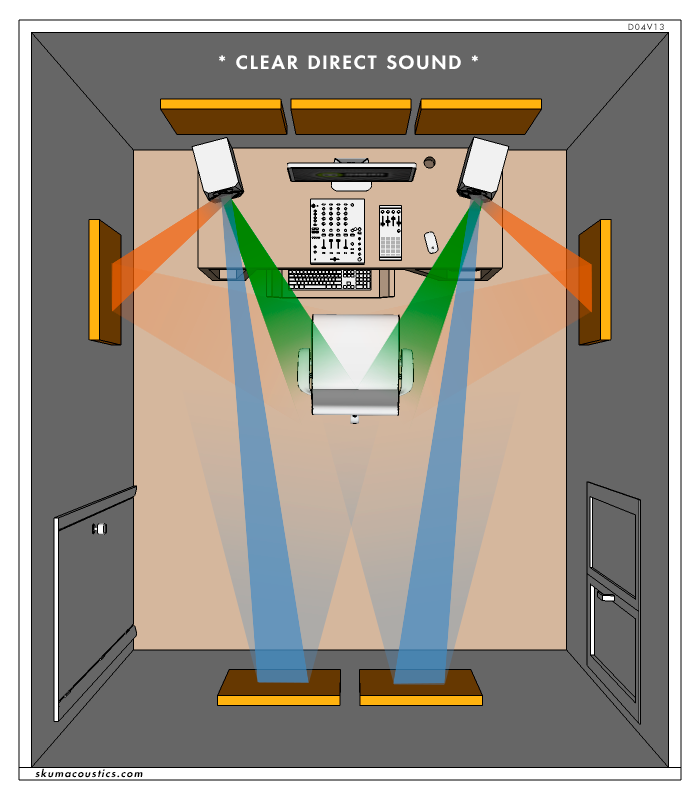
First reflection points are located using the mirror method: seated at the listening position, an assistant slides a mirror along the side wall; wherever the engineer can see a monitor reflected in the mirror is where treatment should be placed.
Flutter echo is a particular case of problematic reflection: a rapid, repeated series of reflections bouncing between two parallel, smooth, reflective surfaces. It is perceived as a characteristic "pfff" or metallic ringing when clapping in the room. It is eliminated by applying absorption or diffusion to at least one of the two facing surfaces, or by slightly angling the walls to break the parallelism.
Absorptive panels
Absorptive panels are the most common treatment element. They work using porous materials — primarily rockwool, glass wool or melamine foam — that convert sound energy into heat by causing their internal fibres or cells to vibrate. Sound penetrates the material, loses energy with each collision with the fibres and exits with far less intensity.
The factors that determine their effectiveness are:
- Thickness: The most important factor. A porous absorber begins to be effective at the frequency whose wavelength is four times the panel's thickness. A 5 cm panel starts to be effective at around 1,700 Hz; a 10 cm panel from around 850 Hz; a 20 cm panel from around 425 Hz. For lower frequencies, specific bass traps are required.
- Density: Denser materials absorb better up to a certain limit. Rockwool at 40–70 kg/m³ and glass wool at 32–48 kg/m³ are the reference materials in professional studios. Conventional polyurethane foams — those imitating egg crates or pyramids — have very low density and poor acoustic performance; they should only be considered if they are melamine foam or very high density.
- Wall separation: Installing the panel a few centimetres away from the wall improves its absorption at lower frequencies without increasing thickness, because the air gap between the panel and the wall increases its effectiveness in the lower range.
Absorptive panels are placed primarily at first reflection points (side walls and ceiling above the listening position), on the front wall between and around the monitors, and as a complement to bass traps in the corners.

A very common mistake is applying too much absorption, particularly in the high frequencies, resulting in a room that sounds "dead" and unnatural. The goal is not to eliminate all reverberation, but to control and balance it. A recording room needs a certain degree of acoustic life so that instruments and voices sound full and natural.
Bass traps
Bass traps are the most critical — and most frequently omitted — element of studio acoustic treatment. Their purpose is to absorb low-frequency energy that conventional panels cannot control.
Low-frequency energy tends to accumulate with particular intensity in the corners of the room: both vertical corners (where two walls meet) and triedral corners (where two walls meet the ceiling or the floor). In those zones, room modes concentrate their energy, producing the well-known "bass build-up" effect that causes mixes to sound bass-light when played on other systems.
Without bass traps, the RT60 in the low-frequency range will always be much longer than in the rest of the spectrum, creating an imbalance that cannot be corrected by equalisation in the signal chain.
The main types of bass trap are:
- Corner porous bass traps: Large blocks or columns of high-density rockwool or glass wool installed in vertical and triedral corners. They are broadband: they act across the entire bass and upper-bass range. The deeper and denser they are, the lower in frequency they remain effective.
- Membrane or diaphragmatic absorbers: Panels of wood or plasterboard tensioned over an air cavity that act as resonant membranes. They can be tuned to absorb selectively at a specific problematic frequency by adjusting the membrane mass and the cavity volume.
- Helmholtz resonators: Acoustic cavities that absorb at a very specific frequency determined by the cavity volume and neck diameter. Useful for modal problems that are highly localised at a specific frequency.
Acoustic diffusers
Acoustic diffusers act in a radically different way from absorbers: rather than eliminating sound energy, they scatter it in multiple directions. The result is that problematic reflections — those reaching the engineer's ear from a specific, clearly defined direction — are broken down into many lower-intensity reflections arriving from varied directions, none of which dominates over the direct sound field.
The subjective effect is significant: diffusers maintain the sense of life and space in the room without the colouration problems generated by specular reflections. They eliminate flutter echo and reduce the energy of late reflections without shortening the RT60, producing a room that sounds balanced and natural.
The most widely used diffuser in professional studios is the QRD diffuser (Quadratic Residue Diffuser), designed by physicist Manfred R. Schroeder in 1979. It consists of a series of slots or wells of different depths calculated using a mathematical sequence of quadratic residues. Each depth corresponds to a different phase delay, causing reflections to leave the diffuser in different directions with great uniformity.

Diffusers are installed primarily on the rear wall of the control room — behind the listening position — and on the rear side walls, where absorption of early reflections is no longer the priority but control of late reflections is. They are not appropriate near the front of the room or in vocal booths, where a dry environment is sought.

Priority order in acoustic treatment
One of the most common sources of confusion in home studio acoustic design is the order of intervention. Applying diffusers before resolving room modes, or placing high-frequency panels before installing bass traps, yields very poor results. The correct order is:
- 1. Bass traps in corners: The priority intervention. Without a minimum level of room mode control, no other treatment can deliver reliable results.
- 2. Early reflection control: Absorptive panels at first reflection points (side walls, ceiling above the listening position, console surface).
- 3. Front wall treatment: Absorption between and around the monitors to reduce reflections returning toward the engineer from the front wall.
- 4. Late reflection and flutter echo control: Combination of absorption and diffusion on the rear wall and late-reflection zones.
- 5. Fine-tuning: Measuring the resulting RT60 and adding or removing treatment in areas where the spectrum is not balanced.
Treatment of the recording room vs. the control room
The two main rooms of a studio have different treatment objectives:
- Control room: Maximum listening accuracy. Short, consistent RT60 (0.2–0.4 s). Intensive absorption at early reflection points. Diffusion in the rear zone. Bass traps in all corners. The goal is for the engineer to hear the monitors with the minimum possible room colouration.
- Recording room: The goal is not always the driest possible room, but the most appropriate one for the instruments to be captured. For acoustic instruments or ensembles seeking a room sound, a natural, balanced reverberation is desirable. For vocals or instruments recorded direct, a drier room is preferred. In professional studios, the recording room often features movable panels or variable acoustics that allow the RT60 to be adjusted between sessions.