A standing wave is an acoustic and physical phenomenon that occurs when two waves of equal frequency, amplitude, and direction overlap while propagating in opposite directions within the same medium.
Unlike common waves, this interference pattern generates an oscillatory disturbance that remains confined in a specific space, such as a string or a tube, giving the appearance that the wave does not travel as a whole.
To understand this phenomenon in depth, it is necessary to analyze its main elements and mechanisms:
Formation and structure
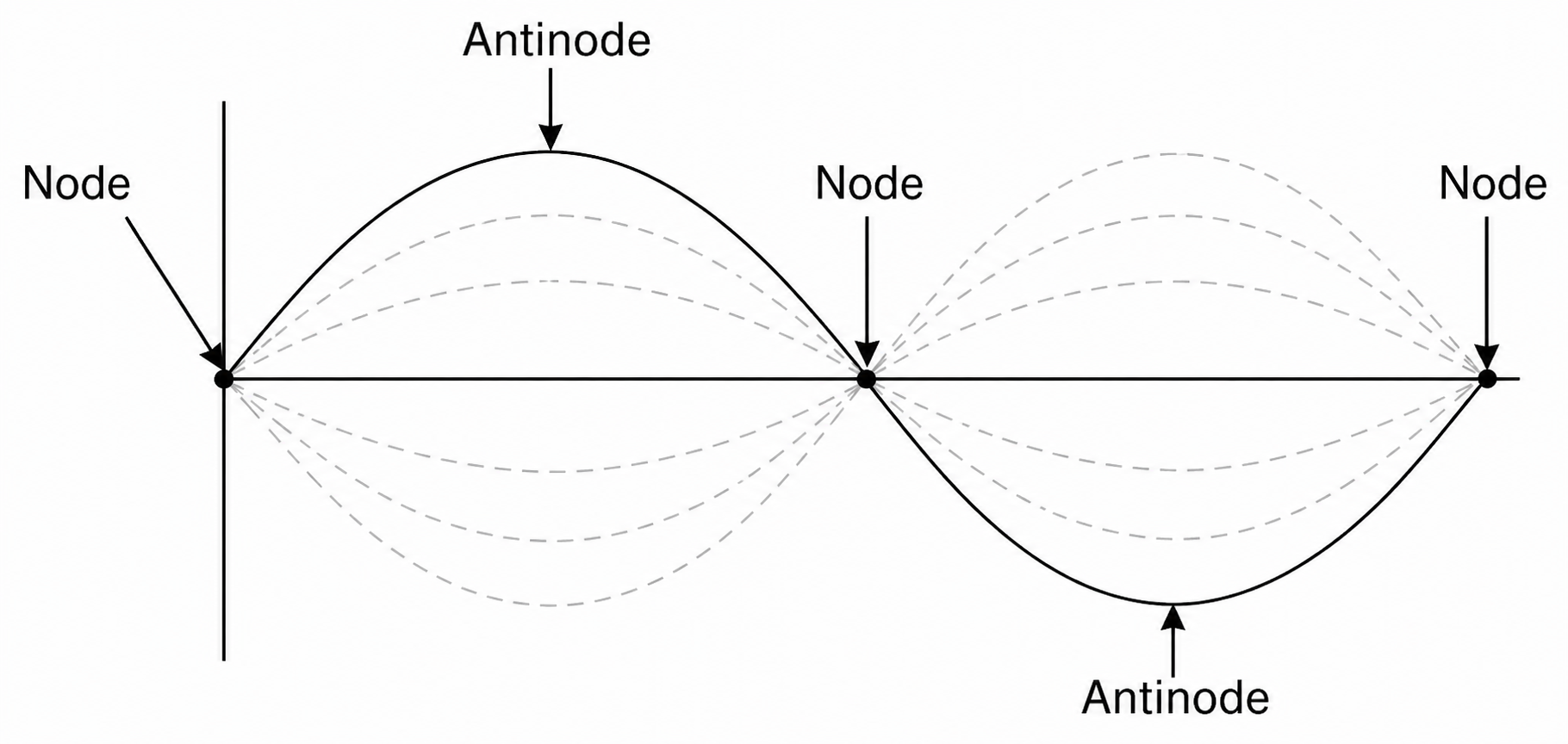
The formation of these waves typically occurs when an incident wave interacts with its own reflection. This interaction creates a specific pattern characterized by two types of critical points:
- Nodes: These are points where the oscillation amplitude is zero and remain stationary due to the constant destructive interference between the waves. The distance between two consecutive nodes is always equal to half a wavelength (\( \frac{\lambda}{2} \)).
- Antinodes: These are the positions where the particles of the medium experience maximum movement. At these points, the interference is constructive, and the vibration amplitude is equal to the sum of the amplitudes of the interfering waves.
Resonance frequencies and modes
Standing waves are not produced at just any frequency, but at specific values called resonance frequencies. These depend on the properties of the medium and its physical geometry.
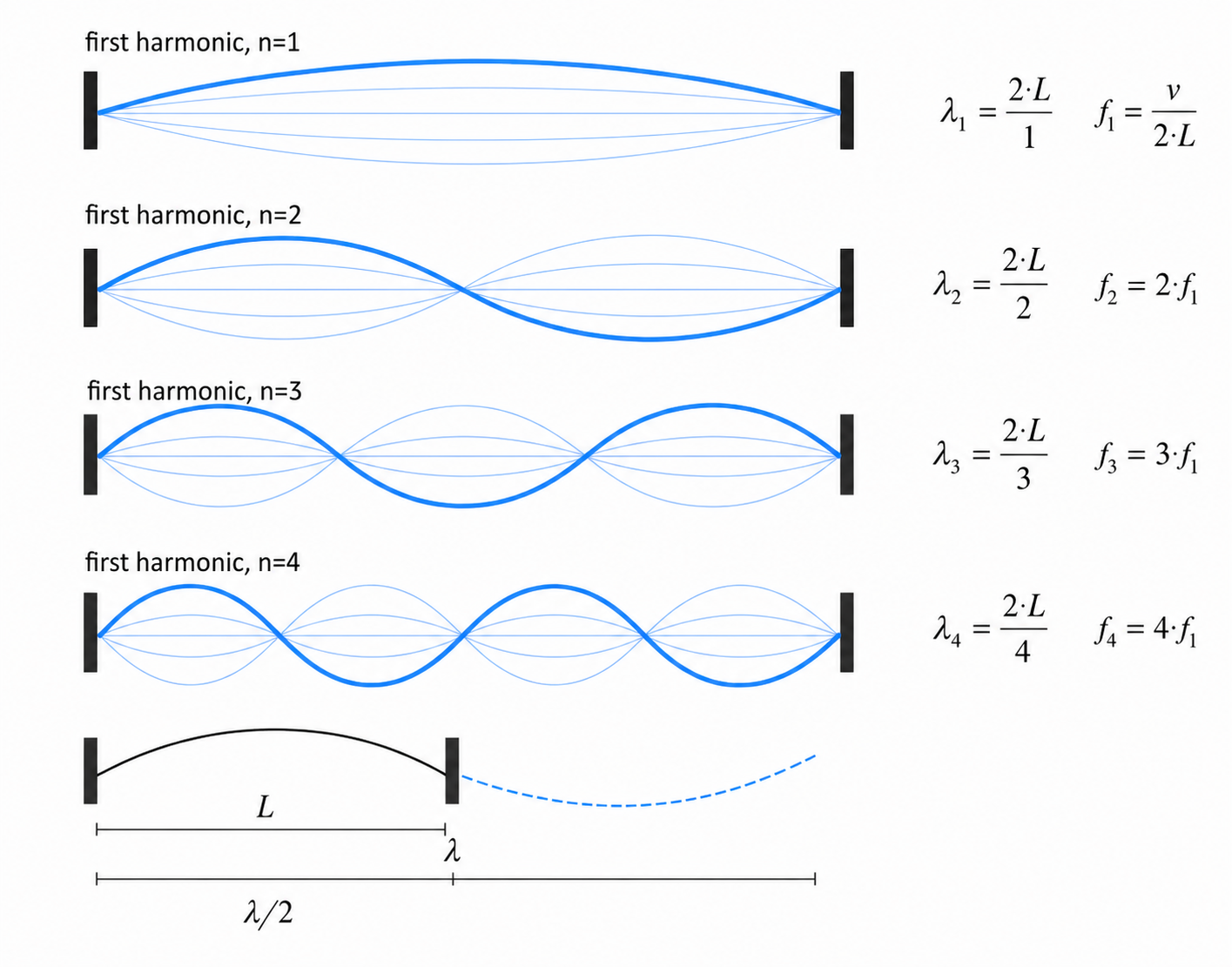
First, we have the fundamental frequency, which is the lowest frequency at which a standing wave can form in an object (such as a string of length L) and is characterized by having no intermediate nodes between its ends.
Then we have the harmonics and vibration modes, which are integer multiples of the fundamental frequency. Each vibration mode (\( n \)) corresponds to a different shape the wave adopts, where the wavelength is calculated using the formula \( \lambda = \frac{2L}{n} \).
Standing Wave Calculations
To mathematically calculate the position of the nodes and the antinodes (or bellies), we start from the equation of a standing wave, which is generated by the interference of two waves of equal amplitude and frequency moving in opposite directions.
The resulting equation describing the displacement of any point \( x \) at time \( t \) is:
Where \( k \) is the wave number (\( k = \frac{2\pi}{\lambda} \)) and \( \omega \) is the angular frequency.
Calculation of nodes
Nodes are points where the amplitude is always zero due to destructive interference. Mathematically, this occurs when the spatial term of the equation is zero: \( \sin(kx) = 0 \).
- Angular condition: This is met when \( kx = 0, \pi, 2\pi, \dots, n\pi \) for any integer \( n \).
- Position calculation (\( x \)): By substituting \( k = \frac{2\pi}{\lambda} \), the formula to find the location of the nodes is:
\[ x = n \cdot \frac{\lambda}{2} \]
This confirms that the distance between two consecutive nodes is always half a wavelength (\( \frac{\lambda}{2} \)).
Calculation of antinodes
Antinodes are the points of maximum vibration amplitude, resulting from constructive interference. This happens when the spatial term reaches its maximum values: \( \sin(kx) = \pm 1 \).
- Angular condition: This is met when \( kx = (n + \frac{1}{2})\pi \) for any integer \( n \).
- Position calculation (\( x \)): Solving for \( x \), the location of the antinodes is calculated as:
\[ x = \left( n + \frac{1}{2} \right) \cdot \frac{\lambda}{2} \]
Just as with the nodes, the distance between two consecutive antinodes is \( \frac{\lambda}{2} \).
The calculation of nodes and antinodes in acoustic design is fundamental to identify where nodes and antinodes will form, thus avoiding dead spots and achieving acoustic uniformity in the room.