Acoustic diffraction is the phenomenon that allows a sound wave to bend and propagate around obstacles or through openings without changing medium.
Thanks to this effect, sound can reach areas that would normally be in "acoustic shadow", allowing us to hear someone even if they are behind a wall or around a corner.
Huygens' Principle
Huygens' Principle is the theoretical foundation that explains why sound can travel around objects and continue on its path. According to this principle, every point on a wavefront acts as a new source of secondary waves that spread out in all directions.
When sound encounters a slit or the edge of an obstacle, the points on the wavefront that manage to pass through — or that sit right at the edge — behave as independent emitters. This means sound does not stop abruptly; instead, the new secondary waves propagate even into the space behind the object.
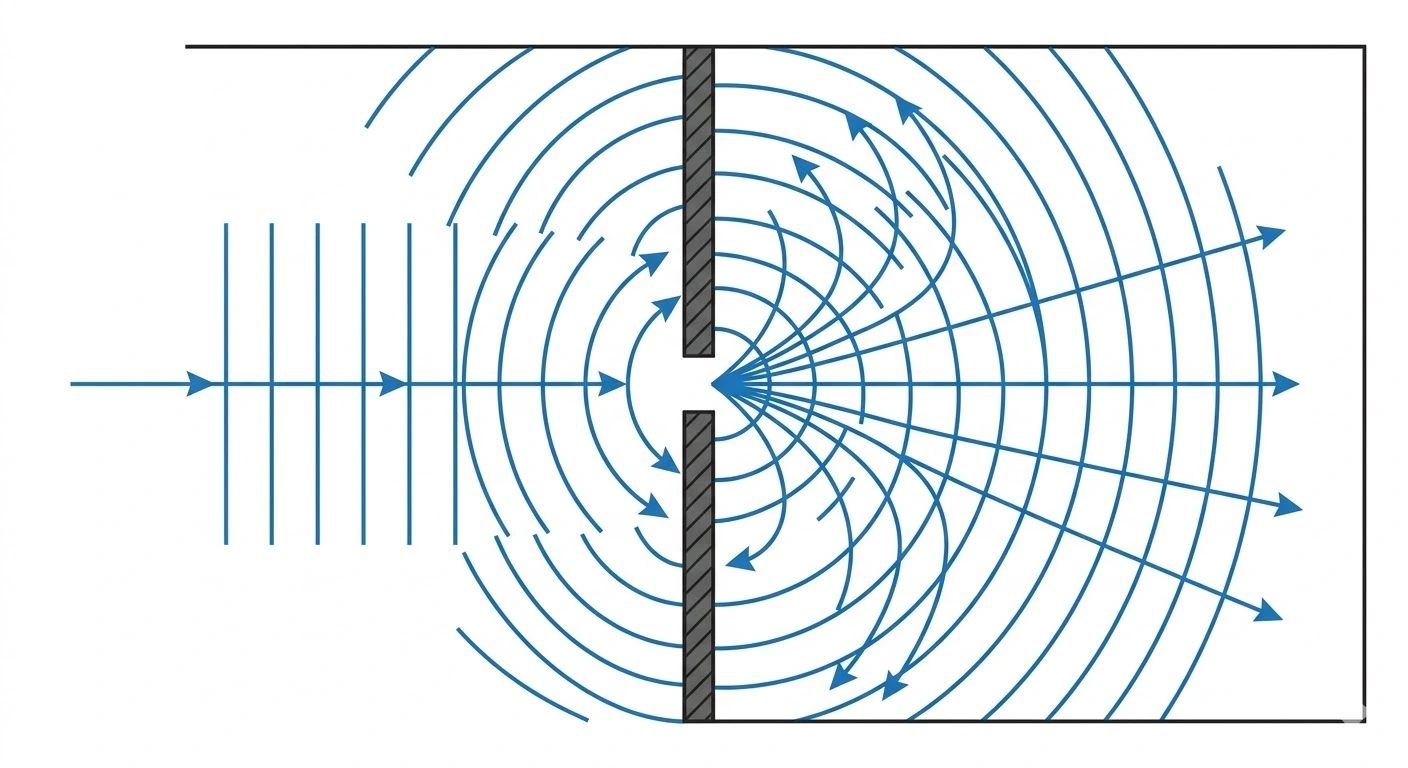
This principle is what makes acoustic diffraction possible, allowing waves to bend and reach acoustic shadow zones where, in theory, sound should not arrive in a straight line.
How effectively these secondary waves travel around an object depends on the relationship between the size of the obstacle and the wavelength. If the obstacle is small or similar in size to the wavelength, Huygens' Principle explains how sound manages to "wrap around" and surround the object with ease.
Relationship with frequency
The relationship between frequency and acoustic diffraction is fundamental to understanding how sound behaves in space, and is based primarily on the wavelength of each sound.
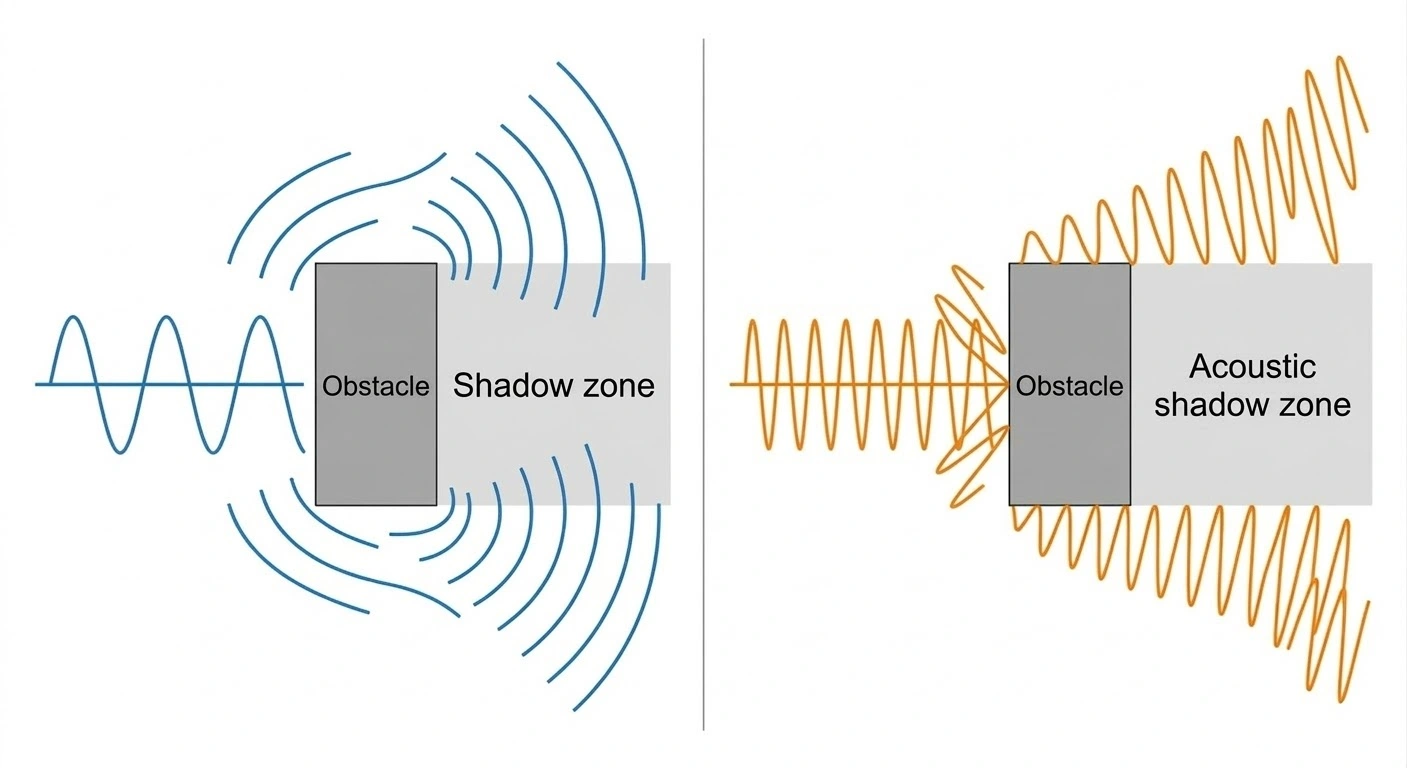
Low frequencies (bass sounds) have a long wavelength. As a result, they diffract easily around objects. For example, if a sound wave is larger than the obstacle it encounters, it simply "wraps around" it and continues on its way without being blocked.
High frequencies (treble sounds) have a short wavelength. Being so small, they tend to travel in a straight line, which drastically reduces their ability to diffract. If they encounter a large obstacle in their path, they cannot bend around it and an acoustic shadow is created where sound does not reach.
The size rule
Diffraction is most effective when the size of the obstacle or opening is comparable to or smaller than the wavelength of the sound.
If the object is small compared to the wavelength (low frequencies), sound bends around it easily. However, if it is large compared to the wavelength (high frequencies), sound is blocked.
A common example is outdoor concerts, where bass sounds (such as bass guitar or kick drum) can be heard clearly even from behind a structure or wall. High-frequency sounds (such as cymbals or higher-pitched vocals), however, are lost or heavily attenuated in those same areas because they cannot bend around the obstacle.