The sound field can be defined as the spatial distribution of sound waves as they propagate through a medium; that is, the sound pressure at every point in space.
Components of the sound field
Depending on whether the sound has interacted with surfaces or not, the field is divided into:
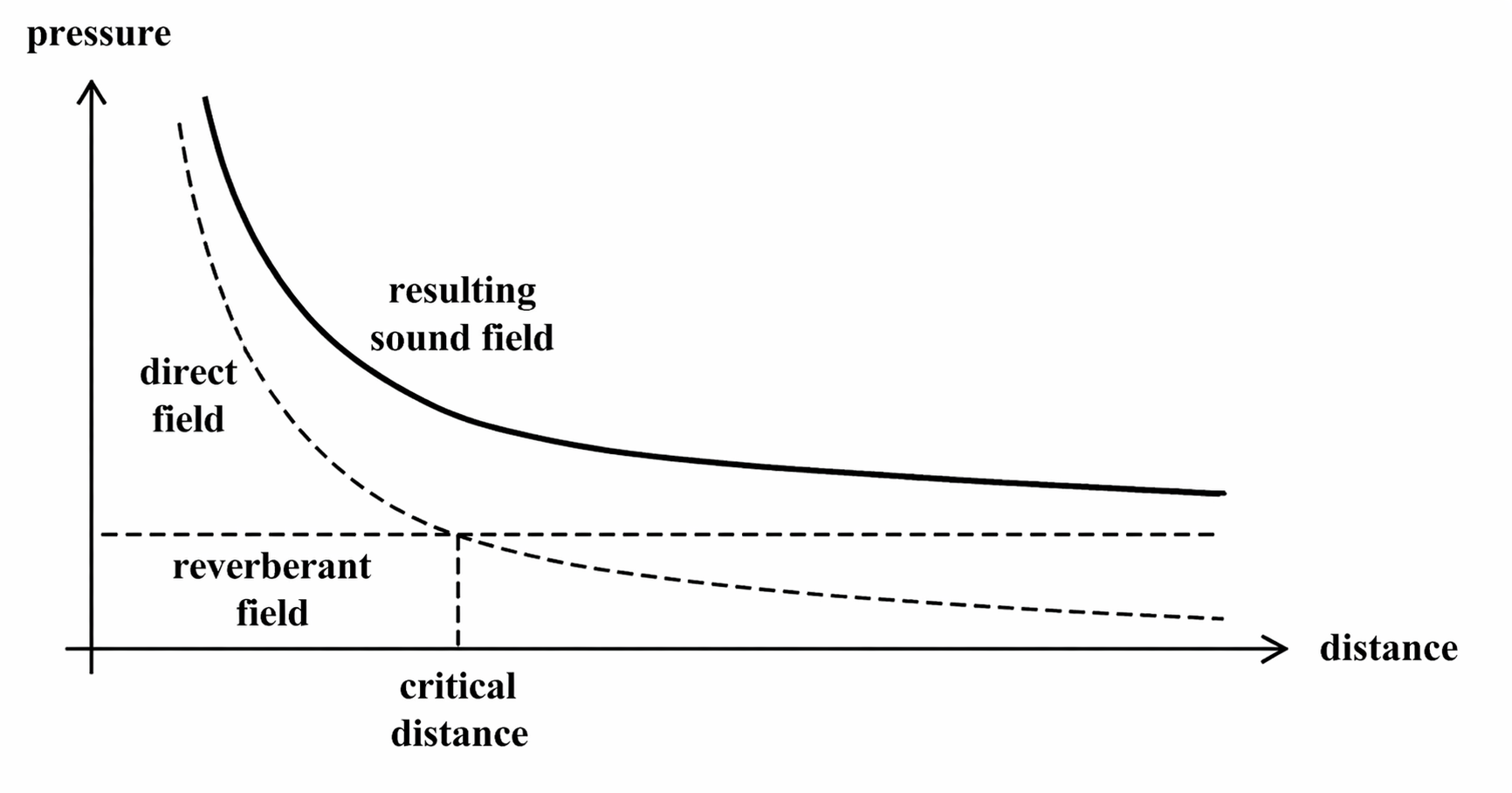
- Direct field: This is the area closest to the sound source where the sound arrives without having experienced any reflections. In this field, the sound pressure level decreases exclusively due to the inverse square law, which results in a loss of 6 dB every time the distance from the source is doubled.
- Reverberant field: It prevails at points far from the source and is composed of sound that has bounced off at least one surface. In enclosed spaces, multiple reflections overlap, creating an almost uniform sound distribution.
- Diffuse field: This is a special case of the reverberant field where the energy density is uniform at any point. This state is what is sought to be emulated in reverberation chambers for acoustic testing.
Critical distance
A fundamental concept for defining the sound field is the critical distance. This is the exact point in space where the levels of the direct field and the reverberant field are equal.
- At distances shorter than the critical distance, direct sound predominates (more clarity and directionality).
- At greater distances, the reverberant field takes over (more diffuse sound).
How is the critical distance calculated in a room?
The critical distance (\( D_c \)) in a room is calculated using a mathematical expression that relates the directivity of the source to the absorbent properties of the enclosure.
The fundamental formula to obtain this value is as follows:
To perform this calculation, it is necessary to know the following parameters:
- \( Q \) (Directivity factor): This is the directivity factor of the sound source in the direction being considered.
- \( R \) (Room constant): It represents the absorption capacity of the enclosure and is measured in \( m^2 \). This value is crucial because it determines how "live" or "dead" the acoustic environment is.
Typical values of \( Q \)
The value of \( Q \) mainly depends on the physical location of the sound source and how much its radiation is restricted:
- \( Q \)=1 (Omnidirectional source): Used for sources that radiate sound equally in all directions (full sphere). This ideally occurs when the source is suspended in the air, far from any surface.
- \( Q \)=2 (Hemispherical radiation): Assigned when the source is located on an infinite flat surface (for example, in the center of a room's floor). The sound can only propagate into one hemisphere, concentrating twice the energy in that area.
- \( Q \)=4 (Dihedral): Applied when the source is placed at the intersection of two surfaces (for example, where a wall meets the floor). The energy is concentrated in a quarter sphere.
- \( Q \)=8 (Trihedral or corner): Used when the source is in a corner (the junction of two walls and the floor). The energy is concentrated in an eighth of a sphere, maximizing directivity.
The higher the value of \( Q \), the greater the critical distance, meaning the direct field of the source reaches further before being matched by the reverberant field.
Calculating the Room Constant (\( R \))
Since \( R \) is not always a direct piece of data, it must be calculated beforehand using the following formula:
This equation involves:
- \( S_t \): The total surface area of the room (walls, ceiling, and floor) expressed in \( m^2 \).
- \( \bar{\alpha} \): The average absorption coefficient of the room, which depends on the materials covering the surfaces.
We will see more about the absorption coefficient in the next section, reverberation.
Zoning by distance (Near Field and Far Field)
The field can also be classified according to how the source's directivity varies.
On one hand, we have the near field, which is the zone where sound pressure varies significantly with small changes in position. In this area, directivity still depends on distance, so it is not recommended to perform acoustic measurements here.
On the other hand, we have the far field, which is the zone from which the directivity of the sound source becomes independent of distance.
Influence of the environment
The nature of the sound field changes drastically depending on the medium:
- Open spaces or free fields: Where there are no obstacles (or the surfaces are totally absorbent, such as in an anechoic chamber), only the direct field exists, causing sound intensity to decrease rapidly with distance.
- Enclosed spaces: The presence of surfaces generates reflection and diffraction, giving rise to the coexistence of direct and reflected sound (early reflections and late reflections).