Reverberation is an acoustic phenomenon consisting of the persistence of sound in a space after the original source has stopped emitting. It occurs due to the continuous reflection of sound waves off the surfaces of an enclosure (walls, ceilings, and floors), which return to the listener from multiple directions.
Difference between reverberation and echo
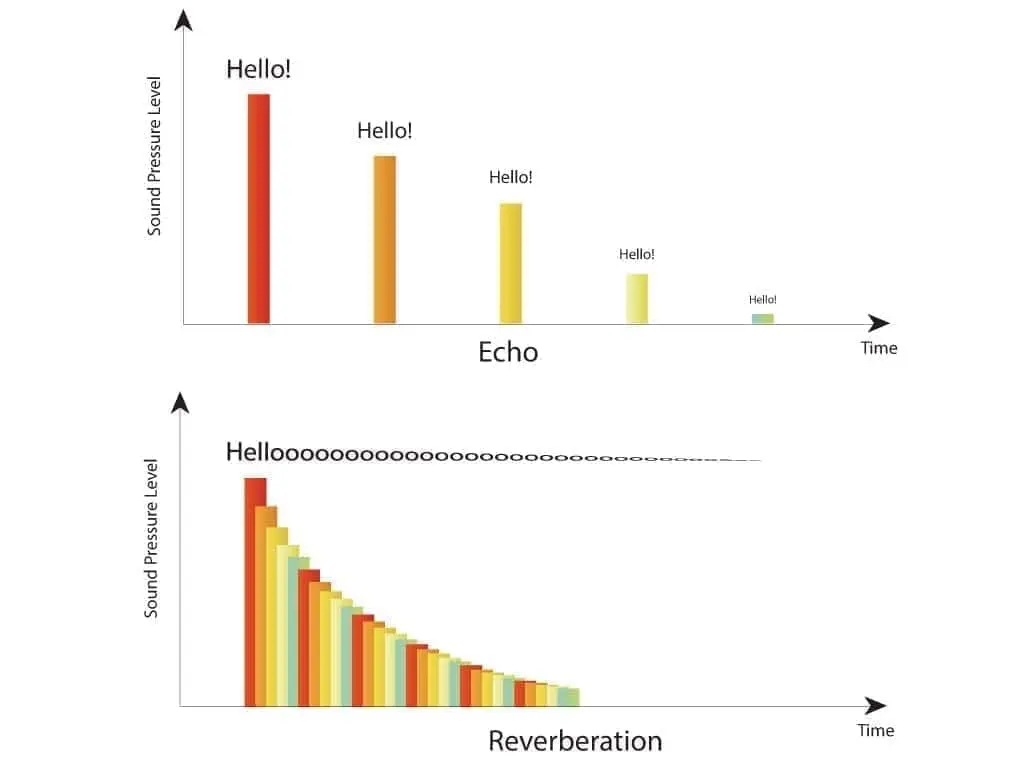
Although both are reflection phenomena, they are distinguished by human perception:
- Echo: Occurs when the reflected sound is perceived by the ear as a separate and intelligible second sound.
- Reverberation: Is a slight lingering perceived as an addition that modifies the original sound, due to acoustic persistence.
How is reverberation time measured?
The main parameter for quantifying this phenomenon is the RT60. This value indicates the time (in seconds) it takes for the sound to decrease by 60 decibels (one millionth of its original intensity) after the source ceases.
To calculate it, the Sabine Formula is commonly used, which relates the dimensions of the space to its sound absorption capacity:
Formula components:
- \( RT_{60} \): Represents the reverberation time measured in seconds. It is the period that elapses from when the sound source stops until the sound pressure level drops 60 decibels (dB) relative to its initial value.
- \( V \): Is the total volume of the room, measured in cubic meters (\( m^3 \)).
- \( \alpha \): Is the absorption coefficient. This value varies between 0 (total reflection) and 1 (total absorption) and depends on the materials present in the room.
- \( S \): Is the total interior surface area of the enclosure, measured in square meters (\( m^2 \)).
Absorption coefficient
The absorption coefficient (\( \alpha \)) is a measure that describes the amount of sound energy a material can absorb compared to what it reflects. Its calculation and application are based on the following points:
- Range of values: The value of this coefficient is always between 0 and 1. A value of 1 indicates that the material absorbs all the sound energy incident upon it, while a value of 0 means that all energy is reflected.
- Variation by frequency: Absorption capacity is not constant; the coefficient varies according to the sound frequency. Because of this, manufacturers of acoustic materials usually provide coefficient values with a resolution of at least one octave.
To determine how a room behaves acoustically, the coefficient of each material present in it must be known. The total absorption of an enclosure is calculated by relating this coefficient (\( \alpha \)) to the total interior surface area (\( S \)).
Optimal times according to use
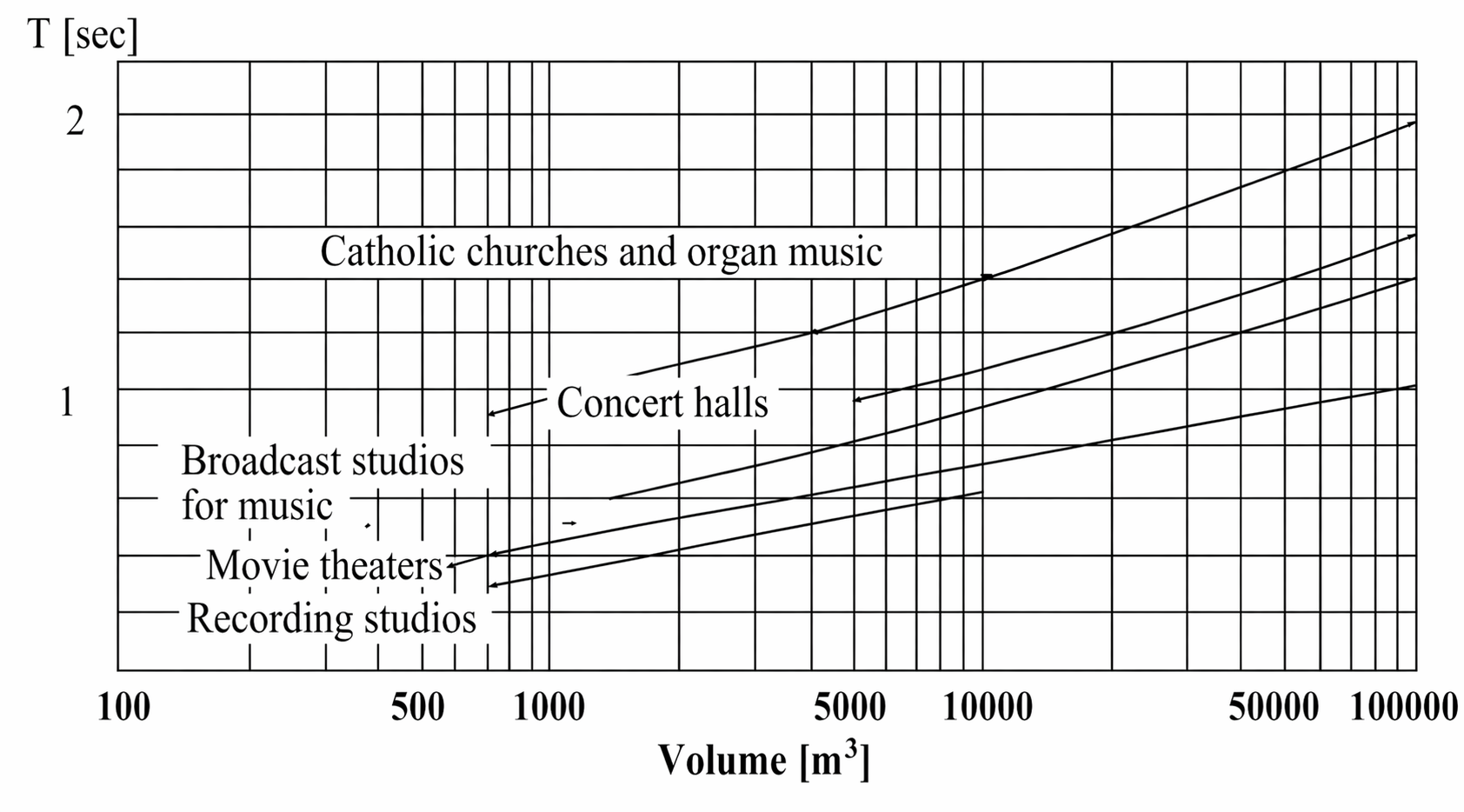
There is no single "perfect" reverberation time; it must be adjusted to the function of the place:
- Conference rooms: Require a short RT (0.5 to 1.0 s) for speech to be clear.
- Opera houses: Need a balance (1.3 to 1.8 s) to give clarity to voices and instruments.
- Symphonic music: Require longer times (1.8 to 2.3 s) to enrich and give body to the sound of the orchestra or choirs.
Sound “color” and quality
Reverberation affects not only duration but also the timbre or "color" of the sound in a room.
In rooms with materials that reflect high frequencies well, there will be a “brighter” reverberation, but when surfaces reflect more of the low frequencies of the spectrum, the reverberation will become duller.
Additionally, reverberation will also affect intelligibility, as if it is very pronounced in the mid-frequencies, speech comprehension becomes difficult.