Sound waves are mechanical disturbances produced when a sound source vibrates. They require an elastic medium, such as air, water, or solids, in order to travel.
When the sound source vibrates, it creates a chain reaction in the particles of the medium, which begin to compress and expand, generating local fluctuations in pressure and density.
The human ear perceives these movements as sounds, provided they fall within a specific frequency range of approximately 20 to 20,000 Hz.

Classification of waves
Sound waves can be classified according to several criteria, including their physical nature, their frequency, and the way they propagate through different media.
Classification by physical nature and vibration
Sound waves are classified as mechanical waves because they require a material medium (solid, liquid, or gas) to propagate; they cannot travel through a vacuum. They are also elastic waves because they depend on the ability of the medium to compress and expand in order to transmit vibrations.
Within this general classification, we can find a more specific one based on the nature of their propagation and the medium through which they travel:
- Longitudinal waves: in most contexts, sound waves are longitudinal waves (also called compression waves), meaning that the vibration of the particles occurs in a direction parallel to the direction of wave propagation.
- Transverse waves: while sound is longitudinal in fluids, in solids sound can also propagate as transverse elastic waves.
Classification by human perception (frequency)
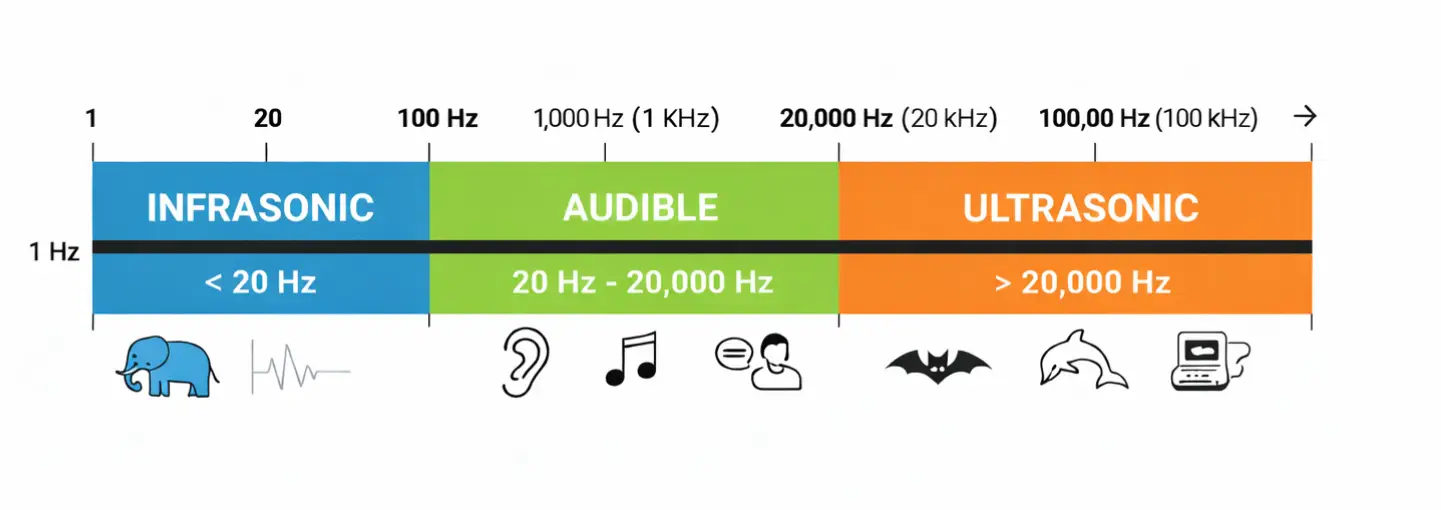
Sound waves are classified according to whether the human ear can perceive them:
- Audible waves: these are frequencies that the human ear can normally detect, generally between 20 Hz and 20,000 Hz, although some experts refine this range to between 16 Hz and 16,000 Hz.
- Infrasonic waves: these waves have a frequency below the audible range (below 20 Hz).
- Ultrasonic waves: these waves have a frequency above the audible range (above 20,000 Hz).
Sound waves can also be classified by their intensity (decibels) or by the type of source (point source versus line source), but we will cover those concepts later.
Principles involved in sound waves
In addition to wave classification, there are several fundamental aspects of the physical nature and perception of sound waves that explain how they interact with the world around us.
First, the speed at which sound travels is not constant and depends entirely on the material through which it moves. The same sound will travel faster in solids, then in liquids, and will be slowest in air.
Furthermore, for sound to propagate, the medium must be elastic. A completely rigid body will not allow the transmission of vibrations, and in a vacuum sound simply cannot exist.