The speed of sound is a fundamental property of sound waves that defines how quickly an acoustic vibration is transmitted through a specific medium.
This motion is not constant, as it fluctuates depending on the physical characteristics of the environment, such as its density and elasticity.
Factors affecting the speed of sound
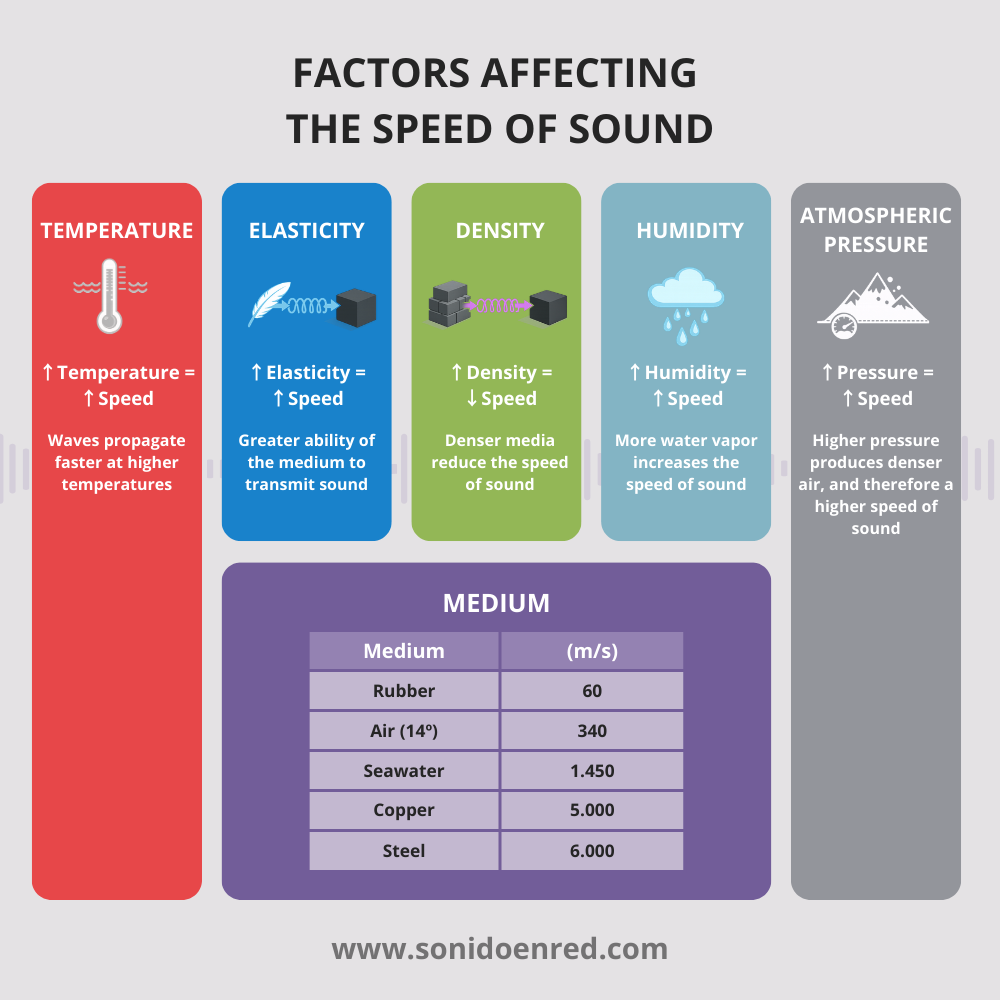
The speed of sound varies according to the physical properties of the medium through which it propagates. The main factors influencing this phenomenon are:
Temperature
This is one of the most significant factors. As temperature increases, the molecules of the medium move more rapidly, allowing vibrations to be transmitted more quickly. In air, the speed increases by approximately 0.6 m/s for each degree Celsius of temperature rise.
Elasticity
Elasticity refers to the medium’s ability to return to its original shape after a disturbance. In the general formula, this is represented by the bulk modulus (\( B \)). The greater the elasticity or resistance to compression, the higher the speed of sound.
Density
The speed is inversely proportional to the square root of the medium’s density. However, in solids and liquids, although they are denser than air, their high elasticity compensates for this factor, allowing sound to travel much faster.
| Medium | Speed (m/s) |
|---|---|
| Rubber | 60 |
| Air (14º) | 340 |
| Seawater | 1.450 |
| Copper | 5.000 |
| Glass | 5.700 |
| Steel | 6.000 |
Humidity
In air, higher humidity means more water vapor is present, which reduces air density. With lower density, sound can propagate more easily and quickly.
Atmospheric pressure
Since atmospheric pressure affects how compressed air particles are, there is an indirect relationship: changes in pressure alter density, which influences how rapidly particles transmit vibrations.
The standard speed of 343 m/s is calculated under “normal conditions,” specifically at sea level. Significant pressure variations, such as those at high altitudes, can therefore affect sound propagation conditions.
Formula for calculating the speed of sound
There are two main ways to calculate the speed of sound:
General formula
For a gas such as air, a formula is used that relates compressibility to the mass of the medium:
- \( v \): Speed of sound \( \mathrm{m/s} \)
- \( B \): Bulk modulus of the medium \( \mathrm{N/m^2} \)
- \( \rho \): Density of the medium \( \mathrm{kg/m^3} \)
In general, sound travels faster in dense and elastic media such as steel (6,000 \( \mathrm{m/s} \)) than in air (approximately 343 \( \mathrm{m/s} \) at \( \mathrm{^\circ C} \)).
Simplified formula for air
Since temperature is the dominant factor in air, the following practical formula is commonly used:
- \( v \): Speed of sound \( \mathrm{m/s} \)
- \( T \): Temperature \( \mathrm{^\circ C} \)
As temperature increases, molecules move faster, facilitating the transmission of sound waves. Other factors, such as humidity, can also slightly increase this speed by reducing air density.