Every microphone shares the same mission: converting a sound wave into an electrical signal that can be amplified, processed or recorded. But the path that energy travels inside the microphone — from air vibration to electrical current — varies radically depending on the type of transducer it uses.
Understanding that internal process is the foundation for understanding why a dynamic microphone sounds and behaves so differently from a condenser microphone, or why some need external power and others do not.
Two stages of transduction
A microphone is an electroacoustic transducer: a device that converts acoustic energy into electrical energy. That process does not happen in a single step, but in two successive and clearly distinct stages:
- Acoustic-to-mechanical transduction: The variations in air pressure that make up the sound wave cause a very thin membrane called the diaphragm to vibrate. In this first stage, acoustic energy is converted into mechanical energy: the physical movement of an object.
- Mechanical-to-electrical transduction: That mechanical movement of the diaphragm is, in turn, converted into a varying electrical signal. It is in this second stage that the different types of microphone diverge from one another, because each employs a different physical mechanism to achieve that conversion.
The diaphragm is therefore the element common to virtually every type of microphone. What changes from one type to another is what lies behind it and how it harnesses its movement to generate electricity.
The dynamic microphone: electromagnetic induction
The dynamic moving-coil microphone is, alongside the condenser, the most widespread design in the professional audio world. Its operating principle is electromagnetic induction, the same physical phenomenon described by Faraday's law: when a conductor moves within a magnetic field, an electrical current is induced in it.
Its internal construction consists of three fundamental elements:
- The diaphragm: A lightweight, rigid membrane, typically made of metallised polyester, that vibrates when it receives sound waves.
- The moving coil: A small cylinder of conductive wire (typically copper or aluminium) attached directly to the back of the diaphragm.
- The permanent magnet: A magnetic structure — with pole pieces that concentrate and direct the field — within which the coil is suspended, without ever touching it.
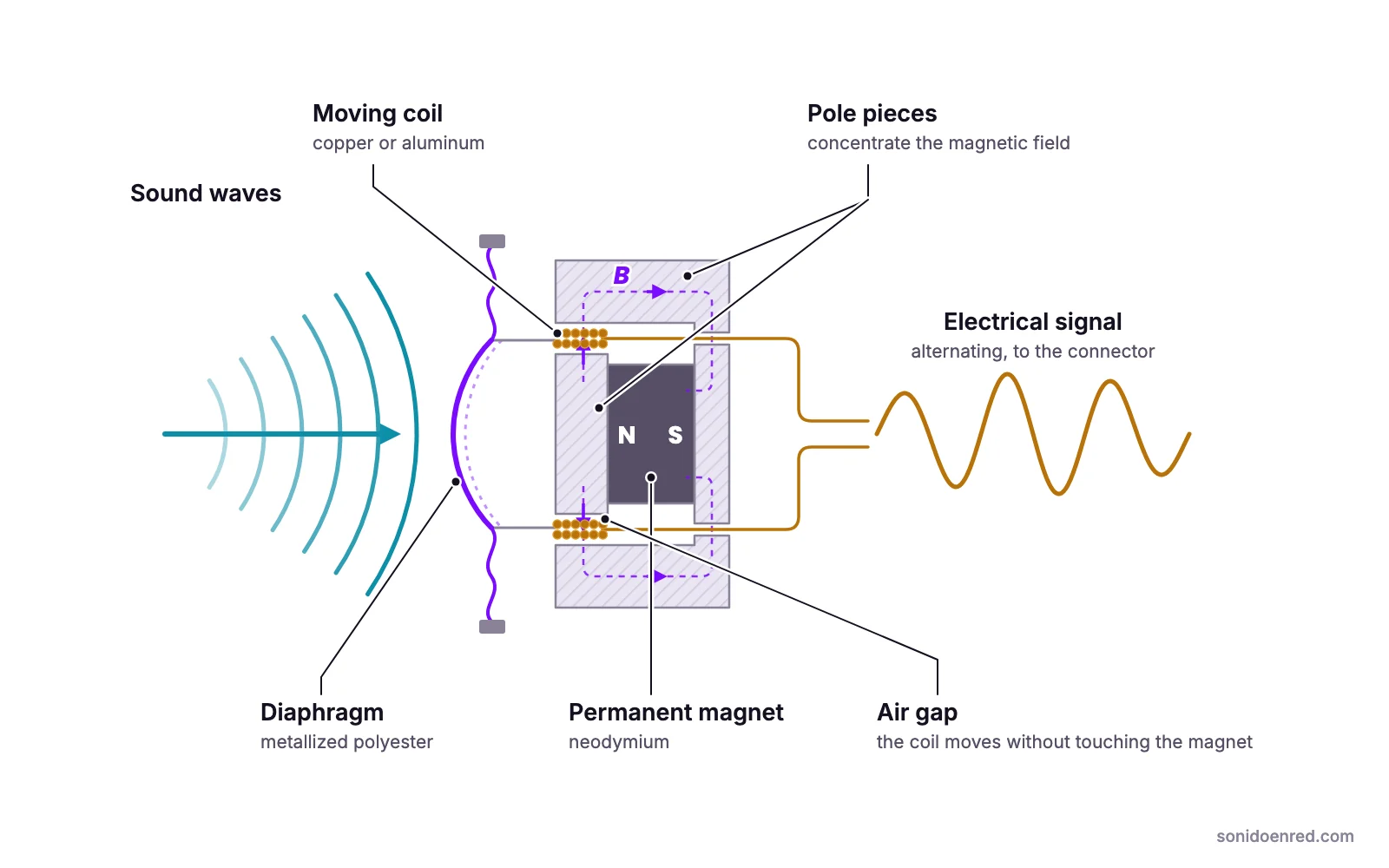
When sound moves the diaphragm, the coil shifts back and forth within the gap in the magnet. That movement within a magnetic field induces an alternating electrical current in the coil, whose shape faithfully reproduces the original vibration of the diaphragm. The ends of the coil connect to a small internal transformer, which adapts the signal — very low impedance — to the balanced output of the XLR connector.
Since it relies on no active electronic components, the dynamic microphone is entirely passive: it needs no external power supply to operate. That mechanical simplicity also explains its robustness: it withstands knocks, humidity and temperature variations well, and tolerates very high sound pressure levels without distorting.
The ribbon microphone: the same principle, a different design
The ribbon microphone is based on exactly the same physical principle as the moving-coil dynamic — electromagnetic induction — but with a different construction that fuses diaphragm and conductor into a single element.
Instead of a diaphragm attached to a coil, the ribbon microphone uses an extremely thin corrugated aluminium strip (just a few microns thick), suspended between the two poles of a powerful magnet. That ribbon acts simultaneously as the diaphragm — vibrating directly in response to air pressure — and as the conductor: as it moves within the magnetic field, it generates the induced electrical current by itself.
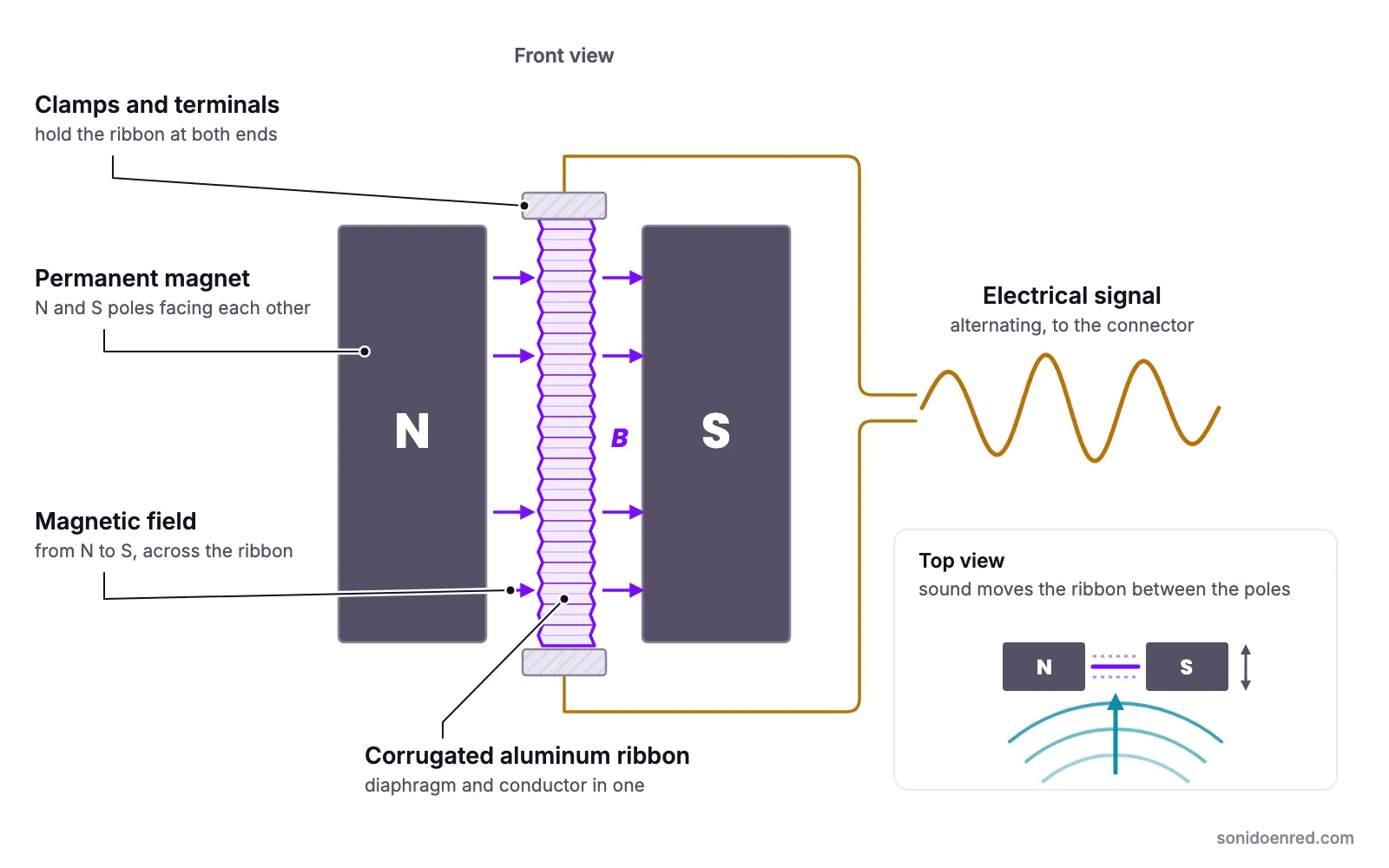
Being far lighter than the diaphragm-and-coil assembly of a conventional dynamic microphone, the ribbon responds with greater fidelity to fast sonic transients. In exchange, that same lightness and its very low electrical resistance mean it produces a much weaker output signal, requiring preamplifiers with a lot of clean gain to work properly. Like the moving-coil dynamic, the passive ribbon microphone requires no external power, and phantom power can in fact destroy the ribbon if mistakenly applied to a model not designed to receive it.
The condenser microphone: the electrostatic principle
The condenser microphone (or capacitor microphone) works on a completely different physical principle: the electrostatic principle. Rather than generating the signal through movement within a magnetic field, it generates it from variations in the capacitance of an electrical capacitor.
A capacitor is, in its simplest form, two parallel conductive plates separated by an air gap, electrically charged. Its ability to store charge — its capacitance — depends directly on the distance between those two plates: the closer they are, the higher the capacitance.
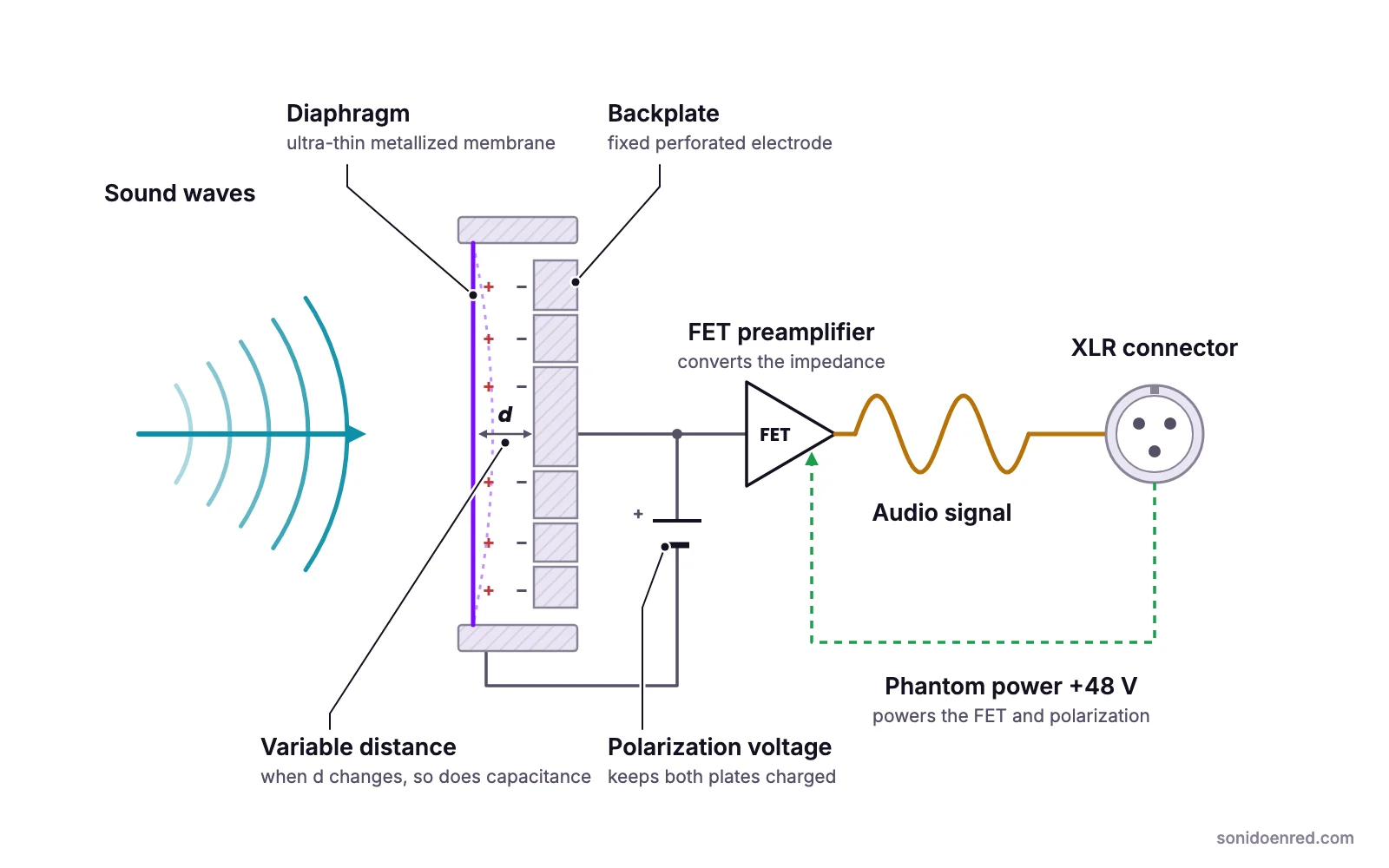
In the condenser microphone, one of those two plates is the diaphragm: an extraordinarily thin and lightweight metallised membrane, far more so than that of a dynamic microphone. The other is a fixed plate called the backplate, positioned very close behind the diaphragm. Both plates are kept electrically charged by a constant polarisation voltage. When sound moves the diaphragm, the distance between the two plates varies, and with it the capacitance of the assembly, producing a voltage variation proportional to the diaphragm's vibration.
That voltage variation is extremely weak and at very high impedance, so the condenser microphone always incorporates a small internal preamplifier — typically a field-effect transistor (FET) — that adapts the signal to a manageable impedance before sending it down the cable. This internal circuit, together with the plates' polarisation voltage, is why the condenser microphone always needs an external power source: +48V phantom power is the standard way of supplying it through the XLR cable itself.
Because it relies on an extremely lightweight diaphragm and an internal electronic circuit, the condenser microphone is more sensitive and detailed than a dynamic one, but also more delicate around moisture, dust and physical impact.
The electret microphone: a variant with no external polarisation
The electret microphone is a variant of the condenser microphone that solves the plate polarisation problem in a different way. Instead of applying a constant electrical voltage from outside, one of the plates — or a layer of dielectric material placed next to it — is made from an electret material: a special polymer capable of permanently retaining an electrical charge from manufacture, in a way similar to how a permanent magnet retains its magnetic field.
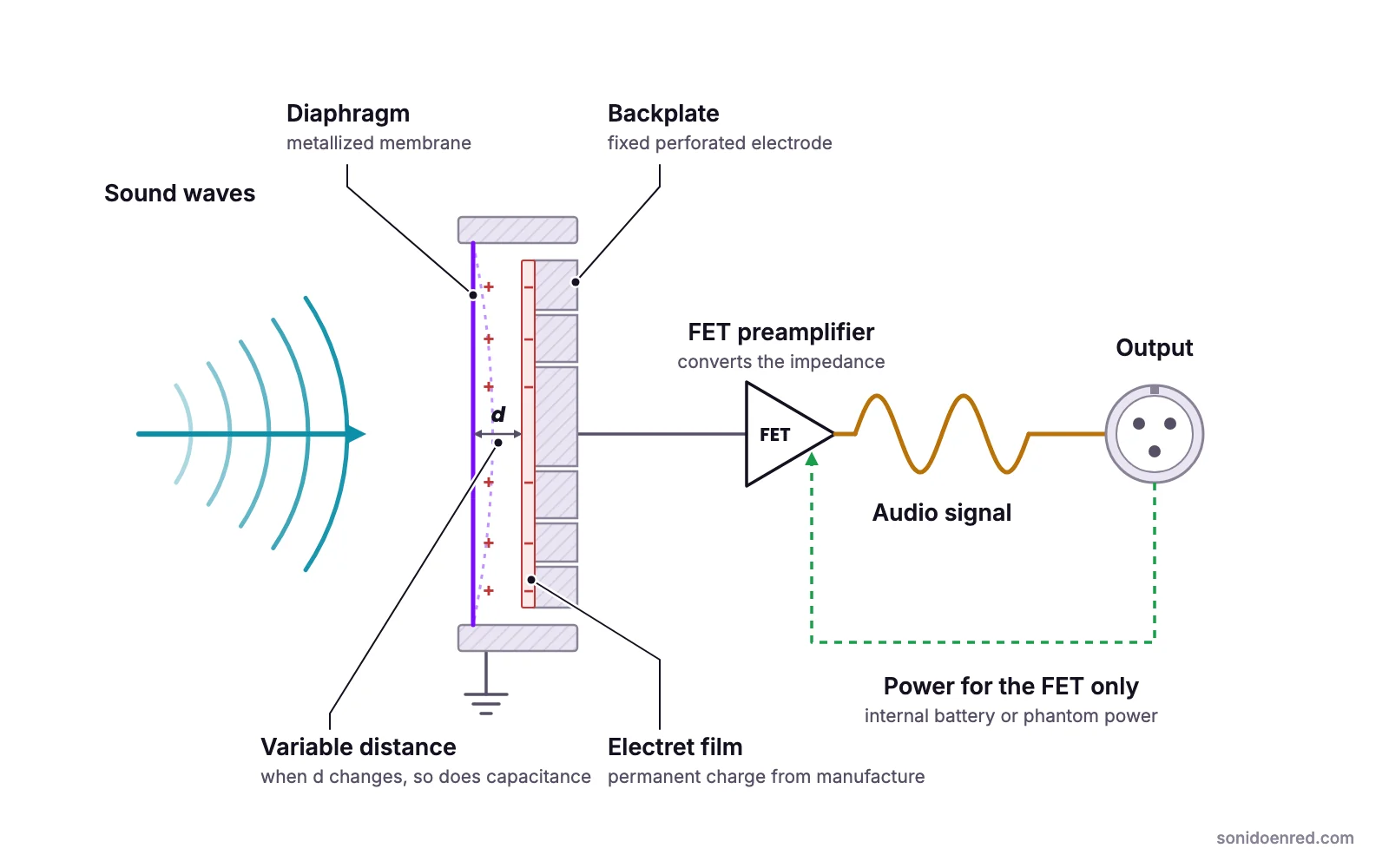
Thanks to that factory-built-in charge, the electret microphone needs no external polarisation source for its plates to function as a capacitor. However, it still needs electrical power for another purpose: running the internal FET preamplifier that adapts the capsule's extremely high-impedance signal before sending it down the rest of the chain. That power can come from a small internal battery or from phantom power, depending on the design.
The electret design is cheaper to manufacture than the externally polarised condenser, which makes it the dominant technology in low-cost microphones, lavalier microphones, headset microphones and the capsules built into mobile phones and computers.
Other transduction principles
Beyond the three mechanisms dominant in professional audio today — electromagnetic induction and the electrostatic principle — other transduction principles exist with more specific or historical applications:
- Piezoelectric microphone: Exploits the property of certain crystals and ceramics to generate an electrical voltage when physically deformed. It is the principle behind contact pickups for acoustic instruments, which capture the vibration of the instrument's body directly rather than the sound transmitted through the air.
- Carbon microphone: The oldest design, now obsolete except in very specific applications. It works by variation in electrical resistance: a capsule filled with carbon granules changes its resistance as it is compressed by sound vibrations. It was the telephony standard for decades due to its low cost and high electrical output, though with very limited fidelity.
Summary: transduction mechanism by microphone type
- Dynamic (moving-coil): Electromagnetic induction. Coil attached to the diaphragm within a magnetic field. Passive, no power needed.
- Ribbon: Electromagnetic induction. The ribbon acts as both diaphragm and conductor. Passive (except active models).
- Condenser: Electrostatic principle. Capacitance variation between two charged plates. Requires phantom power.
- Electret: Electrostatic principle with a permanent factory charge. Requires power only for the internal preamplifier.
- Piezoelectric: Deformation of a crystal or ceramic. Common in contact pickups.