Two microphones with the same capsule, the same diaphragm size and the same transducer type can behave in completely different ways depending on which direction they are "listening" in. That difference is determined by the polar pattern: the property that defines from which directions a microphone picks up sound and with what relative intensity. Understanding how a polar pattern is physically generated — rather than simply memorising its names — is what allows the real-world behaviour of any microphone to be anticipated before using it.
What a polar pattern is
The polar pattern (or polar diagram, or directivity) is the graphical representation of a microphone's sensitivity as a function of the angle from which sound arrives, typically measured across a 360° circle around the capsule. The microphone's front axis (0°) represents the direction of maximum sensitivity in most designs, and the chart shows how that sensitivity falls off — or does not — as the angle of incidence moves away from that axis.
A polar pattern is not a secondary property of a microphone: it is the direct result of the physical principle with which its capsule is built. All polar patterns, however complex they may appear, derive from the combination of just two fundamental transduction principles.
The two fundamental principles: pressure and pressure gradient
Pressure microphone (omnidirectional pattern)
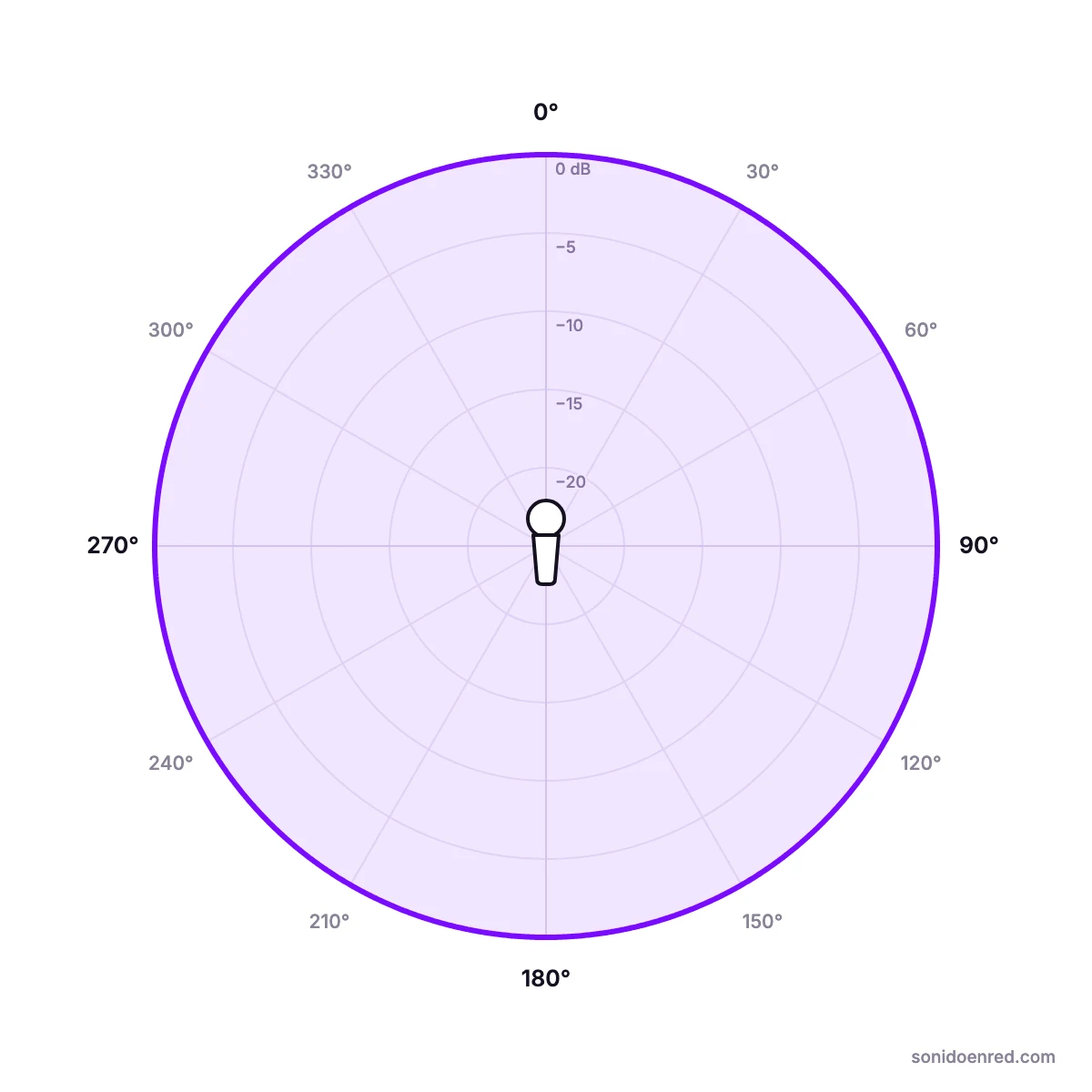
In a pressure microphone, the diaphragm is exposed to the outside air only on its front side. Its rear side is completely sealed inside a closed chamber. The diaphragm responds to absolute variations in air pressure at the point where it is located, regardless of the direction from which that pressure variation arrives.
The result is that a pressure microphone picks up sound with equal sensitivity wherever it comes from: front, back, above or the sides. This produces the omnidirectional pattern, represented on a polar diagram as a perfect circle.
Pressure-gradient microphone (bidirectional pattern)
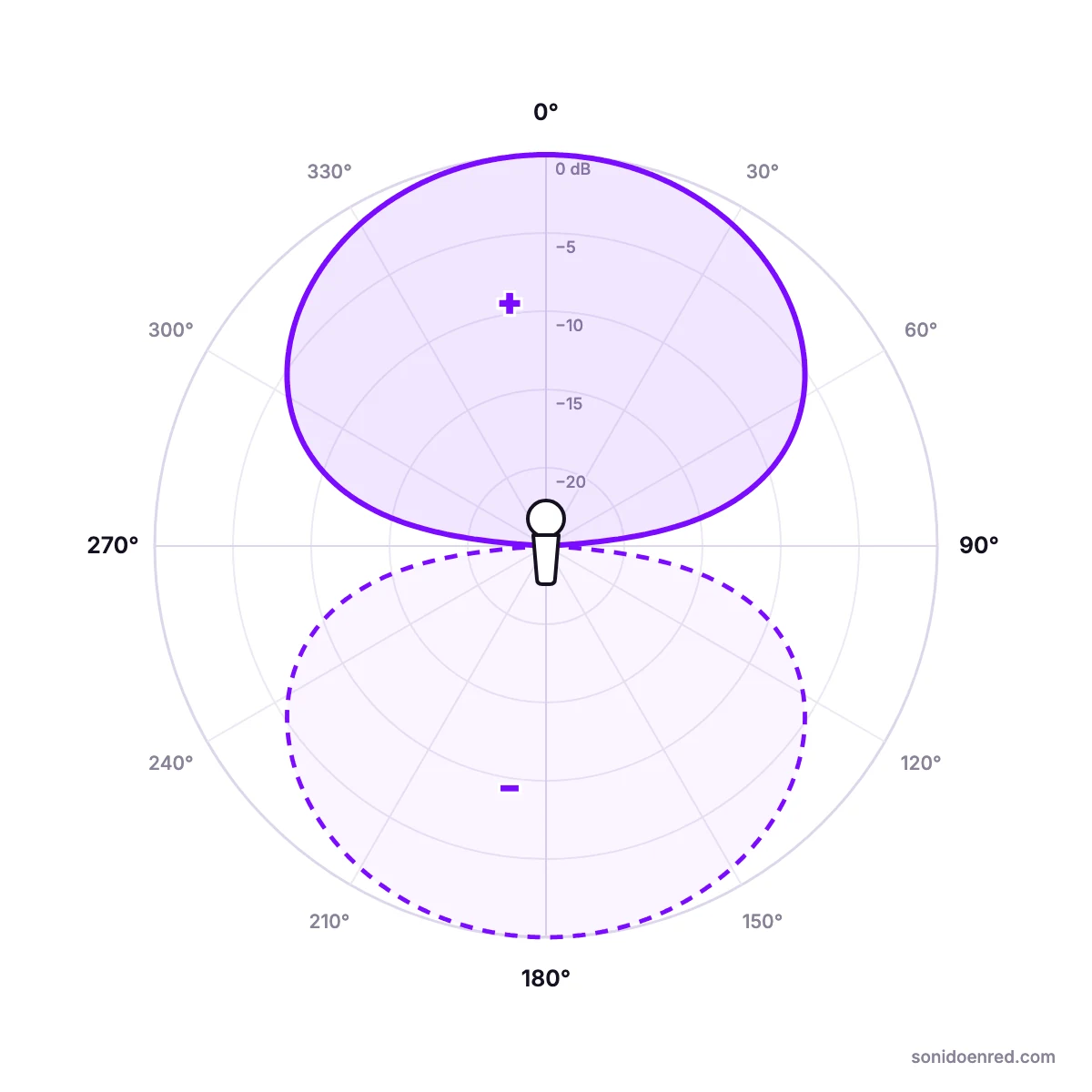
In a pressure-gradient microphone, by contrast, both sides of the diaphragm are exposed to external sound. The diaphragm does not respond to absolute pressure at one point, but to the pressure difference between its front and rear sides.
A sound arriving exactly from the side (90°) reaches both sides of the diaphragm with the same intensity and at practically the same time, so the pressure difference between the two sides is almost nil: the microphone barely picks it up. A sound arriving from the front or rear axis, by contrast, generates a significant pressure difference between the two sides, and the microphone captures it strongly — though with inverted electrical polarity between front and rear. The result is the bidirectional or figure-of-8 pattern: maximum sensitivity at the front and rear, almost total silence at the sides. The ribbon microphone is the classic example of a pure pressure-gradient transducer.
How the cardioid pattern is built
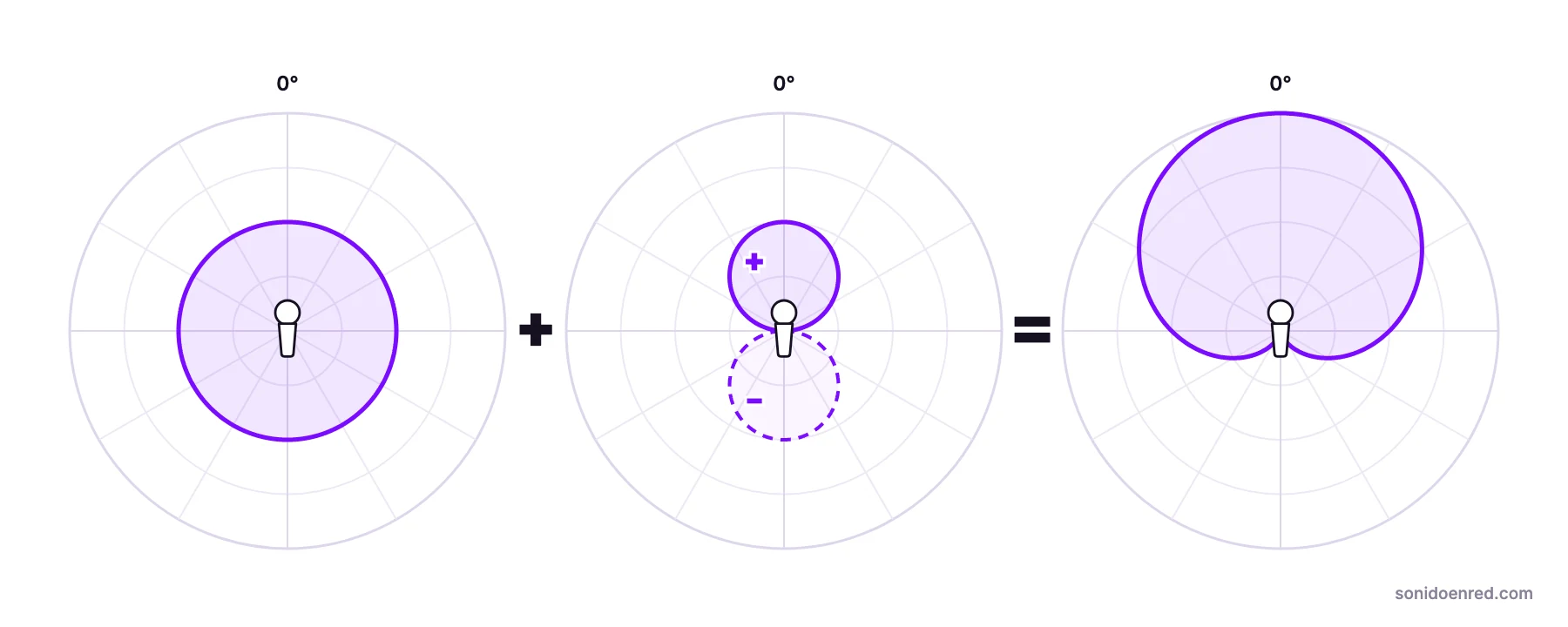
The cardioid pattern — the most widely used in both live sound and studio work — does not follow either of the two pure principles described above, but rather a combination of both in roughly equal proportions.
It can be understood as the mathematical superposition of the omnidirectional pattern (pressure) and the bidirectional pattern (pressure gradient): at the front of the microphone, both signals arrive in the same phase and add together, reinforcing each other. At the rear, the negative signal of the pressure-gradient component cancels out the positive signal of the pressure component, producing a null point of almost total insensitivity at 180°.
There are two ways of physically achieving this combination:
- Acoustic labyrinth: A series of internal ports and channels in the capsule housing that controllably delay the sound reaching the back of the diaphragm, so that it interferes destructively with the front sound in the rear direction. This is the standard method in single-capsule microphones, both dynamic and condenser.
- Electronic combination of two capsules: A design with an omnidirectional capsule and a bidirectional capsule mounted together, whose signals are electrically summed in different proportions to produce the desired pattern. This is the basis of how multi-pattern microphones work.
By varying the proportion between the omnidirectional and bidirectional components, the entire cardioid family of patterns is obtained:
- Subcardioid (wide cardioid): Predominance of the omnidirectional component (approximately 70% omni / 30% bidirectional). Gentle rear rejection, a wider pickup area than the standard cardioid.
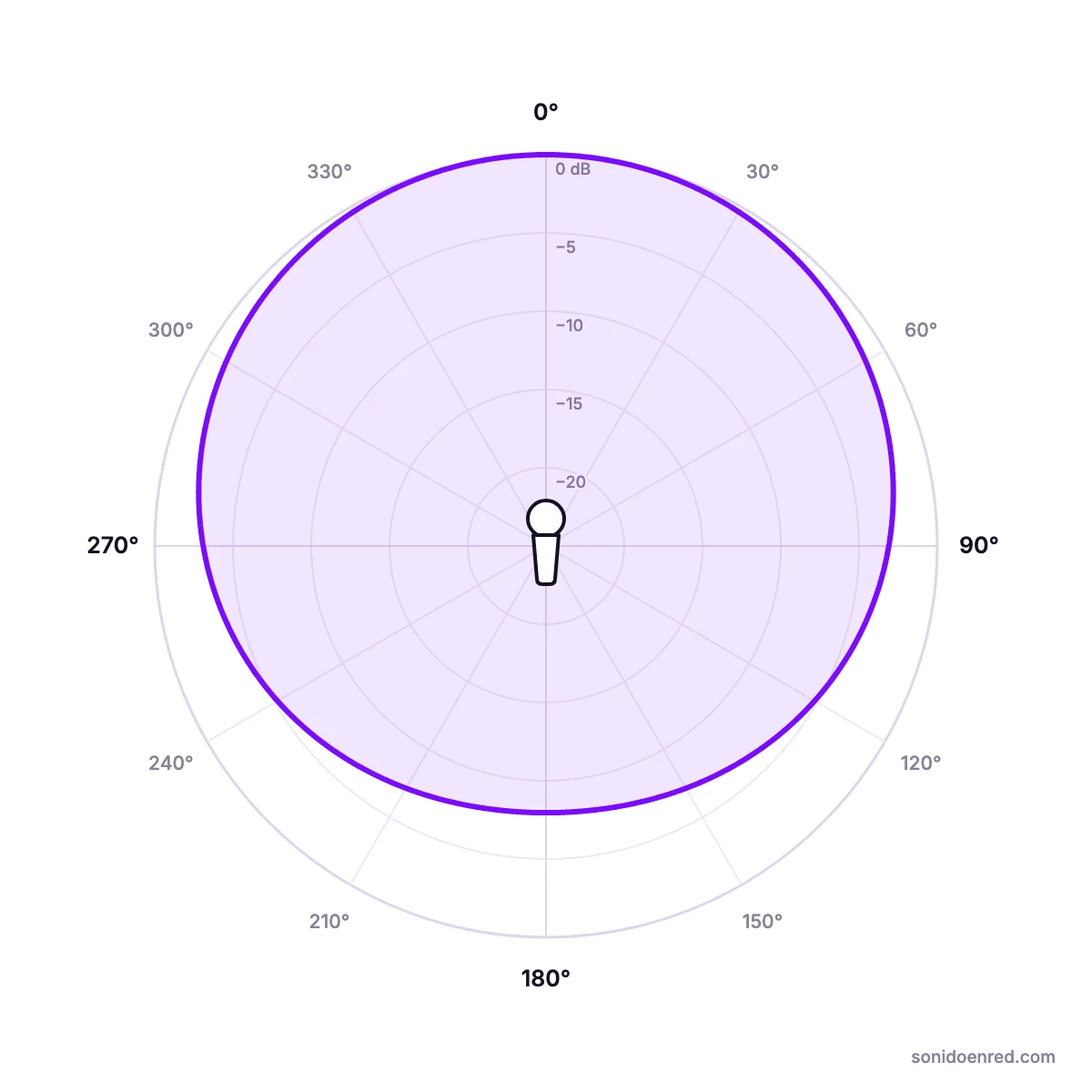
Subcardioid: an omni with some directionality. - Cardioid: Balanced proportion (50% / 50%). Maximum rejection exactly at 180°.
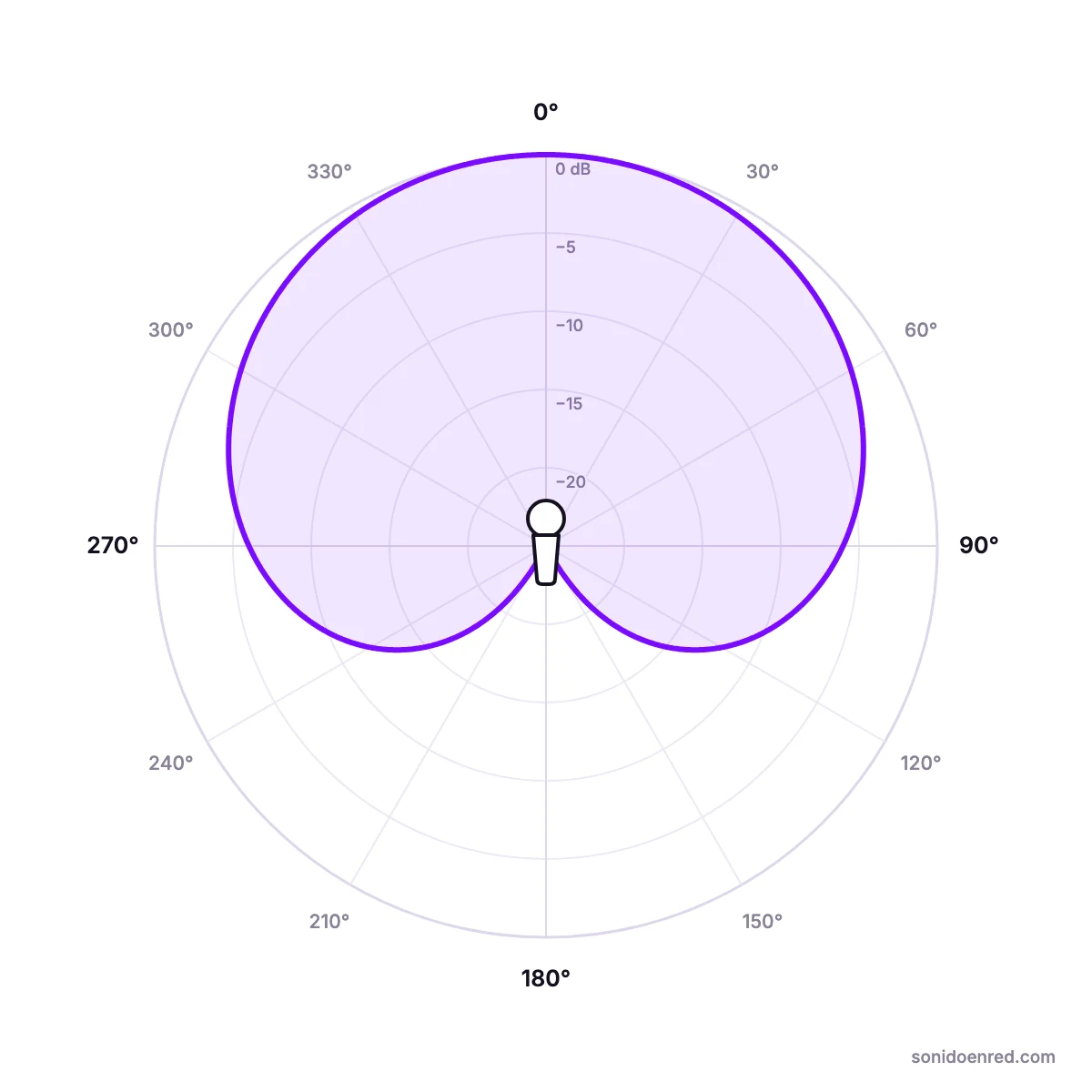
Cardioid: the most widely used pattern, with maximum rejection directly behind. - Supercardioid: Predominance of the bidirectional component (approximately 37% omni / 63% bidirectional). Narrower, deeper side rejection, with nulls at around 126° and a small rear lobe (around −12 dB at 180°).
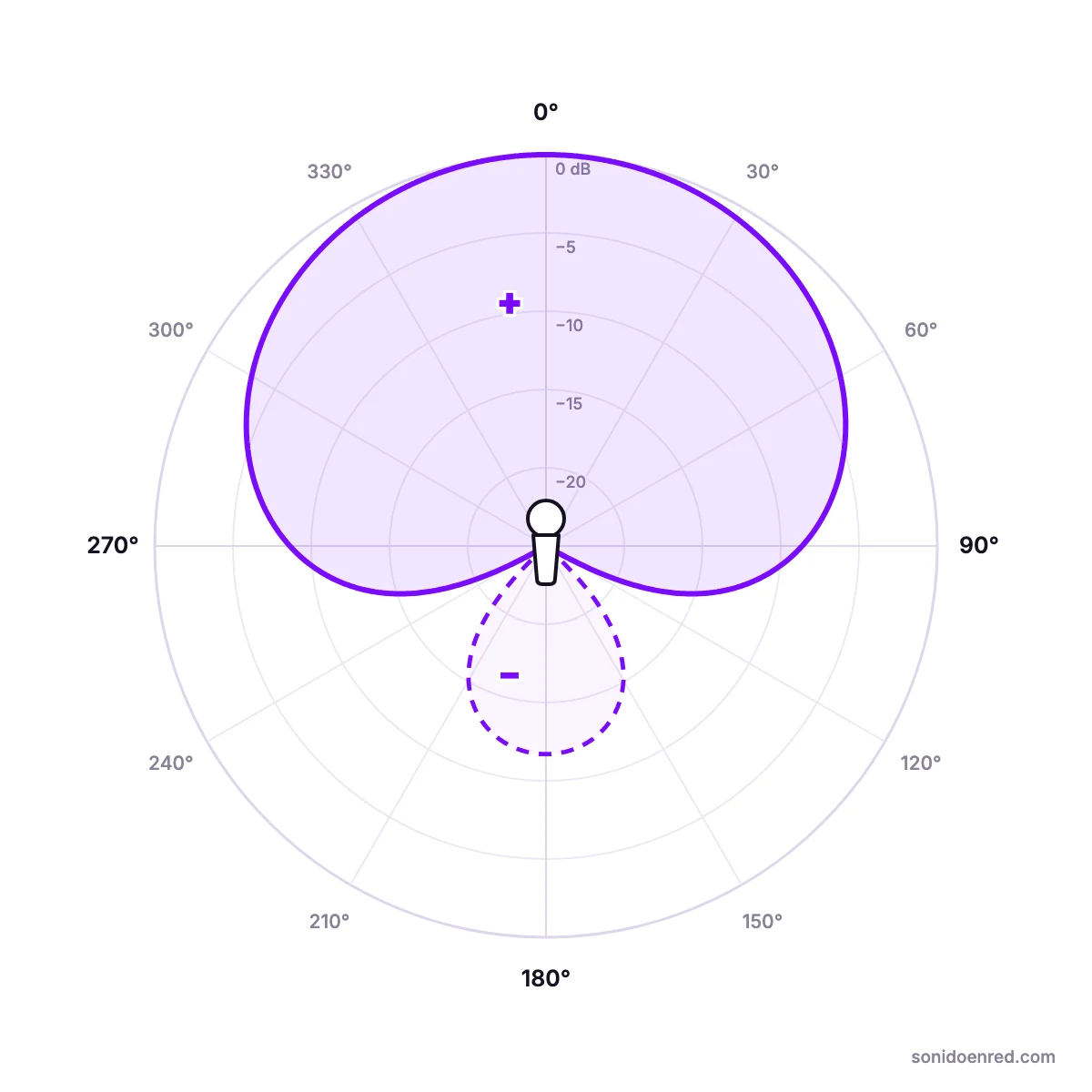
Supercardioid: more side rejection in exchange for a small rear lobe. - Hypercardioid: Even greater predominance of the bidirectional component (25% omni / 75% bidirectional). The greatest side rejection of the whole family, with nulls at around 110° and a more pronounced rear lobe (around −6 dB at 180°).
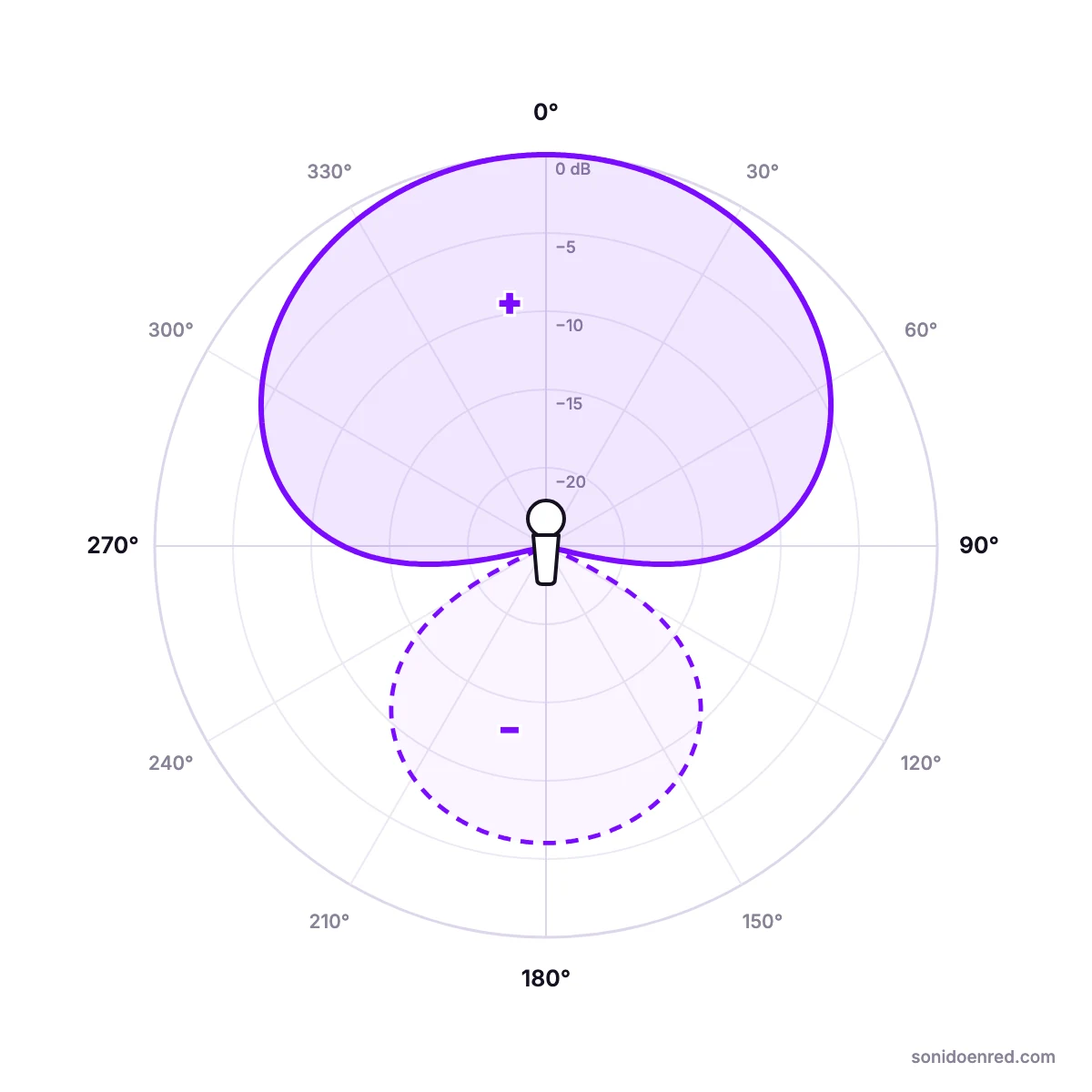
Hypercardioid: maximum side rejection, but it picks up more from behind than the supercardioid.
How to read a polar diagram
A professional polar diagram is represented as a circular chart divided into degrees (from 0° to 360°), with the microphone's front axis typically placed at the top (0°). The concentric circles represent sensitivity levels in decibels: the outer ring corresponds to 0 dB (maximum sensitivity) and each ring towards the centre indicates lower sensitivity.
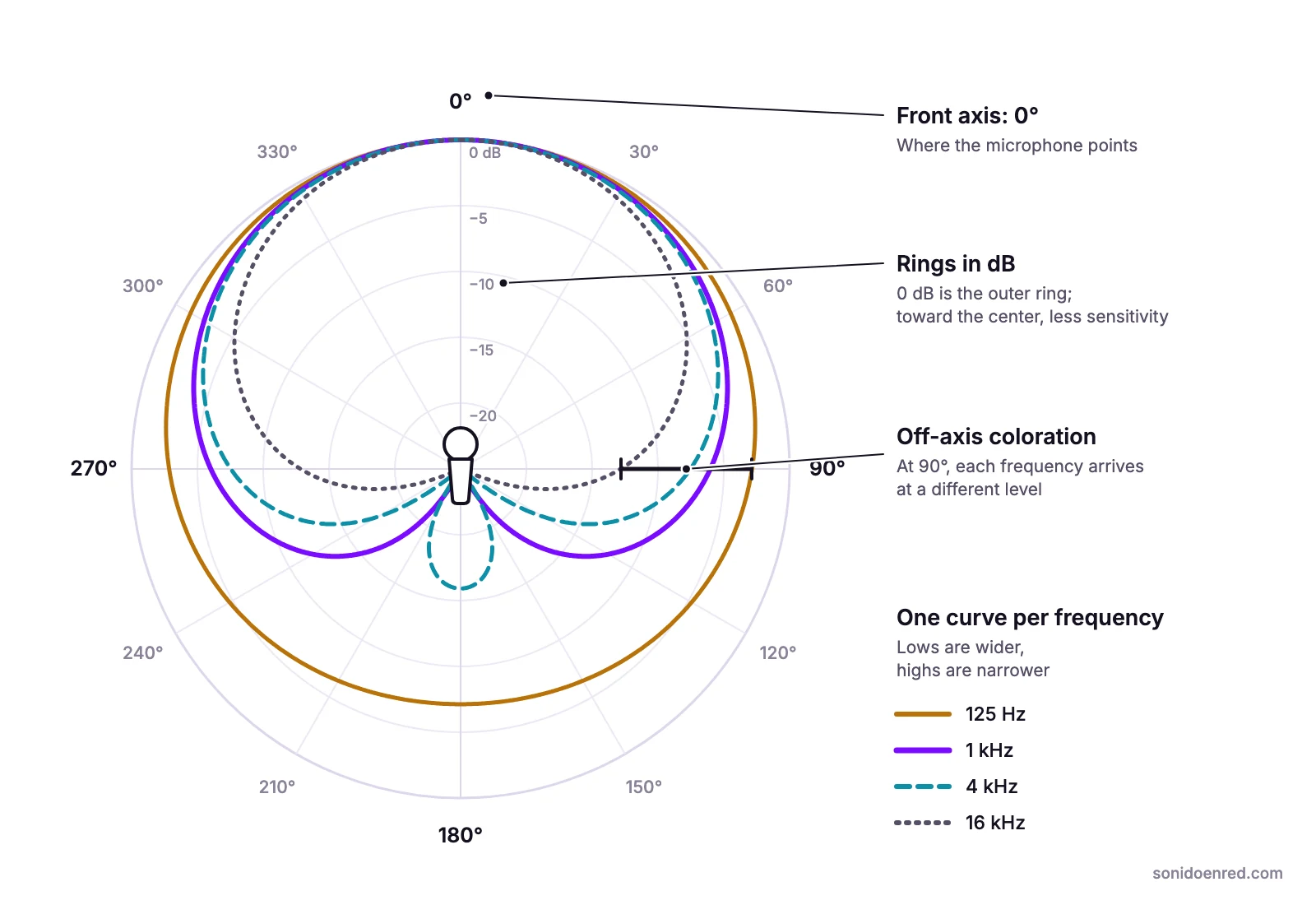
Quality diagrams do not show a single curve, but several overlaid curves corresponding to different frequencies (for example, 125 Hz, 1 kHz, 4 kHz and 16 kHz), because a microphone's real directional behaviour varies with frequency. It is common for a cardioid microphone to behave more omnidirectionally at low frequencies — where the wavelength is too large for the acoustic labyrinth to be effective — and progressively narrow and become more directional at high frequencies. This variation explains the phenomenon of off-axis colouration: a source captured from a side angle is not only lower in level, but also has a different tonal character than the same source captured on the front axis.
Multi-pattern microphones
A multi-pattern microphone incorporates, within a single housing, two large-diaphragm condenser capsules mounted back to back, each functioning separately as a cardioid microphone facing in opposite directions. The microphone's internal circuit can electrically combine the signal from both capsules in different proportions and polarities, allowing several polar patterns to be selected from a simple switch, without changing microphones:
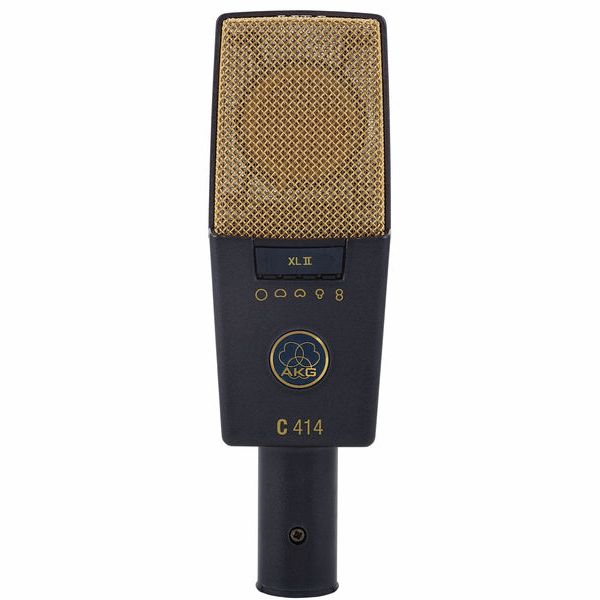
- Summing both cardioid capsules in phase with equal gain produces an omnidirectional pattern.
- Using only one of the two cardioid capsules produces the standard cardioid pattern.
- Subtracting one capsule's signal from the other's (inverting the phase of one of them) produces the bidirectional pattern.
- Combining both signals in intermediate proportions produces intermediate patterns such as subcardioid or hypercardioid.
This versatility makes the multi-pattern microphone a highly valued tool in the studio, where it allows a single microphone to be adapted to different sources and recording techniques without needing several separate models.
Practical consequences of the polar pattern
Beyond its theoretical definition, the polar pattern has direct implications for how a microphone behaves in real-world use:
- Rejection of unwanted sound: The narrower the pattern, the greater the microphone's ability to reject sound from other nearby sources, stage monitors or room ambience.
- Proximity effect: This phenomenon is exclusive to pressure-gradient microphones — cardioid, supercardioid, hypercardioid and bidirectional — and consists of the bass boost that occurs when the microphone is moved closer to the source. Pure omnidirectional microphones do not exhibit it, precisely because their diaphragm does not respond to a pressure difference between two sides.
- Sensitivity to air blasts: With both sides of the diaphragm exposed to external air, pressure-gradient microphones are more sensitive to vocal plosives and wind noise than a pure pressure microphone.
- Off-axis colouration: As explained above, a directional microphone does not only attenuate side sound — it also colours it differently from sound captured on the front axis, a factor worth considering when positioning a source relative to the microphone.
Summary: the physical origin of each polar pattern
- Omnidirectional: Pure pressure principle. Diaphragm sealed at the rear. A perfect circle on the polar diagram.
- Bidirectional (figure-of-8): Pure pressure-gradient principle. Both sides of the diaphragm exposed. Sensitive to front and rear, deaf to the sides.
- Cardioid, supercardioid, hypercardioid: Combination of pressure and pressure gradient in different proportions. Achieved via an acoustic labyrinth or the electronic combination of two capsules.
- Multi-pattern: Two cardioid capsules back to back, electrically combined to select between several patterns.