Psychoacoustics is the branch of science that studies the connection between the physical properties of sound and how these are perceived and interpreted by the human ear and brain.
While acoustics is responsible for studying the sound wave as a physical phenomenon, psychoacoustics delves into psychology, physiology, and neuroscience to understand why we hear the way we do.
Processing of the ear and the brain
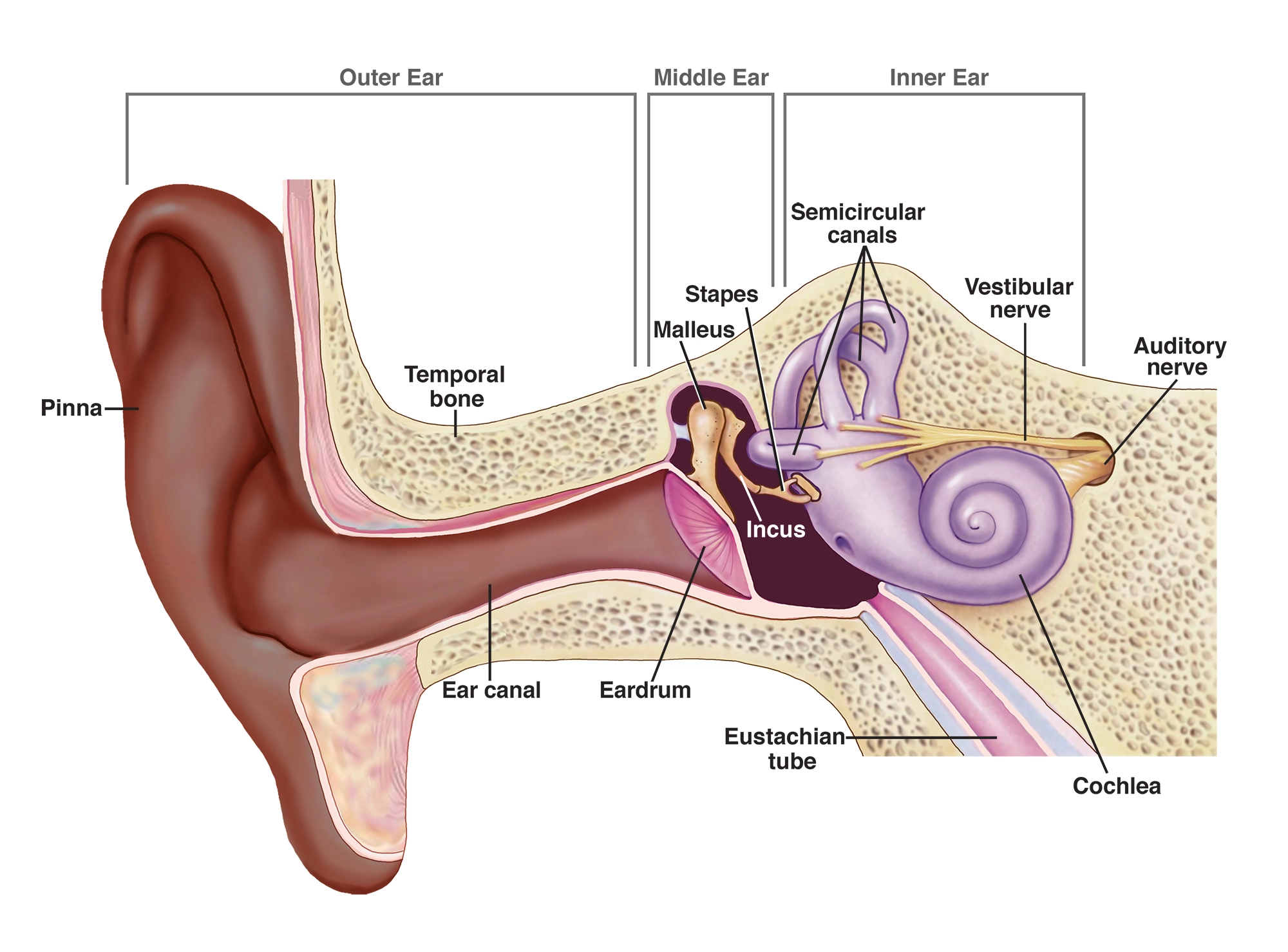
The human auditory system is a complex mechanism designed to capture acoustic waves and transform them into electrical impulses that the brain can interpret. To understand how it works, it is divided into three fundamental parts:
Outer ear: capture and direction
Its main function is to collect, amplify, and direct sound waves into the interior of the system.
- Components: It is composed of the pinna (the ear) and the ear canal, which measures approximately 2.7 cm.
- Spatial processing: The pinna and the head itself act as a physical filter (related to the HRTF function), which helps the brain determine the origin, distance, and elevation of the sound.
Middle ear: transmission and protection
It acts as a mechanical bridge that converts air waves into physical movement.
- Mechanism: The waves strike the eardrum, causing it to vibrate. This vibration is transmitted to the ossicular chain (malleus, incus, and stapes), which function as a lever system to carry the movement to the oval window.
- Protective function: It has the stapedial reflex, which consists of the contraction of certain muscles in response to very loud sounds to attenuate them and prevent damage to the inner ear.
Inner ear: signal transduction
This is where the process of transduction occurs: the conversion from mechanical movement to electrical impulses.
- The process in the cochlea: The movement of the stapes at the oval window displaces the fluid inside the cochlea, generating a pressure wave that travels along the basilar membrane.
- Electrical conversion: Inside the organ of Corti, specialized cells called hair cells detect this movement and transform it into electrical signals.
- Transmission to the brain: These signals, which vary according to the frequency and intensity of the sound, travel through the auditory nerve to the brain, where the sensation of hearing is ultimately generated.
Auditory masking
Auditory masking is a fundamental psychoacoustic phenomenon that occurs when one sound prevents us from perceiving another. It is specifically defined as the lack of perception of a sound due to the presence of another with greater intensity.
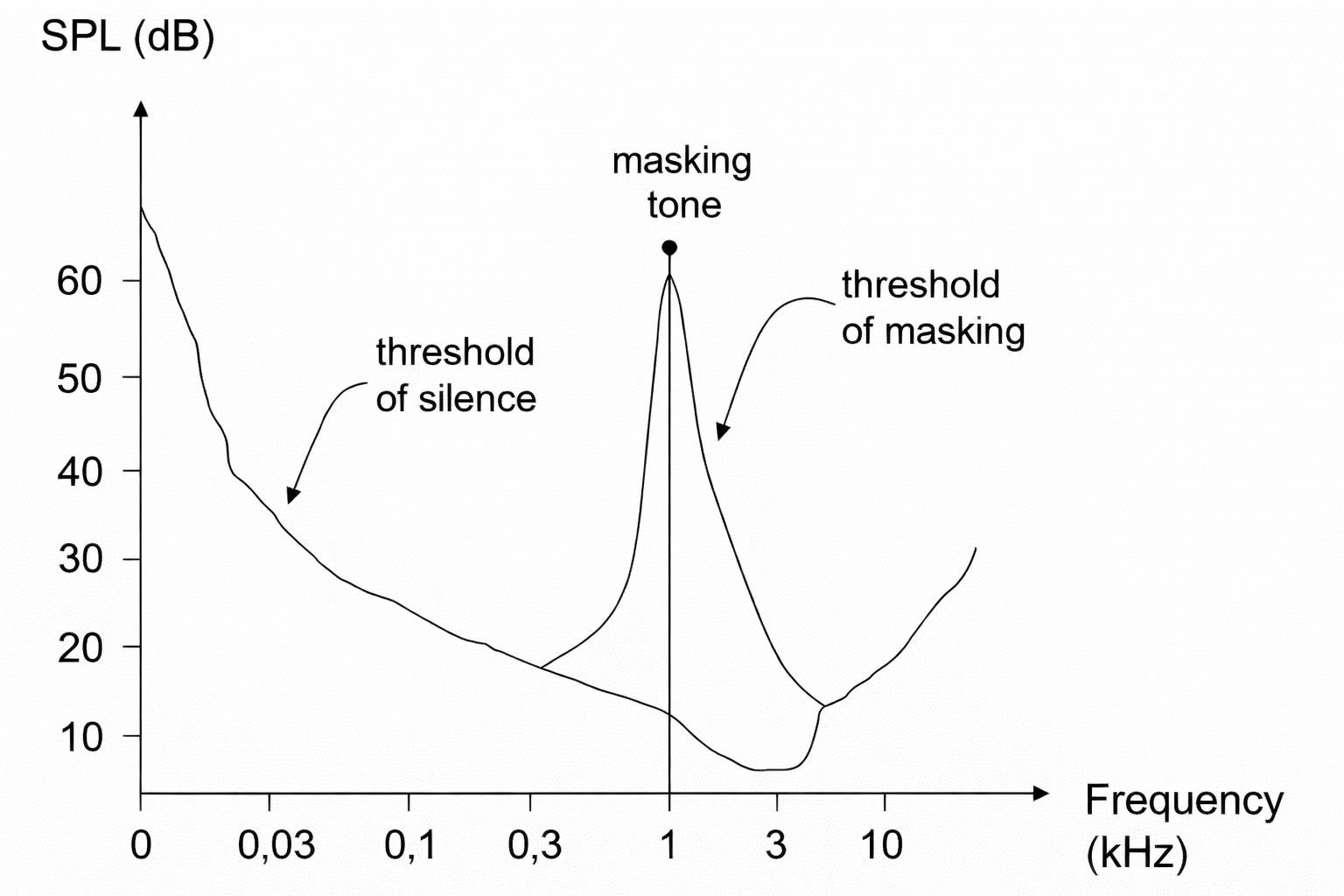
Auditory masking works as follows: a masking tone, that is, a louder sound that "dominates" the environment, creates what is known as a masking threshold.
This masking does not affect all sounds equally; the masking tone makes a specific frequency range imperceptible, which depends directly on the frequency and level (volume) of that tone.
All sounds that fall below that masking threshold will be inaudible to our ear while the masking tone is present. For example, a 1 kHz tone at 65 dB can cause nearby frequencies to become inaudible if they do not exceed a certain intensity.
A common example is a conversation on the street. You are talking to someone and suddenly a loud motorcycle passes by, causing you to stop perceiving the person’s voice even though they are still speaking, because the motorcycle noise has "covered" or masked the message.
Haas effect (or precedence effect)
The Haas effect, also known as the precedence effect, is a psychoacoustic phenomenon that describes how our brain processes and fuses sounds that arrive with a very small time difference.
The fundamental concept is that if several independent sounds reach the brain within an interval of less than 50 ms, it does not hear them separately, but rather fuses and interprets them as a single sound. The brain stops perceiving the individual direction of each sound and understands that the sounds arriving later are simply an echo or reverberation of the first.
Modes of interpretation according to delay
The way the brain localizes sound changes depending on how short that time interval is:
- Delay less than 5 ms: The brain uses only the direction of the first stimulus to localize the sound. Even if other sounds arrive from completely opposite directions, the auditory system will ignore them at the localization level and assume everything comes from the original source.
- Delay between 5 and 50 ms In this range, the listener still hears a single fused sound, but with double intensity. In this case, the perception of the source shifts and the brain localizes it at an intermediate point between all sound sources.
For the precedence effect not to determine the direction of the sound (for example, for the listener to feel that the sound comes from the center), the delayed signal must have a higher volume than the first.
From this arises the Haas curve, which is a representation of the intensity (in decibels) required to compensate for the delay in milliseconds between two signals. This tool is fundamental in the acoustic design of venues to maintain a proper stereo image throughout the space.
Doppler effect
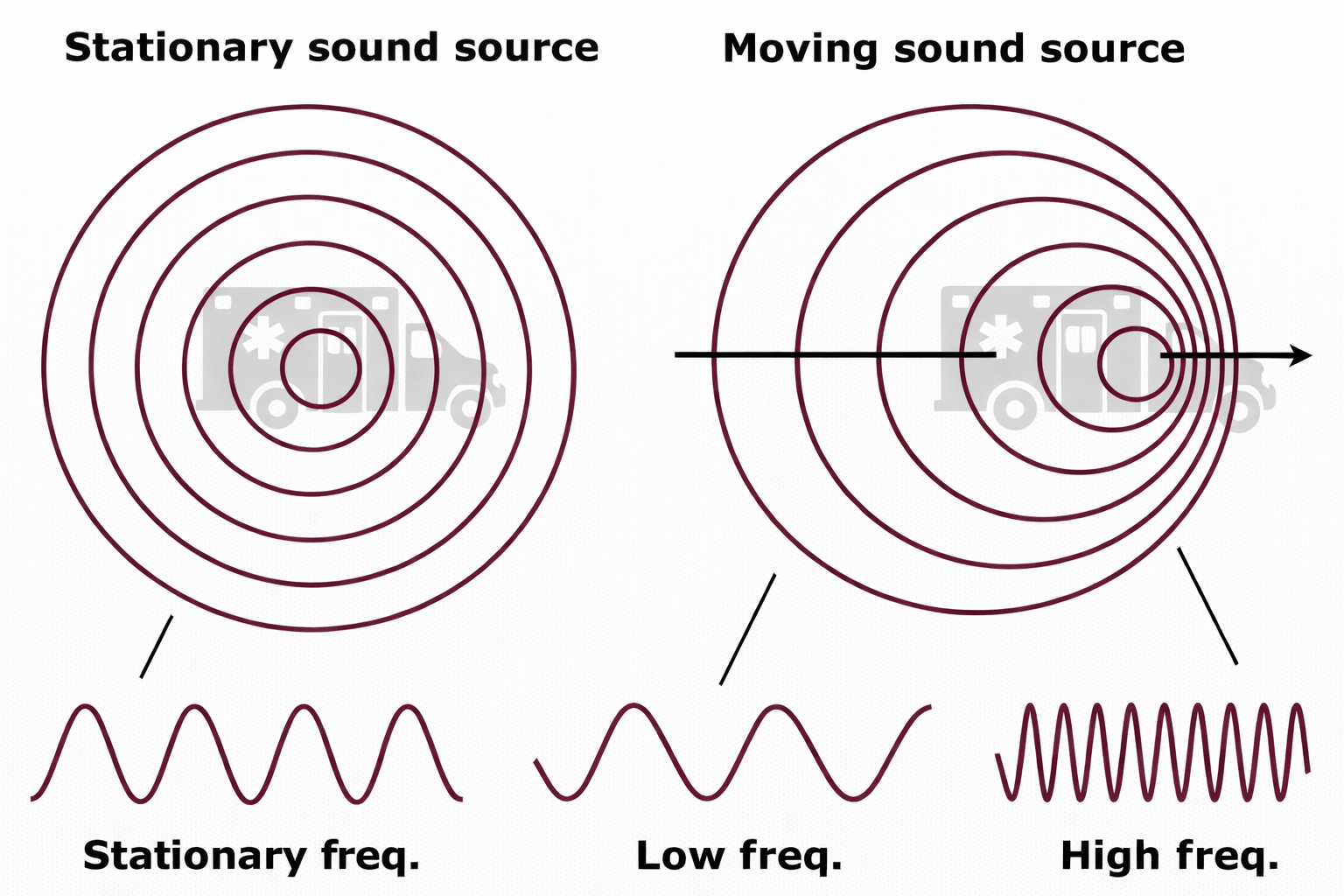
The Doppler effect is defined as the change in the apparent frequency of a wave (in this case, sound) when there is relative motion between the source emitting the sound and the person listening to it.
To understand it better, consider these points:
- Pitch change according to direction: The phenomenon causes us to perceive sound differently depending on whether the object is approaching or moving away. When the source approaches the listener, the pitch is perceived as more high; when the vehicle passes by and begins to move away, the pitch changes and is perceived as more low.
- Relative velocity: This effect is clearly perceptible when the object's speed is a significant fraction of the speed of sound. For example, an ambulance traveling at 50 km/h moves at approximately 4% of the speed of sound (which is 1235 km/h). Although it may seem like a small figure, that 4% is enough for the human ear to perceive the change in the siren’s frequency.
- "Apparent" frequency: It is important to note that the source always emits sound at the same real frequency. What changes is the way the waves reach the observer due to motion, creating that illusion of a change in pitch or apparent frecuency.
Head-Related Transfer Function (HRTF)
The Head-Related Transfer Function (HRTF) is a mathematical representation that describes the complex filtering process that sound undergoes from the moment it is emitted by a source until it reaches the listener’s ears.
Since sound perception is affected by the shape and size of the head, the ears, and the torso, each person has their own HRTF. These physical traits act as a personal acoustic filter that modifies sound waves before they enter the ear canal.
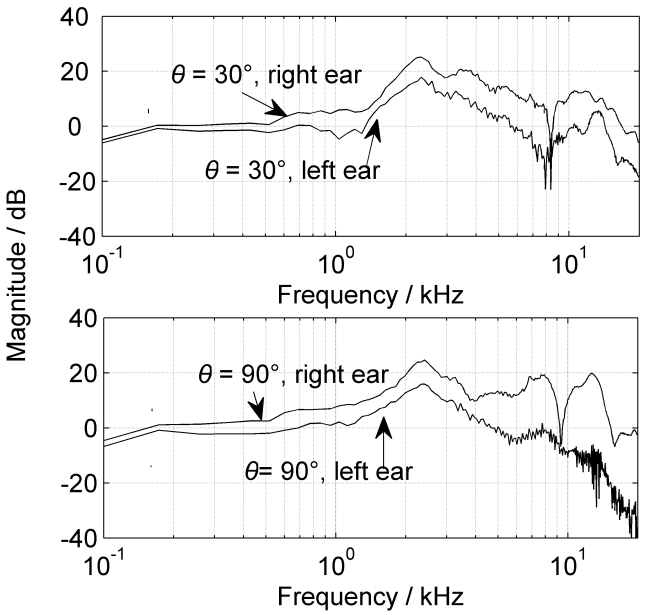
The HRTF is the tool the brain uses to decipher the direction, distance, and elevation of a sound source. By capturing how our body alters sound, the auditory system can interpret exactly where the stimulus originates.
In current technology, these filters are used to simulate spatial perception in sound systems. By applying the appropriate HRTF filters, a highly realistic sense of three-dimensionality can be created, which is especially effective when using headphones or binaural listening techniques.