Phase is a fundamental concept in acoustics that describes the relative position of a point within the oscillation cycle of a sound wave at a specific moment.
Imagine a wave as a repetitive cycle; phase tells us exactly where the wave is along that path.
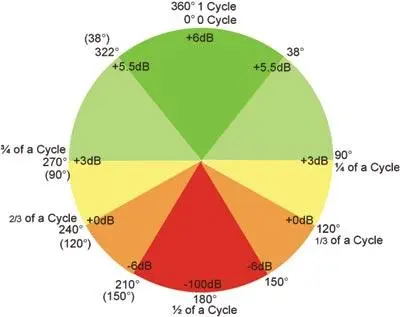
Phase is expressed mathematically in degrees (°) or radians (rad).
A complete wave cycle equals 360° or \( 2\pi \ \text{rad} \).
In the mathematical formula of a sound wave \( y(t) = A \sin(\omega t + \varphi) \), the symbol \( \varphi \) represents the initial phase, which tells us the point at which the wave begins exactly when time is zero (\( t = 0 \)).
Wave interaction (Interference)
The most important aspect of phase appears when two or more waves meet. The phase difference between them determines the final result.
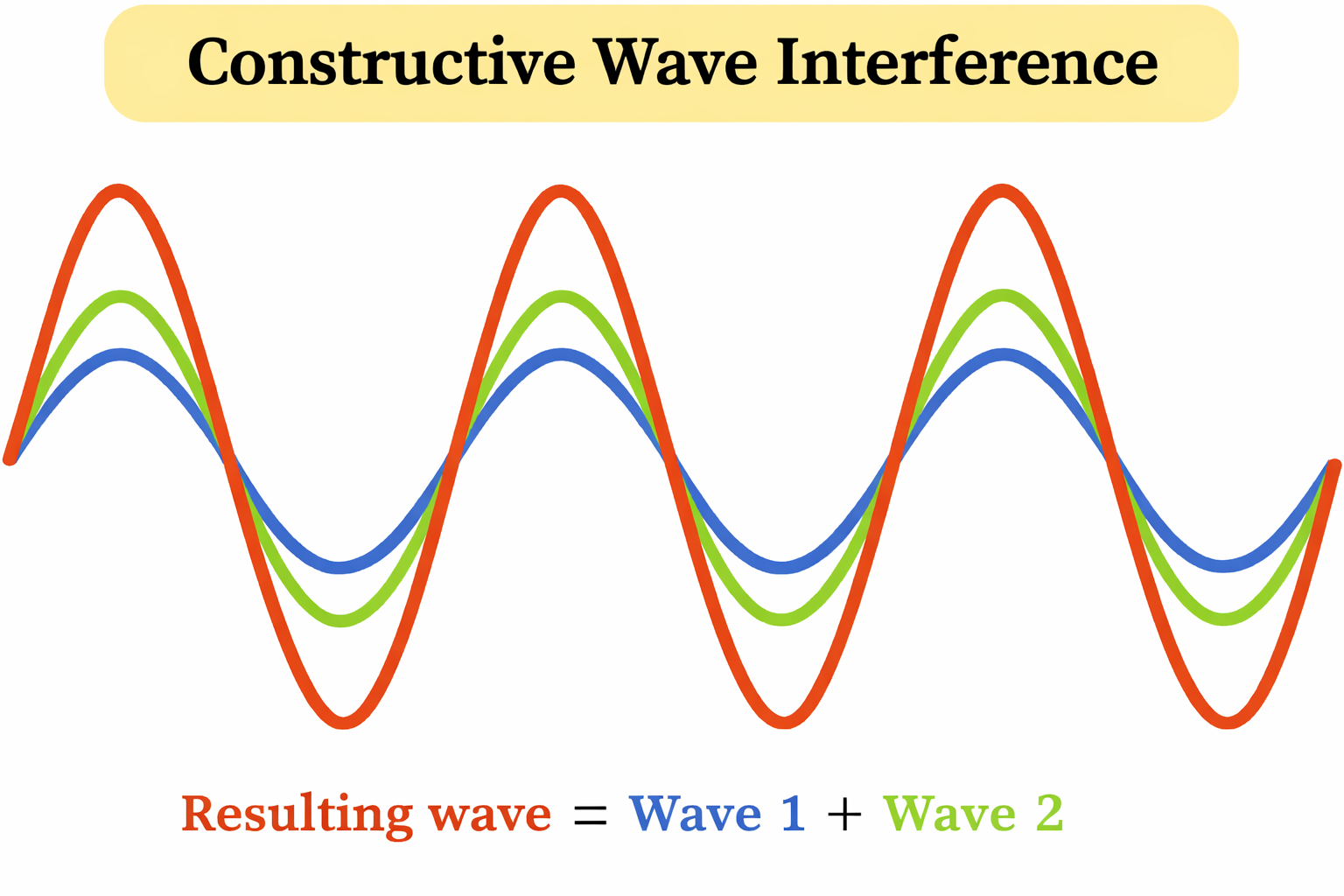
In-phase waves (0° difference)
This occurs when the crests and troughs of two waves align exactly. Their amplitudes add together, which is known as constructive interference, increasing the intensity or loudness of the sound. A common example is when two loudspeakers emit the same signal perfectly aligned.
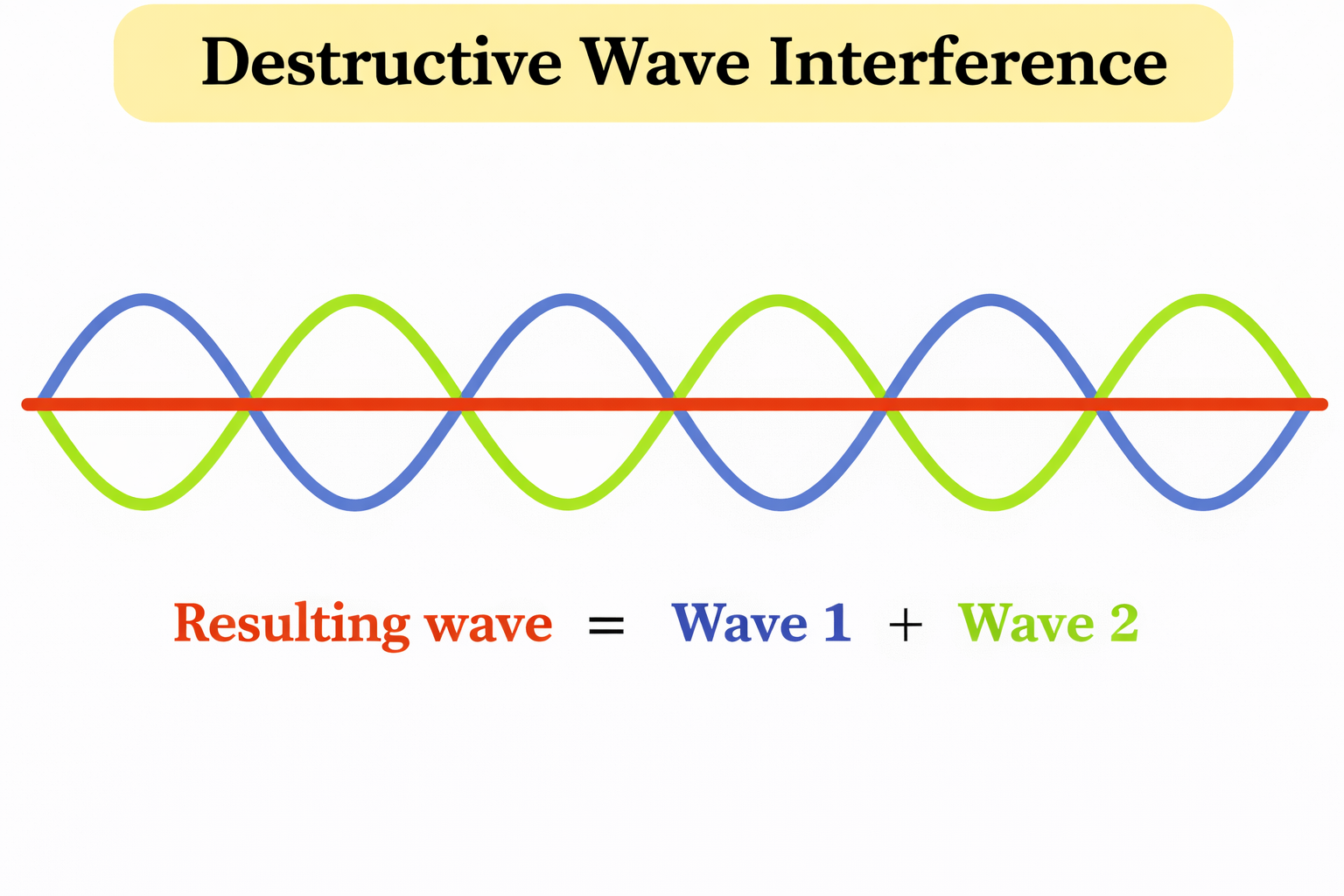
Out-of-phase waves (180° difference)
Here, the crest of one wave coincides with the trough of the other. Since they are opposite, they cancel each other out, creating destructive interference that reduces or eliminates the sound. This is the fundamental technology behind active noise-cancelling headphones, which generate a wave in opposite phase to cancel ambient noise.
Intermediate phase differences
When the phase shift is neither 0° nor 180°, the waves combine partially. This creates complex patterns of reinforcement and cancellation that vary depending on your position, something very common in the acoustics of auditoriums or concert halls.
Factors that determine interference
It does not depend only on phase, but also on other physical elements:
- Frequency and wavelength: Waves with similar frequencies interfere more easily because their cycles align more precisely. The wavelength determines the location of nodes (points of silence or cancellation) and antinodes (points of reinforcement or maximum amplitude) within a space.
- Distance between sources: If loudspeakers or sources are very close together, the sound overlaps more uniformly. If they are separated, complex patterns form with alternating zones of reinforcement and cancellation throughout the environment.
- Reflection and diffraction: Walls and ceilings redirect waves, creating new points of overlap that may cause echoes or unexpected cancellations. Diffraction allows waves to bend around obstacles, altering how interference is distributed within a room.