Wavelength is mathematically defined as the physical distance between two equivalent and consecutive points of a wave, such as two crests or two troughs. Formally, this distance is obtained by dividing the speed of sound (\( v \)) by the frequency (\( f \)), according to the equation \( \lambda = \frac{v}{f}\).
Because of this mathematical relationship:
- Low frequencies = Long wavelengths: When frequency decreases, the wave must travel a greater distance to complete a single cycle. For example, a very low tone at 20 Hz has a wavelength of approximately 17.15 meters in air.
- High frequencies = Short wavelengths: As frequency increases, cycles repeat more rapidly over time, meaning the distance covered in each cycle becomes much smaller. A high-pitched tone at 20,000 Hz has a wavelength of only about 1.7 centimeters.
Impact on Sound Behavior
The relationship between these two properties determines how we perceive sound and how it interacts with the physical world:
Diffraction and obstacles
A wave’s ability to bend around objects depends on its wavelength. Low-frequency waves (long wavelengths) can easily diffract around obstacles, which is why bass frequencies from music can often be heard from another room.
Resonance in spaces
In acoustic design, wavelength is critical because it determines a room’s resonant frequencies. If a sound’s wavelength matches the distance between room boundaries (or integer multiples of that distance), acoustic reinforcement or resonance occurs.
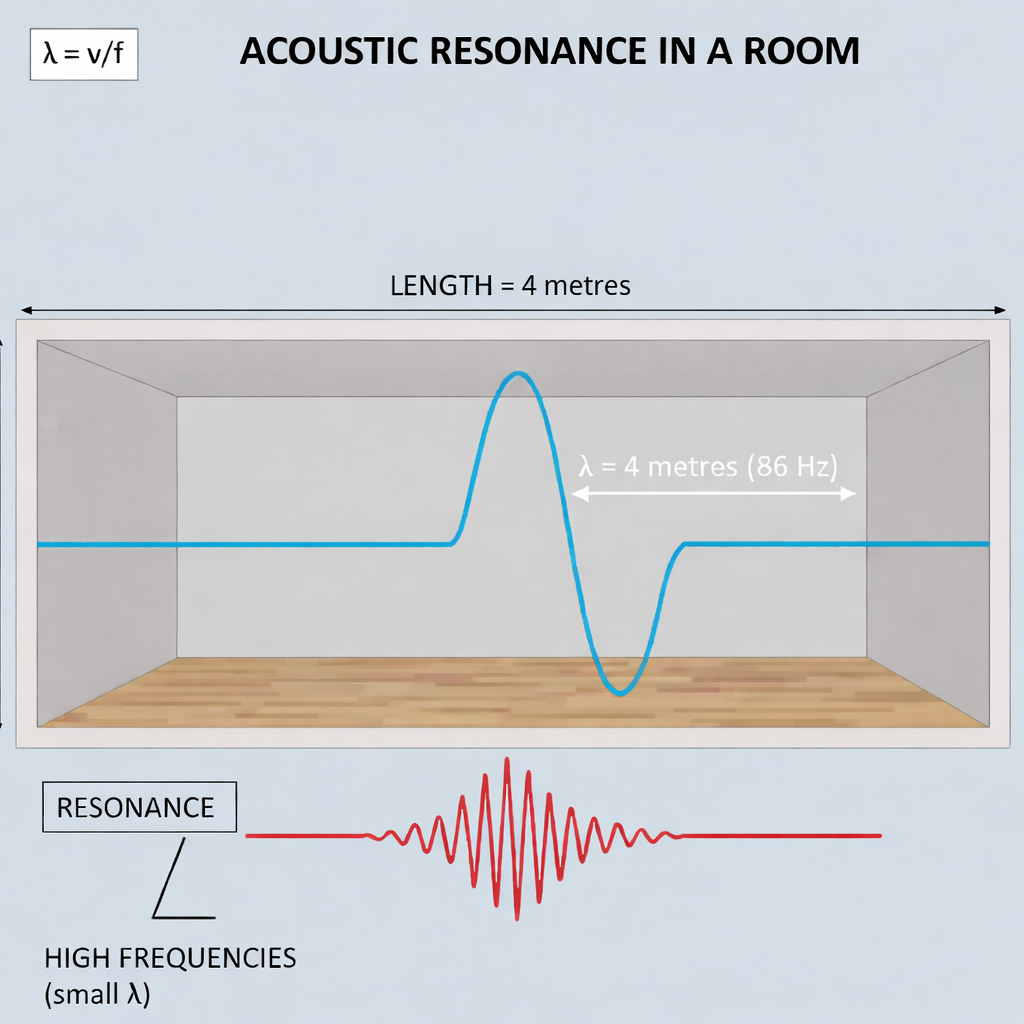
For example, in a room measuring 4 meters in length, a frequency of approximately 86 Hz (with a wavelength of 4 meters) will strongly resonate.
Interference
When two waves of similar wavelengths meet, their interaction can produce constructive interference (increased amplitude) or destructive interference (cancellation), depending on whether their phases align in space.