Amplitude is a physical property of the sound wave that determines its intensity.
If you imagine the graph of a sound wave, amplitude is represented as the distance between the equilibrium point and the highest point (crest) or the lowest point (trough) of the wave. Technically, it is the distance between the point of maximum compression and maximum rarefaction of the air.
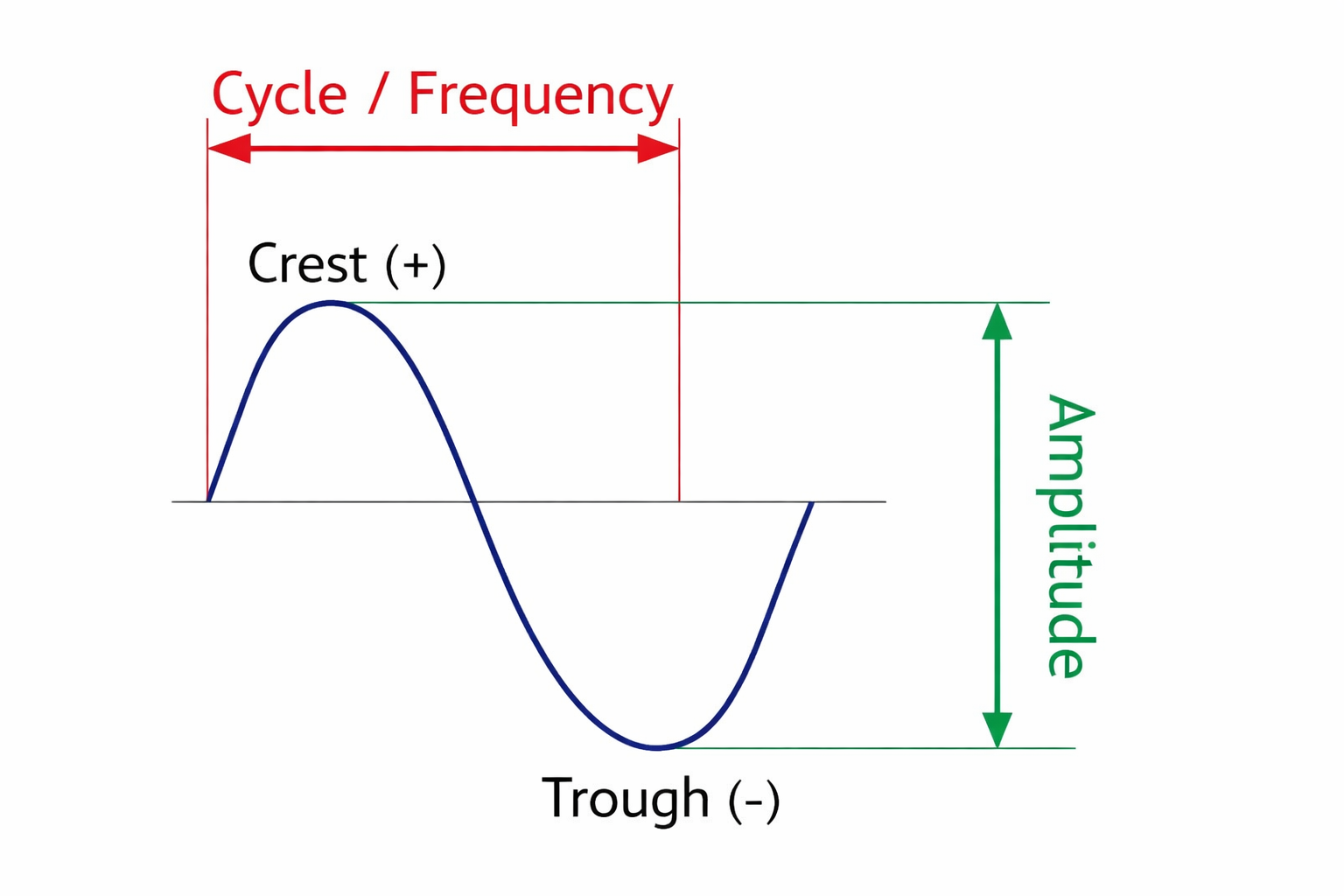
There are two main ways to quantify amplitude:
- Sound pressure (Pascals): Physically measures fluctuations in air pressure. The minimum pressure level that the human ear can detect is approximately 20 micropascals (µPa).
- Decibels (dB SPL): Since the pressure range in Pascals is extremely large, audio uses the decibel, which is a logarithmic unit. This scale is more practical: 0 dB represents the threshold of hearing and 120 dB the threshold of pain.
Difference between frequency and loudness
These terms are often confused, but there is an important distinction.
Amplitude is a physical and objective quantity that can be measured precisely with instruments, whereas loudness is a subjective perception our brain’s interpretation of that amplitude.
Two sounds with the same amplitude may be perceived at different loudness levels depending on their frequency; for example, the human ear perceives mid frequencies as louder than low or high frequencies, even when they have the same physical intensity.
Fletcher–Munson equal-loudness curves
The Fletcher–Munson curves, also known as equal-loudness contours, are graphical representations that show how the sensitivity of the human ear varies across different frequencies.
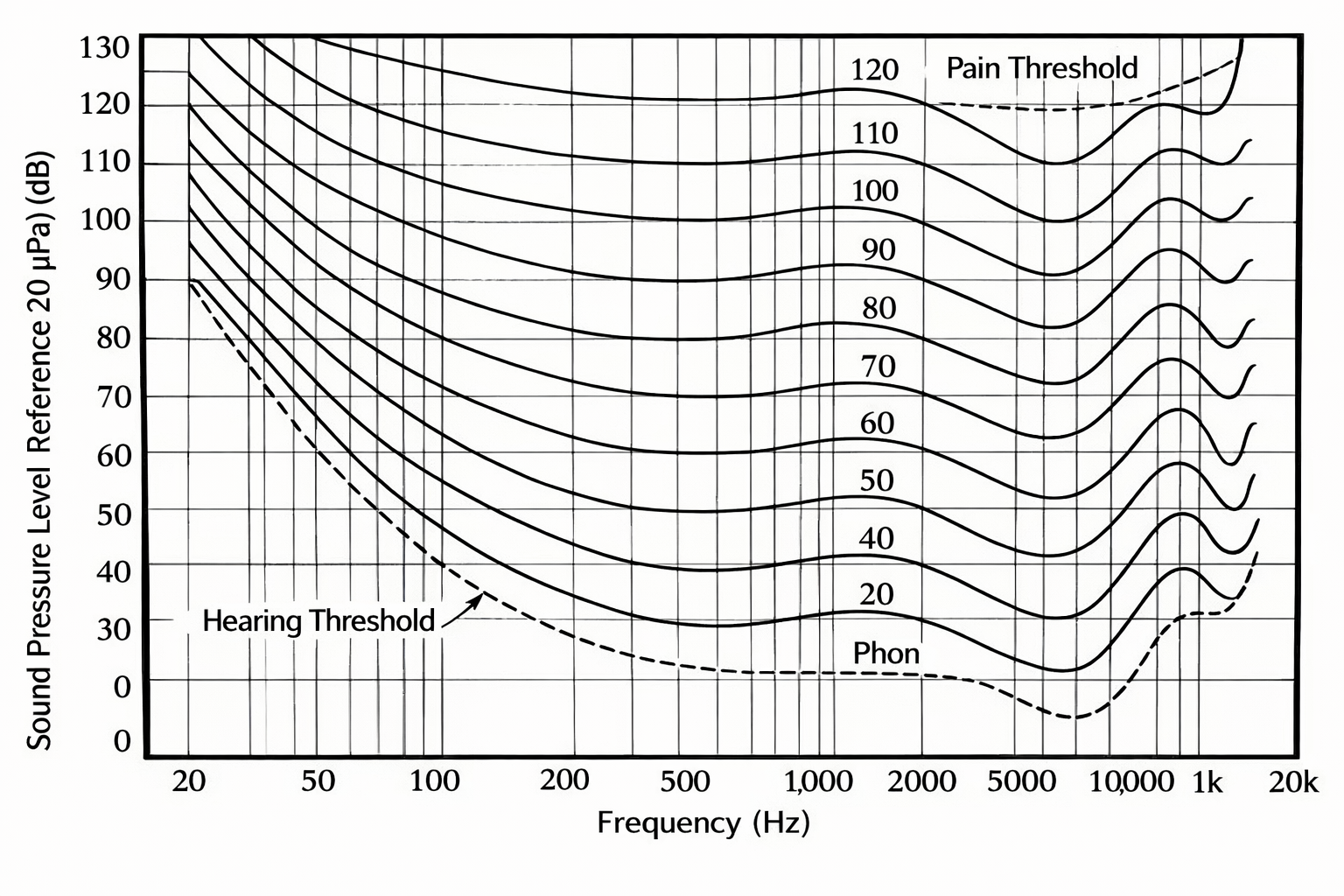
Some of their most important points:
- We do not hear all frequencies equally: humans do not perceive all sounds with the same intensity, even if they have the same physical amplitude. These curves demonstrate that our ears are more sensitive to certain frequencies than others.
- Reference point (1,000 Hz): The curves are calculated using a 1,000 Hz tone as a reference. From there, it is determined how much intensity (in decibels) other frequencies require for the brain to perceive them with the same “strength” or loudness as the reference tone.
-
Sensitivity to low and high frequencies:
- Low frequencies (bass): The ear is less sensitive. For example, for a 100 Hz sound to be perceived as equally loud as a 1,000 Hz sound at 40 dB, we need to increase the intensity of the low frequency up to 60 dB.
- Mid frequencies (3,000 Hz – 4,000 Hz): This is the range where we are most sensitive. This occurs because the resonance frequency of our outer ear canal is close to 3,150 Hz, which means fewer decibels are needed for us to hear clearly in this range.
- Thresholds of hearing and pain: These curves also allow us to map the threshold of hearing (the minimum level required to begin hearing) and the threshold of pain, which are not flat but vary significantly depending on the frequency of the sound.