Acoustic reflection occurs when a sound wave strikes a surface and some of that energy is reflected instead of being absorbed or transmitted through the medium.
This physical process is governed by laws similar to those of optics, where the angle of incidence determines the direction of the reflected wave.
Factors that influence reflection
Surface type
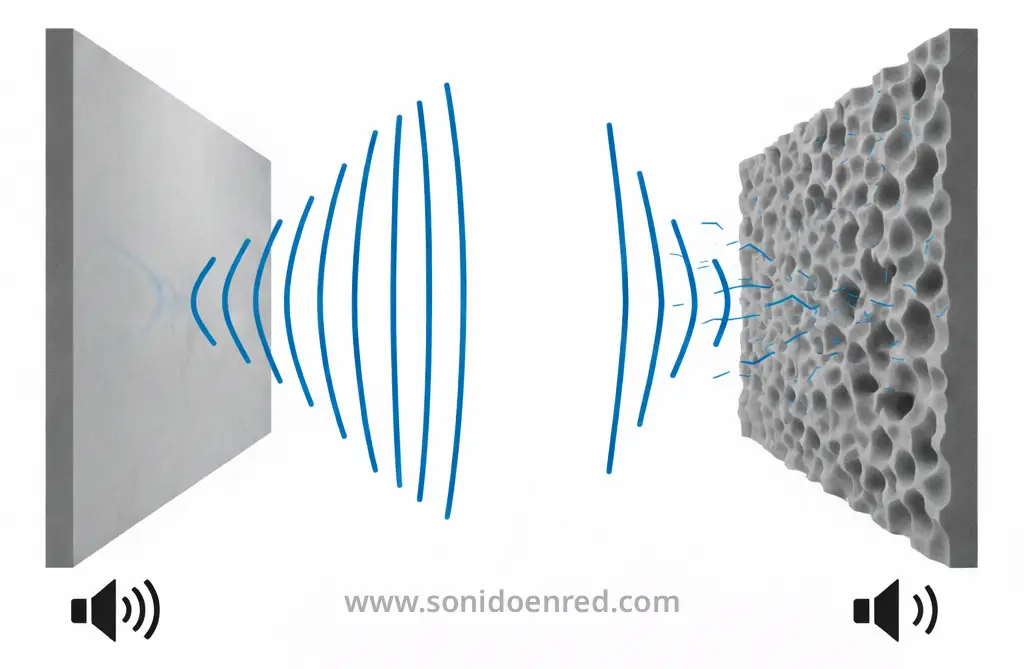
The composition and texture of a material directly influence the reflected sound wave. Smooth, hard surfaces, such as cement or glass, reflect a greater amount of sound energy. In contrast, rough or porous surfaces tend to scatter or absorb sound, reducing direct reflection.
Surface shape
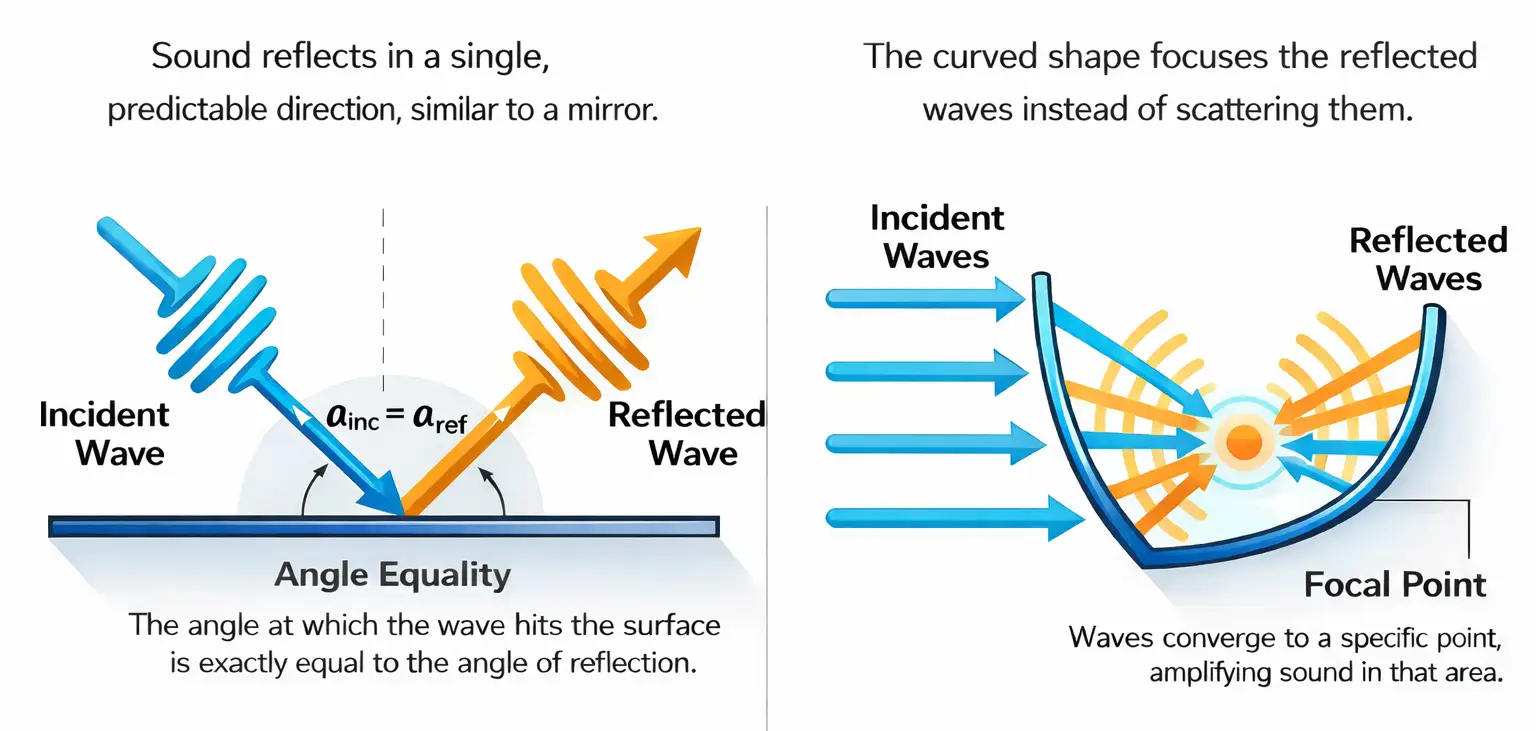
The shape of the obstacle defines the type of reflection. While flat surfaces favor a predictable specular reflection, concave surfaces (such as domes or vaults) can generate a concentrated reflection, focusing and amplifying the sound at a specific point.
Angle of incidence
The behavior of sound follows laws similar to those of light, where the angle of incidence equals the angle of reflection. The direction at which the sound strikes the surface affects the outcome; for example, oblique angles tend to produce more scattered reflections.
Sound frequency
Wavelength influences the ability to reflect sound. Low frequencies (bass sounds) are reflected more easily due to their longer wavelength. Conversely, high frequencies (treble sounds) are more likely to be absorbed or scattered by materials.
Acoustic impedance
Mathematically, reflection is described by the relationship between the impedance of the incident medium (\( Z_1 \)) and that of the surface (\( Z_2 \)). This impedance difference determines what proportion of energy is reflected.
Acoustic impedance equation
This is the main mathematical formula for determining the proportion of sound energy that is reflected when it hits a material:
- \( R \): Represents the proportion of energy that actually bounces off the surface. (Reflection coefficient).
- \( Z_1 \): It is the acoustic impedance of the medium through which the wave originally travels (for example, air).
- \( Z_2 \): It is the acoustic impedance of the surface or obstacle against which the sound hits.
Types of acoustic reflection
There are three main types of acoustic reflection that depend on the shape and texture of the surface the sound hits:
Specular reflection
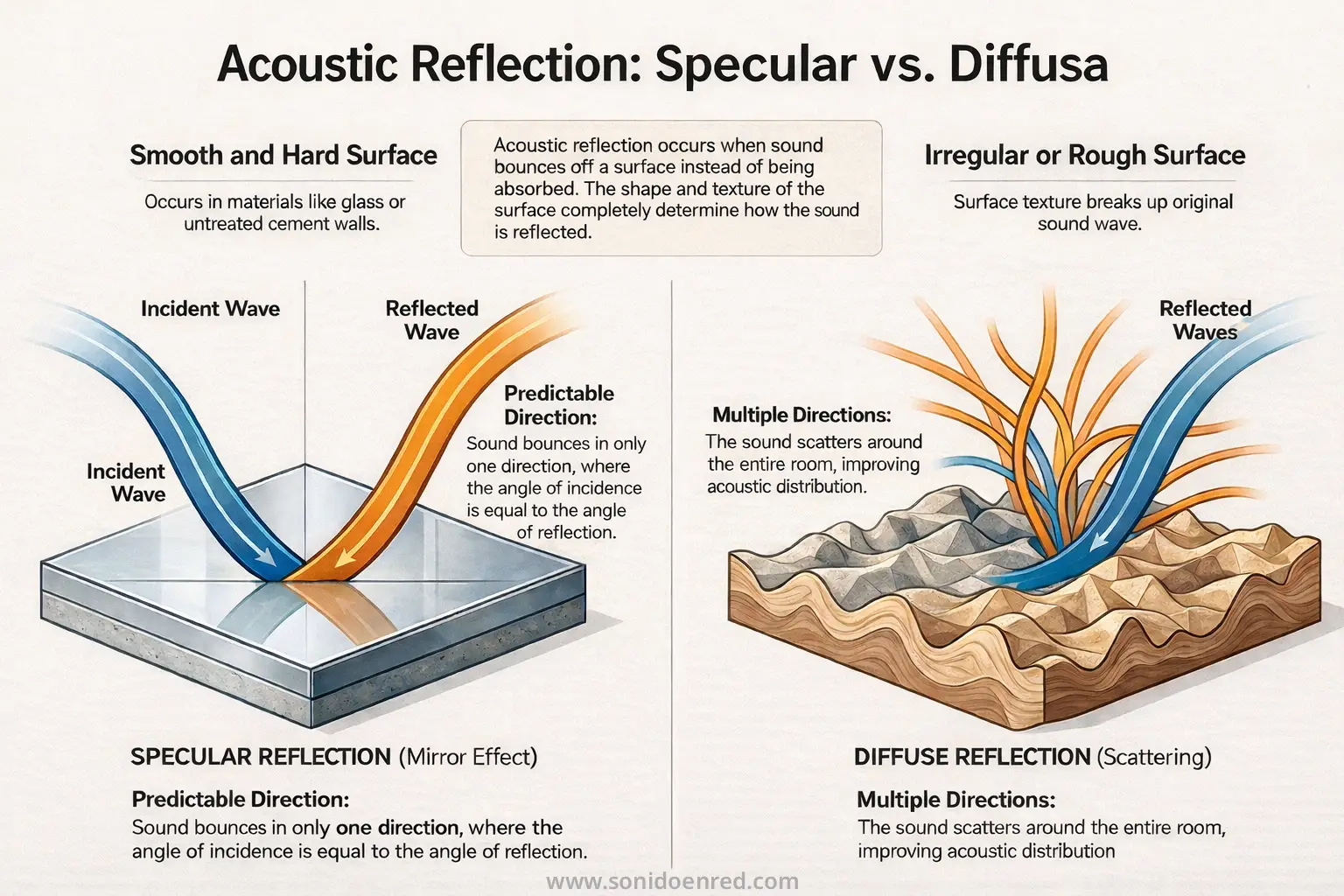
It occurs when sound strikes a smooth surface. In this case, the wave is reflected in a single, predictable direction, functioning similarly to how a mirror reflects light.
This type of reflection is common in rooms with hard walls that do not have acoustic treatment.
Diffuse reflection
This occurs when a sound wave strikes an irregular or rough surface. Unlike specular reflection, this causes the sound to scatter and reflect in multiple directions.
This phenomenon is highly valued in acoustic design, as it helps to improve the uniform distribution of sound in a room.
Concentrated reflection
It is generated when sound encounters a concave surface, such as a dome or vault. These structures act like a lens, directing and focusing the reflected waves toward a specific point, resulting in sound amplification in that particular area.