Acoustic refraction is the physical phenomenon that occurs when a sound wave changes direction as it passes through media with different properties, or when it encounters variations within the same medium, such as changes in density, temperature, or speed of sound.
The change in direction occurs because the propagation speed of sound is not constant — it depends on the physical characteristics of the medium, specifically its density and elasticity. When sound moves from a region where it travels at one speed (\( v_1 \)) to another where it travels at a different speed (\( v_2 \)), its path is deflected.
This behaviour is described mathematically by Snell's Law, which relates the angles of incidence and refraction to the speeds in each medium.
Snell's Law
Snell's Law applied to acoustics is the mathematical tool that describes how a sound wave changes direction when passing from one medium to another with different propagation speeds.
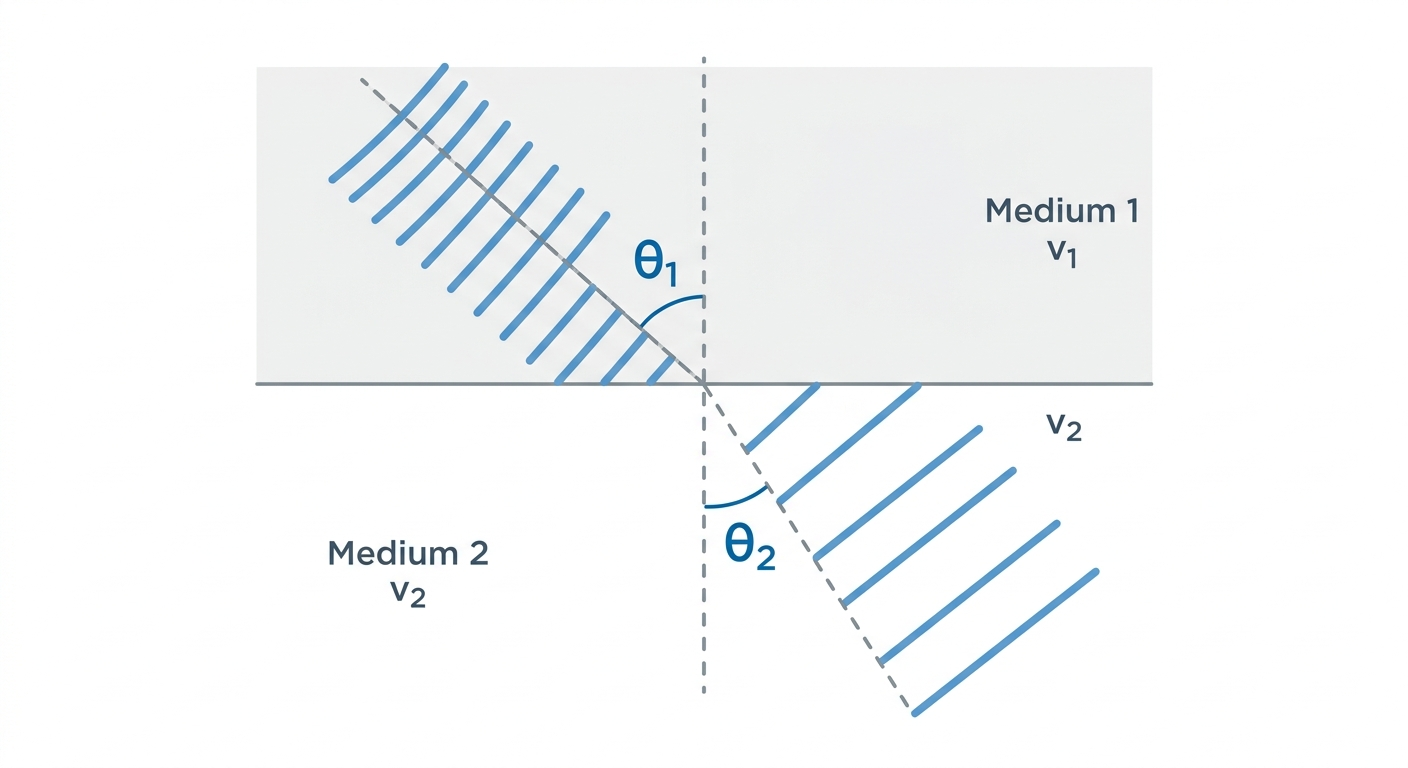
- \( \theta_1 \) is the angle of incidence of the sound wave.
- \( \theta_2 \) is the angle of refraction (the new direction).
- \( v_1 \) and \( v_2 \) are the speeds of sound in the first and second medium, respectively.
The degree to which the sound wave bends depends directly on the relationship between the speeds of the two media involved:
- Towards the normal: If the sound enters a medium where the speed is lower (\( v_1 \)<\( v_2 \)), the wave bends towards the normal line (an imaginary line perpendicular to the boundary surface).
- Away from the normal: If the sound enters a medium where it travels faster (\( v_1 \)>\( v_2 \)), the wave bends away from the normal.
Factors that cause refraction
Temperature variations
In the atmosphere, temperature is the most determining factor. Sound travels faster in warm air than in cold air, which causes sound waves to always bend towards colder regions.
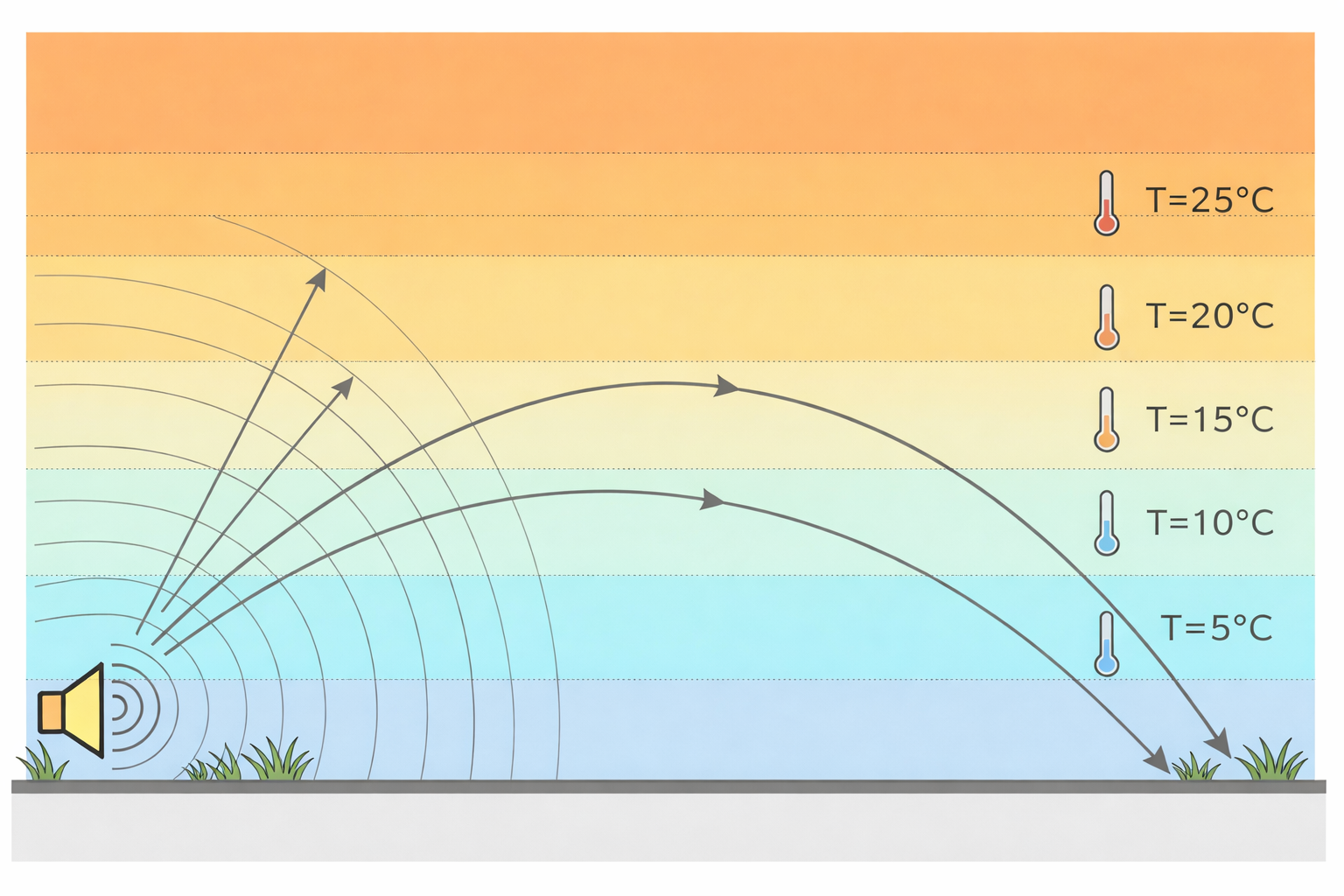
When the air near the ground is colder than the upper layers, this is known as a temperature inversion. In this case, sound bends downwards, allowing it to be heard at much greater distances than usual.
Density and elasticity
The speed of sound depends directly on the density and elasticity of the medium. In media such as water or solid materials, variations in density between layers cause refraction.
In the ocean, for example, sound waves tend to bend towards layers that are deeper and colder.
Pressure and altitude
Geographic location also influences propagation. At high altitudes, the lower air density alters the speed at which sound travels, which in turn modifies the direction in which the wave propagates.