The compressor is probably the most misunderstood mixing tool and, at the same time, one of the most powerful. While the equaliser works in the domain of frequencies, the compressor works in the domain of time and amplitude: it controls how the level of a signal changes over time. Understanding what a compressor actually does — and what it does not do — is the starting point for using it musically and effectively.
What dynamics are and what the compressor does
Dynamics are the difference between the lowest and highest levels of an audio signal. A sung vocal has a lot of dynamics: some syllables are very soft while some notes are very powerful. A drum kit too: hits have very high, brief level peaks followed by decay. That variation is what makes sound expressive and natural.
The problem in mixing is that a very wide dynamic range makes the work harder: if the vocal rises and falls a lot, it is difficult to keep it consistently above the instruments. If the kick drum has very high, very brief peaks, it consumes a lot of headroom on the bus. The compressor solves this by automatically reducing the signal level when it exceeds a defined threshold, narrowing the difference between the loud and quiet moments.
In mixing, the compressor serves three distinct purposes:
- Dynamics control: Evening out the performance so the instrument or vocal is more consistent in level throughout the song.
- Tonal character: Different compressor types add their own harmonic colouration, which can make an instrument sound fatter, more aggressive or warmer.
- Glue: When applied to the mix bus or subgroups, it unifies the sound of several elements and makes them feel like a cohesive whole.
Compressor parameters
Threshold
The threshold defines the level above which the compressor starts to act. Everything above it is compressed; everything below is left untouched. If the threshold is set very high, the compressor barely acts (only on the most extreme peaks). If it is set very low, the compressor acts almost all the time, reducing dynamics more intensely.

The threshold is adjusted based on how much gain reduction is desired: it is moved until the compressor's gain reduction meter shows the target amount at the loudest moments of the signal.
Ratio
The ratio determines how much the signal is compressed once it exceeds the threshold. It is expressed as a relationship: for every X dB that the signal exceeds the threshold, only Y dB passes through.

- 2:1: For every 2 dB above the threshold, only 1 dB passes. Gentle, transparent compression. Common on vocals and acoustic instruments.
- 4:1: For every 4 dB, only 1 passes. Moderate compression. Common on guitars and bass.
- 8:1: Aggressive compression. Common on drums and effect compression.
- 10:1 or higher: Limiting. The compressor acts as a limiter, preventing the signal from exceeding the threshold.
- ∞:1 (infinity): Hard limiting. The signal cannot exceed the threshold under any circumstances.
Attack
The attack is the time it takes for the compressor to start compressing from the moment the signal exceeds the threshold. Measured in milliseconds.
- Fast attack (0.1–10 ms): The compressor acts almost instantly, flattening transients. Useful for controlling aggressive peaks on vocals or for a more "glued" sound. On percussion, it can remove punch and make hits sound flat.
- Slow attack (30–100 ms or more): The compressor lets the initial transient pass through uncompressed and starts acting on the body of the sound. Preserves the natural attack and punch of the instrument. The standard approach on drums when punch needs to be maintained.

The relationship between attack and transients is the tool with which the engineer shapes the percussive character of each instrument. Attack controls how much "hit" reaches the listener.
Release
The release is the time it takes for the compressor to stop compressing once the signal has dropped below the threshold. Measured in milliseconds.

- Fast release: The compressor recovers quickly and returns to rest before the next peak. Can produce an audible "pumping" effect if too fast: the level rises and falls perceptibly between notes.
- Slow release: The compressor maintains gain reduction for longer. Produces smoother, more transparent compression, but can flatten dynamics if too slow, as the compressor does not recover in time between peaks.
The most common practical approach is to set the release so the compressor recovers just before the next peak, following the song's rhythm. Many compressors offer an Auto Release mode that automatically adjusts the release time based on the signal content.
Knee
The knee controls how smoothly the compressor begins to act around the threshold.

- Hard knee: The compressor engages abruptly exactly at the threshold. More aggressive and perceptible.
- Soft knee: The compressor begins to act gradually slightly before the threshold and progressively increases compression up to the full ratio. More natural and transparent.
Make-up gain
Compressing a signal lowers its average level. Make-up gain (also called output gain) compensates for this loss by raising the compressor's output level. The correct way to set it is to match the output level to the input level (the same perceived volume in bypass and with the compressor active), so that with and without compression can be compared fairly.
Compressor types: topology and character
Beyond the parameters, compressors differ in the circuit they use to control gain. Each topology has different behaviour and a different sonic character, making the choice of compressor type both a technical and a creative decision.
VCA (Voltage Controlled Amplifier)
The VCA compressor is the most transparent and precise. Its control circuit is very fast and allows attack and release to be adjusted with great accuracy. It adds no significant colouration: what goes in comes out compressed but without obvious tonal changes.
The standard choice for the mix bus and for percussion when precise transient control is needed. Classic references are the SSL G Bus Compressor (for bus) and the dbx 160. In plugin format, the Waves SSL G-Master Buss Compressor and the API 2500 are references.
FET (Field Effect Transistor)
The FET compressor is fast, aggressive and characterful. Its field-effect transistors produce very fast compression that can act almost instantaneously on transients, adding harmonic saturation and a colouration that pushes sound to the front of the mix.

The absolute reference is the Urei/Universal Audio 1176, one of the most widely used compressors in recording history. The go-to compressor for vocals needing presence and aggression, for snare drum and for any element that needs drive and character.
Optical (Opto)
The optical compressor uses a photosensitive cell to control gain reduction: the audio signal illuminates a light source (LED or bulb), and the intensity of that light controls the compression level. This mechanism produces smooth, natural and musical compression, with attack and release times that are not precisely adjustable but depend on the optical behaviour of the circuit.
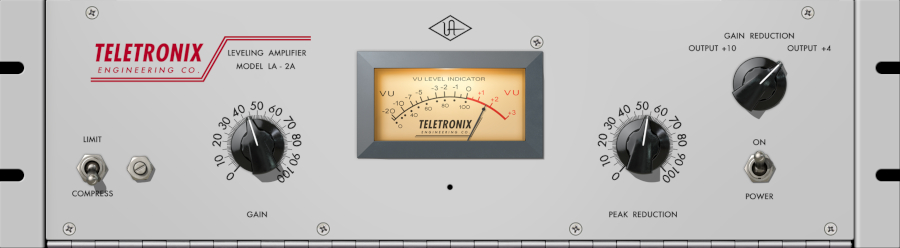
The reference is the Teletronix LA-2A, a compressor with only two controls (threshold and make-up gain) whose simplicity conceals a very musical character. The preferred compressor for vocals needing smoothness and transparency, for acoustic instruments and for strings.
Vari-Mu (valve)
Vari-Mu compressors use vacuum valves to control gain reduction. They produce the warmest and most musical sound of all types, with very pleasant harmonic distortion and an adaptive response that makes the compression "breathe" with the music. They are slow and do not have the precise controls of a VCA or FET.
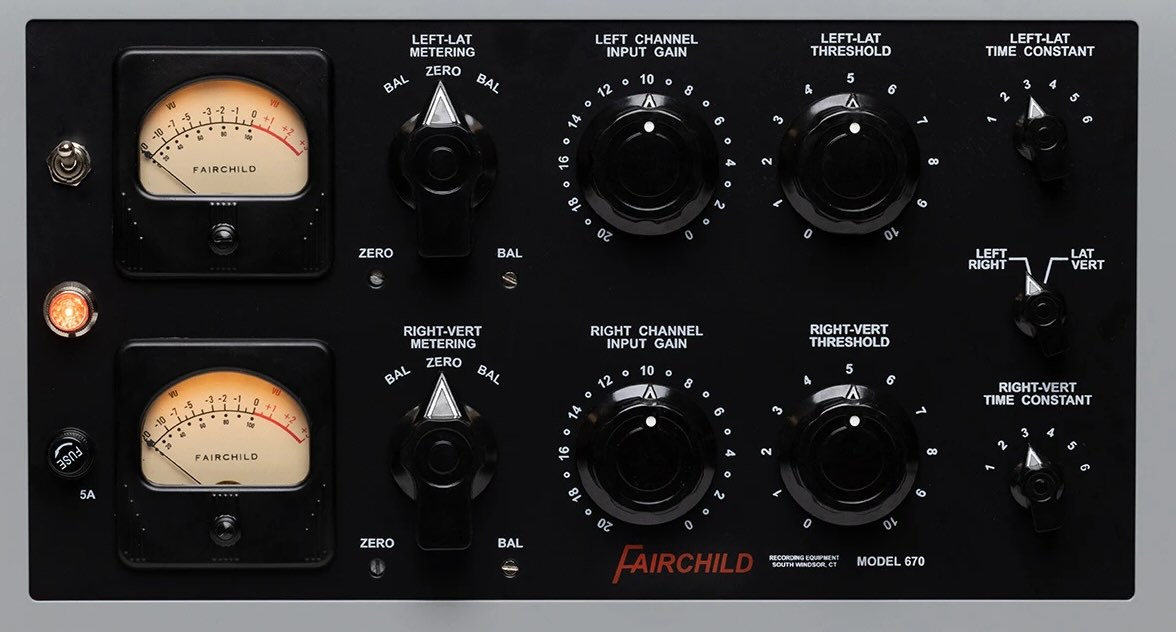
The reference is the Fairchild 670, one of the most sought-after pieces of equipment in audio history. Used primarily in mastering and on the mix bus of high-end productions.
Quick guide: which compressor type for each situation
- Mix bus, precise control: VCA (SSL G, API 2500).
- Vocal with presence and character: FET (1176) or optical (LA-2A).
- Smooth, natural vocal: Optical (LA-2A).
- Snare and percussion with punch: FET (1176) with slow attack.
- Bass with dynamics control: VCA or optical.
- Mix bus with warmth: Vari-Mu (Fairchild, Manley Variable Mu).
- Aggressive parallel compression: VCA or FET with extreme settings.
Parallel compression
Parallel compression (also known as New York compression) blends a compressed signal with the original uncompressed signal. Rather than inserting the compressor directly in the signal chain, a copy is sent to a parallel bus where very aggressive compression is applied, and that compressed signal is then blended underneath the original.
The result differs from direct compression: the compressed signal adds density, body and sustain, while the original signal preserves the natural transients. The ratio between the two signals controls the balance between punch and density.
It is particularly effective on:
- Drum bus: Adds energy and glue without flattening the punch of the close microphones.
- Bass: Adds sustain and consistency without removing the attack of the notes.
- Vocals: Adds presence and density while maintaining the naturalness of the performance.
Many modern plugin compressors include a Mix (or Wet/Dry) parameter that allows parallel compression to be done internally without setting up an additional bus.
Sidechain: triggering compression with another signal
The sidechain is an auxiliary input on the compressor that allows gain reduction to be triggered by a different signal from the one being compressed. Instead of the channel signal compressing its own level, an external signal fires the compression.
The most common mixing applications are:
- Kick-bass ducking: The kick drum triggers compression on the bass channel. Every time the kick hits, the bass dips slightly in level, creating space for both to be heard clearly without occupying the same space. A very common technique in electronic and dance music.
- Music ducking under narration: In podcasting, advertising or audiovisual work, the vocal triggers compression on the background music, making it automatically dip when speech is present.
- Sidechain filter: Many compressors allow a filter to be inserted in the sidechain detection chain. The most common use is a high-pass filter to prevent kick drum bass from over-triggering compression on the mix bus.
Channel compression vs. bus compression
Compression can be applied in two different contexts with different objectives:
- Channel compression (insert): Applied directly in the signal chain of an individual channel. Its purpose is to control the dynamics of that specific instrument, add character or modify the sound's envelope.
- Bus or subgroup compression: Applied to the main mix bus or a subgroup (drum bus, vocal bus). Its purpose is to provide cohesion and glue to the elements passing through that bus, making them sound like an integrated whole. Bus compression is usually gentler (ratios of 2:1 to 4:1, few dB of gain reduction) than channel compression, because it is not trying to control the dynamics of any individual element but to unify the ensemble.