Mixing is the process that transforms a collection of recorded tracks — each with its own sound, level and position — into a coherent, balanced result that can be heard as a complete musical piece. It is the phase where all the previous technical decisions — room acoustics, microphone choice, gain staging, editing — converge into a single final audio file. And it is also where the purely musical work of building the sonic space of the song begins.
What mixing is and what it is not
Audio mixing is the process of combining multiple audio tracks into a single stereo file — or multichannel, in the case of film or immersive audio — by adjusting the volume, panning, equalisation, dynamics and effects of each element so that the whole sounds balanced, clear and aligned with the desired artistic intention.

What mixing is not:
- It is not mastering: mastering is the subsequent process that optimises the finished mix for distribution. They are two distinct phases with distinct objectives.
- It is not recording: although on smaller projects the same person handles both tasks, mixing well requires listening with fresh ears, free from the emotional weight of the recording session.
- It is not correcting recording errors: a mix cannot save a recording with serious pitch, timing or noise problems. Editing and cleaning come first.
The goal of mixing
The fundamental goal of a mix is to create clarity, balance and space so that each element of the production can be heard and fulfil its musical role without getting in the way of the others.
In practice, this means solving four simultaneous problems:
- Volume balance: No element should be so loud that it masks the others, nor so quiet that it disappears. The relative level between elements defines the musical hierarchy of the mix.
- Distribution in the stereo space: Elements should be spread coherently between left, centre and right, creating a wide and balanced stereo image.
- Frequency separation: Each instrument should occupy its frequency range without clashing excessively with the others. When two elements compete in the same frequency region, both lose clarity and presence.
- Dynamics control: The quiet and loud moments of the song should be well balanced, and the level variations within each track should be musically coherent.
Beyond these four technical problems, mixing has an equally important artistic dimension: telling the song's story. Which element leads at each moment, where there is tension and where there is space, how the energy evolves through the sections. These are creative decisions made by the mixing engineer in collaboration with the artist and producer.
Static mix and dynamic mix
A professional mix is built in two complementary phases:
Static mix
The static mix is the starting point: adjusting volume faders, panning and processing inserts without any movement over time. It is the reference balance on which everything else is built. Its goal is to make the mix sound good at the densest point of the song (typically the second chorus) without any automation.

When the static mix sounds good, any remaining problems are problems of composition or arrangement, not of mixing. When it does not sound good in static form, automation will not fix it.
Dynamic mix (automation)
The dynamic mix adds movement over time through automation: faders rise and fall, effects switch on and off, plugin parameters change at specific points in the song. Automation serves to:
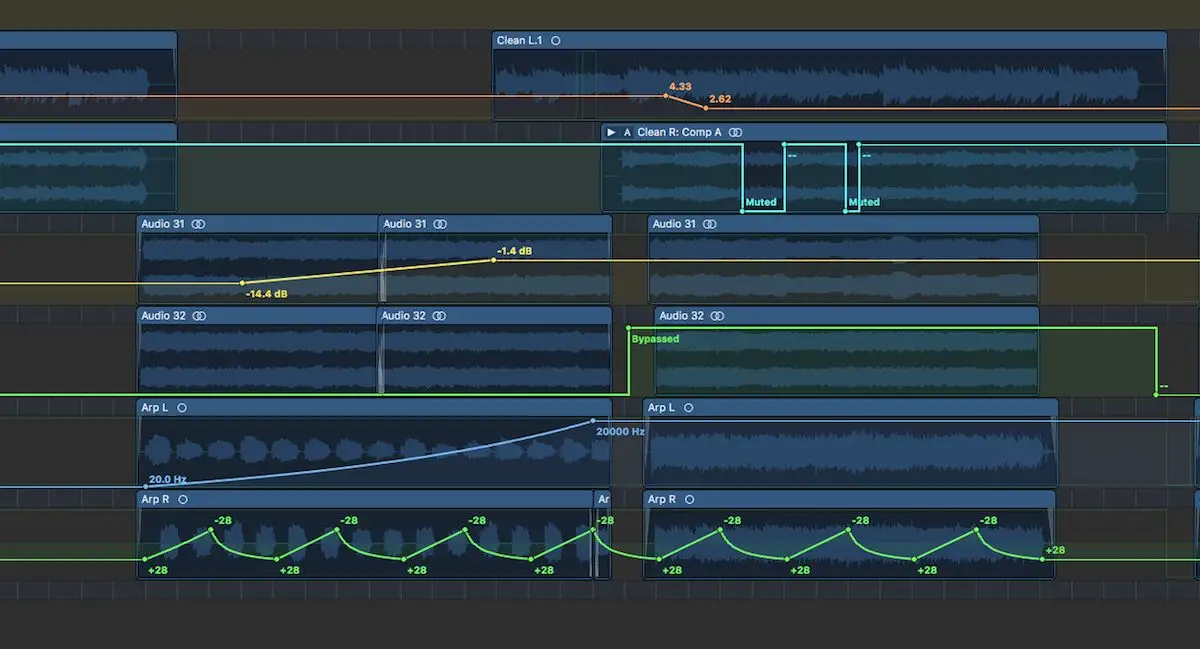
- Keep the vocal consistently present and audible, section by section.
- Create contrast between verses (more space, quieter) and choruses (denser, louder).
- Highlight specific elements at specific moments (a guitar solo, a piano phrase).
- Clean up the space in the silences between vocal phrases.
The basic mixing workflow
There is no single correct order for mixing, but there is a logical sequence that most professional engineers follow as a starting point:
- 1. Session preparation: Verify that all tracks are correctly named, organised and edited. Assign groups and buses. Adjust gain staging on all channels so the main bus has sufficient headroom.
- 2. Volume balance without processing: Pull all faders down to zero and build the balance from scratch, channel by channel, with no active plugins. This step immediately reveals which elements are most important and which are competing.
- 3. Basic panning: Distribute elements in the stereo field: rhythmic instruments in the centre, fill elements towards the sides, vocals always centred or near-centred.
- 4. Dynamics processing: Compression and gates on the channels that need them to control peaks and level variations.
- 5. Equalisation: Shape the tone of each element and create frequency separation between those competing in the same range.
- 6. Time effects: Reverb and delay to add space and depth to elements that need it.
- 7. Bus and subgroup processing: Compress and equalise complete sections (drum bus, vocal bus) to give them internal cohesion.
- 8. Automation: Add fader and parameter movements to better serve the song section by section.
- 9. Mix bus: Light processing on the main bus to unify the sound of the mix.
- 10. Referencing and final adjustment: Compare the mix with commercial references from the same genre to verify frequency balance and relative loudness level.
The four axes of sonic space in mixing
- Left-right (panning): The horizontal position of each element in the stereo image.
- Up-down (frequency): The frequency range each instrument occupies in the spectrum.
- Near-far (level and reverb): The sense of distance of each element relative to the listener.
- Before-after (time): The position of each element in the timeline and its relationship with the groove.
In-the-box mixing and analogue mixing
Mixing can be done in two ways:
- In the box: All processing happens inside the DAW using software plugins. This is the predominant method today for its flexibility, its capacity for total recall (a mix can be picked up exactly where it was left), its lower cost and the continual improvement in quality of modern plugins.
- Out of the box (analogue): Tracks from the DAW are sent through the audio interface to an analogue console or outboard processors (rack compressors, equalisers), where they are physically mixed. This adds the sonic character of analogue hardware but loses the possibility of exact recall and requires a far more costly infrastructure.
Many engineers use a hybrid approach: mixing primarily in the box but sending the main bus or certain key elements through analogue compressors or equalisers to add character and "glue" before returning to the DAW for the final conversion.
Headroom, mono compatibility and export
Headroom
During mixing, it is essential to preserve headroom on the main bus: sufficient margin between the highest peak level and the 0 dBFS limit. The standard reference is that main bus peaks should not exceed -6 dBFS (and the integrated LUFS level should sit between -18 and -14 integrated LUFS) before sending the mix to the mastering engineer. A mix that arrives at mastering hitting 0 dBFS cannot be processed without distortion.
Mono compatibility
Collapsing the mix to mono is one of the most important checks in the process. Many playback systems — Bluetooth speakers, phones, small PA systems — reproduce in mono. If there are phase issues in the mix (elements that cancel when summed), the mono result can be radically different from the stereo: the bass disappears, guitars become hollow or the vocal loses presence. Verifying mono compatibility before declaring the mix finished is a habit of professional engineers.
Export
The final mix is typically exported as:
- WAV or AIFF, 24 bit, at the project sample rate (44.1 kHz or 48 kHz): the standard delivery format for mastering.
- Without a limiter on the main bus: the mastering engineer needs the mix with its dynamics intact to work correctly.
- With sufficient headroom: peaks no higher than -6 dBFS.