Headphones are an essential tool in any recording studio, though their role differs from that of monitors. They are not intended as the primary mixing reference, but as a complement: to let musicians hear the reference mix during recording, to help the engineer check details that speakers may mask, or to work in environments where monitors are not an option. Understanding which type of headphone suits each situation prevents technical errors and improves the studio workflow.
Types by acoustic capsule design
The most important distinction between studio headphones is the design of the housing surrounding the driver capsule, which determines how sound behaves inside and outside the headphone.
Closed headphones
Closed headphones have a completely sealed housing. That airtight chamber isolates sound in both directions: external noise does not enter and audio from the headphones does not escape.
They are essential during recording sessions. When a musician records their part while listening to a reference mix, it is critical that the headphone sound does not leak into the microphone and contaminate the take. A pair of closed headphones with good isolation prevents this problem.
Other advantages of closed headphones:
- They allow work in noisy environments without external sound interfering with the listening experience.
- They typically offer a more robust bass response than open designs at the same price point.
- They are suitable for live sound engineers who need to monitor in very noisy environments.
Their main limitation in a mixing context is that the sealed chamber can produce a slightly artificial sonic image and a brief capsule-level RT60 that lightly colours the listening experience. This is not a problem for recording, but it does limit their reliability as a mixing reference during long sessions.

Open headphones
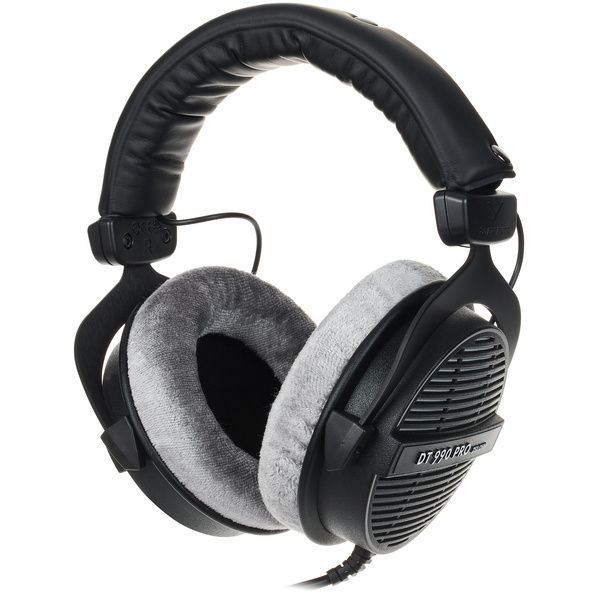
Open headphones have a perforated housing that allows air to flow freely through the capsule. Sound can escape to the outside and external noise can enter. This opening has very significant sonic consequences: the absence of a sealed chamber eliminates the colouration inherent to a closed design and produces a more natural, spacious and less fatiguing sonic image during long sessions.
They are the preferred option for mixing and mastering when the environment allows it — that is, when there is sufficient quiet and no active microphone nearby. They offer a more accurate representation of stereo space and mix dynamics.
However, they are entirely unsuitable during recording: the monitoring mix escapes through the perforated housing and is picked up by the microphone, ruining the take.
Semi-open headphones
Semi-open headphones have a partially perforated housing that offers a balance between the isolation of closed designs and the sonic naturalness of open ones. They provide some isolation — though not as much as closed headphones — and a more open sonic image than closed designs without reaching the transparency of fully open ones.
They are a versatile option for studios where separate pairs for each use are not available: they work for recording sessions where bleed is not critical (electronic instruments, overdubbing at low monitoring levels) and for mixing in environments with some ambient noise. The AKG K240 Studio is one of the longest-established and most widely used semi-open models in studios worldwide.
Types by ear coupling
Regardless of acoustic design, headphones are also classified by how they rest on the ear:
- Circumaural (over-ear): The pad completely surrounds the outer ear without touching it. This is the standard design in professional studio headphones: it offers greater comfort during long sessions, better passive isolation and more controlled bass response by creating a larger acoustic chamber around the ear.
- Supra-aural (on-ear): The pad rests directly on the outer ear. These are lighter and more compact but offer less isolation and can become uncomfortable during extended sessions due to pressure on the cartilage. Less common in professional studios.
Impedance and sensitivity: key parameters
Impedance
Impedance, measured in ohms (Ω), is the electrical resistance the headphones present to the audio signal. It determines how much power the source (the interface, console or external amplifier) needs to drive them to an adequate working volume.
In practice:
- Low impedance (16–32 Ω): Easy to drive. Works well directly from basic interfaces, laptops or mobile devices. The right choice when no powerful headphone output is available.
- Medium impedance (50–80 Ω): The most common range in mid-range studio headphones. Most modern interfaces drive these without difficulty.
- High impedance (150–300 Ω): Requires more power. Can sound quiet and thin when connected to a basic interface. Preferred in professional environments with powerful headphone outputs or dedicated amplifiers, because they offer lower distortion and greater driver control across the dynamic range.
The beyerdynamic DT 770 Pro, DT 880 Pro and DT 990 Pro — three of the most widely used studio headphones in the world — are manufactured in 32 Ω, 80 Ω and 250 Ω versions precisely to suit different working environments.
Sensitivity
Sensitivity (expressed in dB SPL/mW) indicates how much volume the headphones produce per milliwatt of power received. High sensitivity means the headphones produce more volume with less power. Together with impedance, it determines whether a given source can drive the headphones to an adequate working level.
As a general rule, high-impedance, low-sensitivity headphones require more power; low-impedance, high-sensitivity headphones are easy to drive from any source.
When is a headphone amplifier needed?
A headphone amplifier is needed when the interface or console's headphone output cannot deliver sufficient power to drive the chosen headphones to an adequate working level. The symptoms are clear: low level even with the volume knob at maximum, lack of body in the bass and a thin, undynamic sound.
High-end interfaces (such as Universal Audio's Apollo range or Audient's iD series) typically include powerful enough headphone outputs for 250 Ω headphones. Entry-level interfaces, however, are generally optimised for low impedances. If high-impedance headphones are regularly used with a basic interface, an affordable dedicated external headphone amplifier resolves the issue and significantly improves the listening quality.
Headphones in the studio workflow
In a well-equipped studio, headphones are not a single tool: there are typically different pairs for different stages of the process.
During recording
The musician needs to hear a headphone mix (cue mix or monitor mix) while recording their part. The engineer builds that mix from the console or interface via an auxiliary bus, and it can be completely different from the engineer's own mix. Closed headphones are mandatory to prevent bleed into the microphone.
In sessions with several musicians recording simultaneously, each performer has their own headphone mix with different levels. Headphone distribution systems (headphone amplifiers or headphone splitters) allow several pairs to be fed from a single source with independent mixes.
During editing and mixing
Headphones are useful as a secondary reference during mixing: they help detect editing artefacts (clicks, cuts, noise) that monitors may mask, check panning details and verify how the mix behaves on an intimate playback system. However, they should not be the primary reference for level, panning or tonal processing decisions, because the stereo image in headphones differs from that on monitors.
During mastering
Some mastering engineers use high-resolution headphones as an additional reference. In this context, open high-impedance headphones offer the greatest detail and least colouration. Some software tools (crossfeed, binaural rendering) attempt to correct the differences between headphone and monitor listening, with varying degrees of success.
Summary: which headphone type for each situation
- Recording with an active microphone: Closed, always.
- Mixing in a quiet environment: Open (greater naturalness and less fatigue).
- Mixing in a noisy environment: Semi-open or closed.
- Editing and detail checking: Closed or semi-open.
- Live sound engineer: Closed (maximum isolation from the surroundings).
If you want to explore and compare specific models, our studio headphone comparator lets you filter by type, impedance and price to find the one that best suits your workflow.

