Studio microphone technique shares the same physical foundations as live sound microphone technique — transducers, polar patterns, impedance — but its priorities are radically different. On stage, robustness and feedback rejection are the dominant criteria. In the studio, what matters is tonal fidelity, the microphone's sonic character and the ability to capture maximum detail in an acoustically controlled environment. That shift in priorities leads to the use of microphone types and recording techniques that rarely appear in a live sound context.
Large diaphragm vs. small diaphragm
The most important distinction in studio microphone technique is not between dynamic and condenser, but between large diaphragm (LDC, Large Diaphragm Condenser) and small diaphragm (SDC, Small Diaphragm Condenser). Both are condensers, but their acoustic behaviour is significantly different.
Large-diaphragm condenser (LDC)
Defined by a capsule of 25 mm (1 inch) or more. It is the studio microphone par excellence: the one found in virtually every vocal session, and the one that contributes most to the "studio sound" we recognise in professional recordings.
Its most relevant characteristics are:
- Better signal-to-noise ratio: A larger capsule generates a stronger electrical signal for the same sound pressure. That higher signal above the same preamplifier noise floor translates into superior signal-to-noise ratio, particularly relevant for low-level sources such as vocals or quiet acoustic instruments.
- More pronounced and musical proximity effect: Moving the LDC close to a source produces a deeper, more enveloping bass boost than a small-diaphragm microphone. On vocals, this adds body, presence and that sense of "depth" sought in vocal recordings.
- Own sonic character: LDCs typically have more pronounced colouration than SDCs, particularly in how they represent midrange and transients. That colouration is part of their appeal: different models have different "voices" that flatter different vocalists or instruments.
- Side-address orientation: The vast majority of LDCs are side-address microphones (the source points at the side of the capsule, not the end of the body), which affects their positioning on the microphone stand.
The standard choice for vocals, acoustic guitar (with nuances), piano and any source where a rich, present and characterful sound is sought.
Small-diaphragm condenser (SDC)
Defined by a capsule of 12–15 mm. More neutral, more precise and more consistent in its off-axis response than the large diaphragm. Where the LDC colours, the SDC reveals.
Its main characteristics are:
- Faster transient response: A smaller, lighter membrane follows fast transients with greater fidelity. This makes it ideal for instruments with percussive attacks: fingerpicked acoustic guitar, cymbals, xylophone, percussion.
- More consistent off-axis response: The SDC's polar pattern remains more uniform in frequency when the source is not on the main axis. This is critical in stereo techniques: SDCs in XY or ORTF pairs produce a more accurate and coherent stereo image than LDCs.
- Greater tonal neutrality: The SDC introduces less of its own colouration, making it ideal when the goal is to capture the instrument as it sounds, without the character added by an LDC.
- End-address orientation: Most SDCs are end-address (the source points at the tip of the microphone body), like a pencil.
Preferred for drum overheads, acoustic guitar with high detail, piano in stereo pairs, string instruments and any stereo application where phase coherence is the priority.

The ribbon microphone
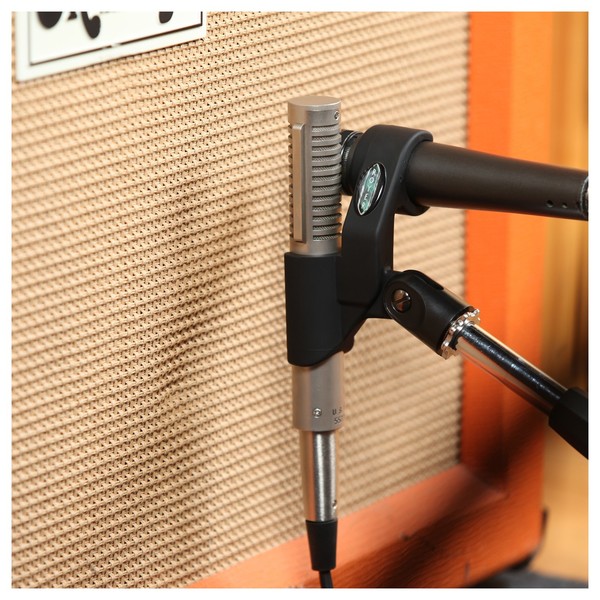
The ribbon microphone is the third major transducer type in the studio, radically different from the others in its operating principle and sonic character. While a dynamic uses a coil and a condenser uses an electrostatic capsule, the ribbon uses a thin aluminium strip (the ribbon) suspended in a magnetic field. When sound waves move the ribbon, its motion in the magnetic field generates the electrical signal by electromagnetic induction.
Its sonic characteristics are very specific:
- Warm, smooth high-frequency response: The ribbon's high-frequency response falls off naturally and gradually, without the brightness or presence peak of condensers. The result is a sound many describe as "vintage", "analogue" or "musical".
- Excellent transient response: Despite the smoothness in the highs, the ribbon captures transients with great fidelity, without the artificial "snap" that some condensers add.
- Figure-of-8 polar pattern: The natural pattern of the ribbon microphone by design: it picks up equally from front and rear, completely rejecting the sides. This makes it ideal for the Blumlein technique and the Mid-Side technique.
- Maximum fragility: The ribbon is an extremely thin and delicate element. Passive ribbon microphones do not accept phantom power: applying +48V to a passive model can destroy the ribbon instantly. They also do not tolerate strong air currents or physical impact. Modern active ribbon models do accept phantom power, but the manufacturer's specifications must always be verified.
- Very low output level: Passive ribbon microphones generate very weak signals that require preamplifiers with high gain and low self-noise. A signal booster (such as a Cloudlifter) may be necessary with entry-level preamps.
Used primarily for electric guitars (softens amplifier brightness without losing body), brass instruments (trumpet, trombone), vocals requiring smoothness, strings and as a room microphone in the recording space.
Stereo recording techniques
Unlike live sound, where virtually all microphone placement is mono (one microphone per source), the studio allows — and often requires — stereo recording techniques that capture the spatial image of the source or the acoustic character of the recording room. These techniques are particularly relevant for piano, acoustic guitar, drum overheads, choirs, strings and ensemble recordings.
Coincident pair: XY
Two cardioid microphones with capsules at the same physical point (or as close as possible), at an angle of between 90° and 135° between their axes. Since they are at the same point, there is no time difference between the two channels: the stereo image is created exclusively by level differences.
Advantages: perfect mono compatibility (no phase cancellations when summed), easy to set up and transport, controlled and stable stereo image.
Limitation: the stereo image is somewhat narrower and less enveloping than techniques with physical separation.
Typical use: drum overheads, piano, acoustic guitar, choirs.
Near-coincident pair: ORTF
Technique developed by the French Broadcasting Organisation (ORTF). Two cardioid microphones separated by 17 cm between capsules and opened at 110°, mimicking the spacing and angle of human ears. Combines level differences and time differences.
Advantages: more natural and spacious stereo image than XY, good source localisation, very compatible with the human auditory system.
Limitation: introduces a small time difference that can produce minor phase imperfections when collapsed to mono, though generally manageable.
Typical use: acoustic recordings, chamber music, piano, choirs, ambiences.
Spaced pair: A/B
Two microphones (cardioid or omnidirectional) physically separated by between 30 cm and several metres, depending on the desired image width. The stereo image is created primarily by time differences between the two channels.
Advantages: very wide and enveloping stereo image, excellent room ambience capture.
Limitation: the time difference between channels can cause phase problems when collapsed to mono. The greater the separation, the greater the risk.
Typical use: orchestral recordings, large choirs, room ambience, very large instruments (grand piano, organ).
Mid-Side (M-S)
A technique using two microphones with different patterns: a cardioid pointing at the source (the Mid channel) and a figure-of-8 microphone rotated 90° (the Side channel). The signals from both microphones are decoded in post-production (by summing and subtracting the Side channel) to obtain the left and right channels.
The most valuable characteristic of M-S is that the stereo image width is controlled in post-production simply by adjusting the level of the Side channel: more Side means wider image; less Side means a more centred image. This gives complete control over the stereo space without the need to re-edit the recording.
In addition, the M-S technique is perfectly mono-compatible by design: when the resulting L+R channels are summed, the Side channel cancels completely, leaving only the Mid, which is the direct signal of the source.
Typical use: situations where mono compatibility is critical (broadcast, radio), room ambiences that need to be adjustable in post-production, acoustic guitar or vocal solos where stereo width control is desired.
Blumlein pair
A coincident pair variant proposed by Alan Blumlein: two figure-of-8 microphones at the same point, crossed at 90°. It captures the front source, the rear source and both sides, producing an extraordinarily natural and three-dimensional stereo image.
It is an acoustically demanding technique: the room must sound good, because the Blumlein pair captures the entire surrounding space. It is common in classical recordings, chamber music and situations where the room sound is part of the desired result.
Summary: which stereo technique for each situation
- XY: Drum overheads, piano, acoustic guitar. Maximum mono compatibility.
- ORTF: Acoustic music, chamber music, piano. More natural image than XY.
- A/B: Orchestra, large choirs, wide ambiences. Very wide image.
- M-S: Width control in post-production. Perfect mono compatibility. Broadcast.
- Blumlein: Chamber music, classical recordings in a room. Requires good acoustics.
Room microphones
In addition to the close microphones that capture each instrument individually, the studio allows the addition of room microphones: one or more microphones placed at a greater distance from the source, typically in the recording room, which capture the instrument's sound already blended with the acoustics of the space.
Room mics add to the mix that sense of depth and of "being in a real space" that close mics alone cannot provide. Mixed with discretion, they contribute air, cohesion and dimension to recordings. In drum recordings, room mics are frequently the microphones that contribute most to the final character of the kit's sound.
The choice of room mic varies according to the desired result: a pair of large-diaphragm condensers in a stereo configuration captures the room sound with maximum detail; a pair of ribbon microphones in a Blumlein configuration produces a warmer and more enveloping ambience; even a single dynamic microphone placed very far away can contribute a raw, compressed character that is highly sought after in certain genres.
How to choose the right microphone for each source
There is no universal rule: the choice depends on the desired sound, the character of the instrument and the acoustics of the room. However, there are practical starting points that work as reference:
- Vocals: LDC cardioid as the first choice. Ribbon for voices that need smoothness or warmth. Dynamic (SM7B, for example) for very powerful voices or genres where a more direct character is sought.
- Acoustic guitar: SDC for maximum detail and transient response; LDC for more body and colour. Often both are combined.
- Electric guitar (amplifier): Dynamic (SM57) as the foundation; ribbon to soften; condenser at greater distance for room ambience.
- Drums (close mics): Dynamics for kick and snare; SDC or clip mics for toms; SDC in XY or ORTF pair for overheads.
- Piano: SDC pair in XY or ORTF for maximum detail; LDC pair for more character.
- Brass: Dynamic or ribbon to soften natural brightness; condenser if brightness and projection are desired.
- Strings (violin, viola, cello): LDC or SDC at medium distance; ribbon for smoothness and naturalness.
If you want to explore and compare specific models by type, polar pattern and price, our microphone comparator lets you filter between large-diaphragm, small-diaphragm and ribbon models to find the one that best suits your studio.

