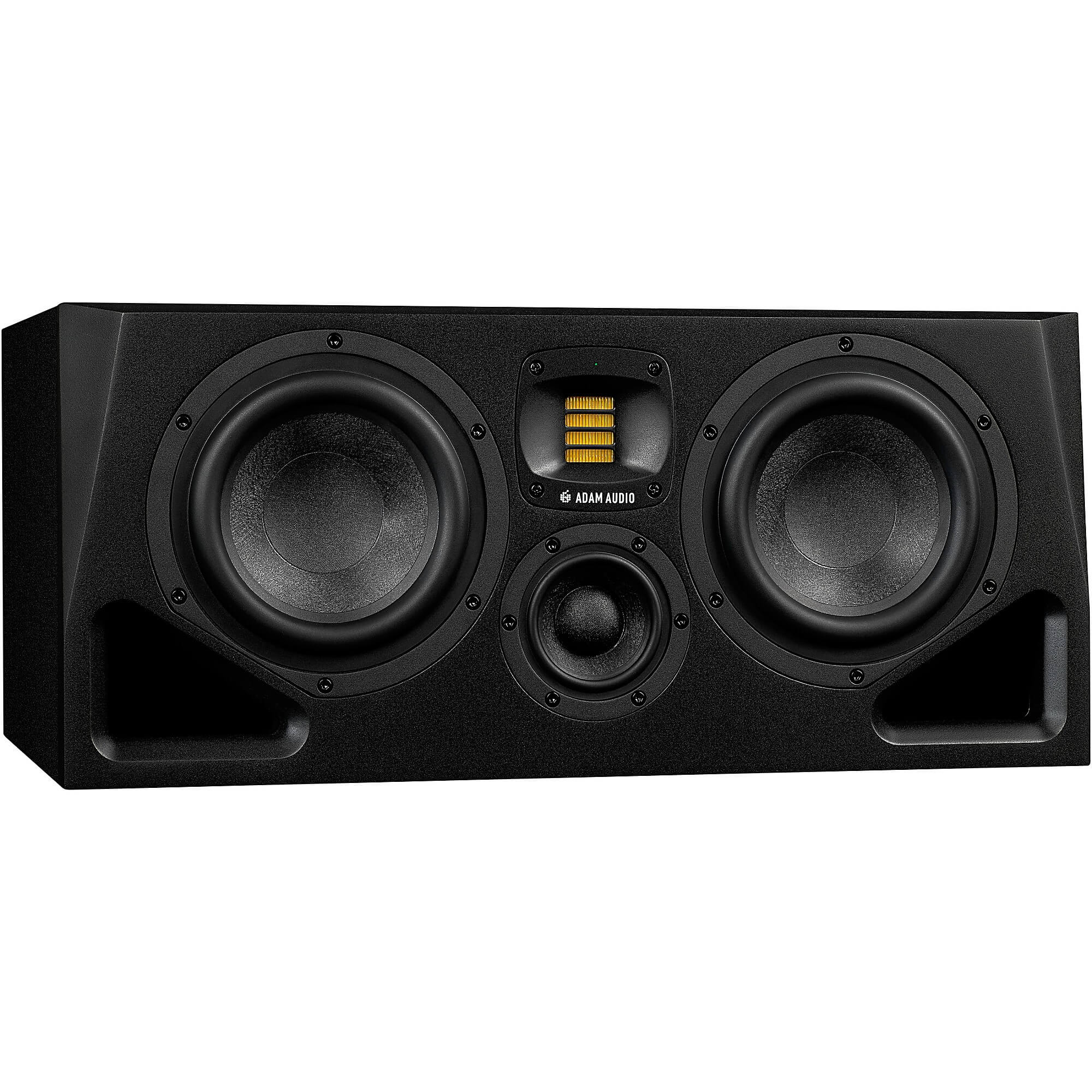
To understand audio signal levels, it is essential to realize that an audio signal is an exact electrical representation of a sound wave. In professional workflows, signals transition through different states of intensity or "levels" to be processed, recorded, or reproduced.
Mic Level
Mic level is the starting point in the audio chain for capturing acoustic sounds, such as voices or instruments.
A microphone acts as a transducer, meaning it converts physical changes in air pressure (sound waves) into electrical currents within a cable. These currents are extremely weak and subtle, typically in the range of millivolts (mV). Due to this low intensity, it is the most fragile of all audio signal standards.
Since a microphone's signal is so low, it cannot be directly processed by most audio equipment. Therefore, it is imperative to use a microphone preamplifier.
Its goal is to significantly amplify the weak mic level signal to raise it to line level, which is the standard for transmission and processing between professional equipment. This adjustment is made using a potentiometer or gain knob on the interface or console. It is a fundamental step: if the gain is insufficient, the signal will be lost in the background noise; if it is excessive, distortion or signal clipping (saturation) will occur.
Balanced Lines
Being very low voltage signals, microphone levels are highly susceptible to electromagnetic interference. In professional environments, this is mitigated through the use of balanced lines (usually XLR connectors), which protect the integrity of these millivolts during their journey from the microphone to the preamplifier.
Their main advantages over unbalanced lines (common in consumer audio) are as follows:
-
Electromagnetic interference rejection: Unlike unbalanced lines, which do not completely eliminate external interference, balanced lines are designed to protect the signal against electromagnetic noise.
In professional audio, where long cables are often required, using unbalanced lines would cause such a high cumulative effect of interference that the distortion would make the sound poor quality or "unbroadcastable."
- Elimination of ground loops: Unbalanced lines are prone to forming so-called ground loops because their outer shield is connected to ground at both ends. Professional balanced systems mitigate this problem, avoiding annoying background noises (like hums) in the audio chain.
-
Maintenance of nominal voltage level: The professional level standard of +4 dBu (1.23 V RMS) is intrinsically linked to the balanced signal. To obtain this correct voltage measurement, the signal must be measured between the positive (+) and negative (-) pins (for example, pins 2 and 3 of an XLR connector). If the signal is measured relative to ground (pin 1), the resulting voltage value will be lower, demonstrating that a balanced structure is necessary to reach the optimal power and performance of professional equipment.

- Suitability for weak signals: Since microphones and instruments generate very low signals (in the order of millivolts), they are extremely susceptible to noise. The use of balanced connections (frequently through Direct Injection boxes or DI boxes) allows these weak signals to be transported safely to preamplifiers without becoming contaminated by external interference during the journey.
Instrument Level
Instrument level is an electrical signal produced by electric or electronic musical instruments, such as guitars, basses, and some keyboards, which requires specific treatment before being professionally processed.
Instruments use pickups (like guitar pickups) to convert the mechanical vibrations of strings or internal elements into electricity. Like microphones, these signals are extremely weak, typically in the range of millivolts (mV).
Because the voltage is so low, working directly with this signal level presents significant risks:
- Vulnerability: These signals are very sensitive to electromagnetic interference and external noise.
- Signal-to-Noise Ratio (SNR): If not correctly amplified immediately, background noise can become almost as loud as the music, degrading audio quality.
- Impedance: Although the voltage is low, the output impedance of instruments like electric guitars is very high, requiring specific inputs to avoid losing high frequencies or power.
For an instrument signal to travel through a mixing console or audio interface without degrading, it must be raised to line level. This is achieved through:
- Specific Preamplifiers: Devices designed to receive the instrument's high-impedance signal and amplify it to the optimal standard (such as +4 dBu).
- DI Boxes (Direct Injection): They are essential for converting unbalanced instrument signals into balanced mic-level signals, allowing them to be connected to a console's preamps.
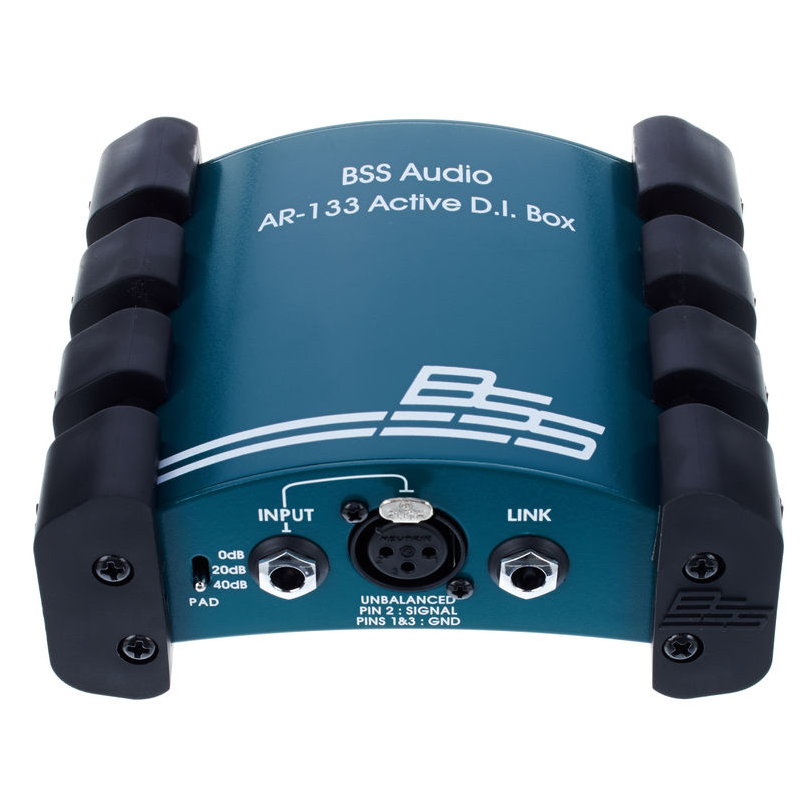
- "Hi-Z" or "Inst" Inputs: Many modern interfaces include direct inputs labeled "Inst" or "DI," which already feature the necessary circuitry to handle this signal level cleanly.
Line Level
Line level is the standard intensity used to transmit analog audio signals between the vast majority of processing devices, such as mixing desks, interfaces, effects processors, and players. It is considered the "optimal" working level in the signal flow.
Line level is not a single value but is divided into two standards defined by their nominal voltage and unit of measurement:
Consumer or Home Level (-10 dBV)
This is the standard for equipment such as DVD players, CD players, or televisions.
Its nominal signal is 0.316 V RMS (or 0.443V peak) and is based on 0 dBV, which equals 1V RMS.
It typically uses unbalanced lines with RCA, DIN, or TS jack connectors.
Why does consumer level use the -10 dBV reference?
The use of the -10 dBV reference for home or consumer level is based on the search for simplicity and its relationship with standard voltage and power values.
The dBV unit takes 1 Volt (RMS) as its absolute reference. This value was chosen because 1 V is a easy to measure and remember figure in the technical field.
It was defined this way so that 0 dBV would correspond exactly to 1 milliwatt (mW) of power when applied across a 1 kΩ (1000 Ohms) resistance. These values (1V, 1mW, 1kΩ) are considered "reasonable" and simple to handle for small signal equipment.
Professional Level (+4 dBu)
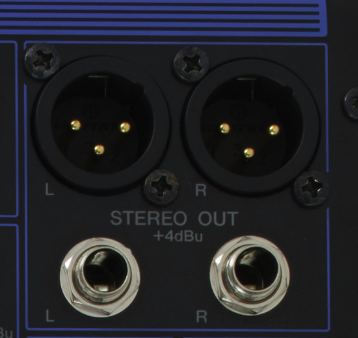
This is the standard used in recording studios and live sound.
Its nominal signal is 1.228 V RMS (or 1.74 V peak) and is based on 0 dBu, which equals 0.7746 V RMS. This measurement historically comes from the voltage needed to generate 1 mW of power across a 600 Ω load.
It typically uses balanced lines (XLR or TRS) to avoid interference and noise over long distances.
Line Level in Signal Flow
Line level acts as the midpoint of processing in an audio chain:
- Elevation: Microphone and instrument signals, which are very weak (millivolts), must be amplified by a preamplifier to reach line level so they can be processed without background noise degrading them.
- Processing: Once at line level (approx. 0.3 V to 2 V RMS), the signal can pass through consoles or outboard effects robustly.
- Output: Since line level does not have enough power to drive a speaker, it must finally pass through a power amplifier to become speaker level, which handles much higher voltage and current.
Speaker Level
Although line level is the standard for processing audio between equipment, it lacks the force necessary to feed a speaker. To reach speaker level, the line signal must pass through a power amplifier. This device takes the relatively weak line input and amplifies it significantly, generating an output with a much higher voltage and current.
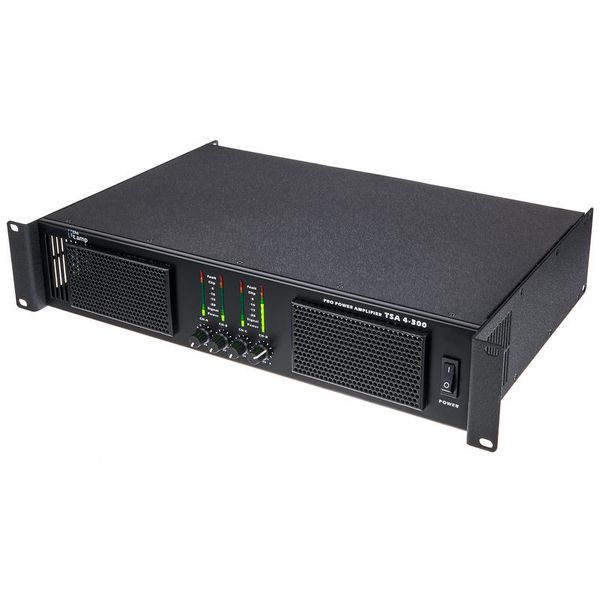
While microphone or line levels are primarily characterized by their voltage (measured in dBu or dBV), speaker level is measured and characterized by its power, expressed in watts (W).
The power an amplifier delivers is intrinsically linked to the impedance (electrical resistance) of the speaker it is connected to. For example, an amplifier will specify how many watts it generates across a typical 8-ohm or 4-ohm load. The exact amount of voltage at this level will depend directly on how much amplification is needed to move the speaker cone at the desired volume.
Unlike line or microphone cables, speaker cables require a much larger cross-section (thickness). This is vital to maintain a very low resistance in the cable (in the order of 0.04 to 0.08 Ω) to prevent losing a considerable part of the power before reaching the speaker.
The Transduction Process
The ultimate goal of speaker level is to perform the reverse process of the microphone, converting electrical fluctuations into changes in air pressure (sound waves).
While a single microphone is usually enough to capture the entire audible range (20 Hz to 20,000 Hz), reproducing it with fidelity at speaker level usually requires two or more specialized transducers (such as woofers for bass and tweeters for treble) working together.