In the audio chain of any professional stage, there is a discreet but indispensable device that bridges the world of instruments and the mixing console: the direct injection box. Its role goes far beyond a simple connector adapter. It solves one of the most common problems in live sound: how to transport an electric instrument's signal to the desk without tonal loss, without noise and over whatever distance is required.
What is a DI box and what problem does it solve?
A DI box (Direct Injection) is a device that performs two simultaneous conversions on an instrument's signal:
- From high impedance to low impedance: Electric instruments such as guitars and basses generate high-impedance (Hi-Z) signals, which are very sensitive to noise and poorly suited to travelling long distances. Professional mixing console inputs are designed to work with low impedance (Low-Z). The DI box acts as a bridge between these two worlds, adapting impedance so that the signal arrives clean and without tonal degradation.
- From unbalanced to balanced signal: An instrument's signal travels via an unbalanced mono cable (TS), which is highly susceptible to electromagnetic interference. The DI box converts it into a balanced XLR signal, allowing long cable runs without picking up noise or hum.
The result is that any electric instrument can be connected directly to a console mic input, at any distance, with a clean, balanced and interference-free signal.
Passive DI box
A passive DI box works exclusively via a transformer: an electromagnetic component that performs the impedance conversion and signal balancing without requiring any external power. No battery or phantom power is needed.

Its main characteristics are:
- Handles high-level signals very well without saturating unpleasantly.
- Produces a 'vintage'-style distortion when pushed, which is more musical and pleasant to the ear than transistor clipping.
- More robust and simple: with no active electronics, there are fewer components that can fail.
- The transformer provides natural galvanic isolation, effectively eliminating ground loops.
It is the recommended choice for instruments with active electronics: keyboards, synthesisers, digital pianos, active basses and electronic drum kits. These instruments already have a built-in preamplifier and generate line-level signals that a passive box's transformer handles with ease.
Active DI box
An active DI box incorporates active electronic components — typically transistors or integrated circuits — that amplify and condition the signal before sending it to the console. It requires external power, either from a 9V battery or the phantom power (+48V) supplied by the mixing console.

Its main characteristics are:
- Offers a very high input impedance, ideal for capturing the signal from passive high-impedance pickups without loss.
- Amplifies weak signals, compensating for the low output level of electric guitars and basses with passive pickups.
- Provides a very clean and transparent frequency response with minimal sonic colouring.
- When overdriven, transistors produce a more abrupt compression than a passive box's transformer, making it less suitable for high-level signals.
It is the most appropriate choice for passive, high-impedance instruments: electric guitars, basses with passive pickups, acoustic guitars with piezoelectric pickups, and jazz or acoustic instruments where maximum transparency and fidelity to the natural sound are required.
The opposites rule: how to choose between active and passive
In professional audio there is a widely accepted practical guide:
- Active source (keyboard, active bass, electronic drum kit) → Passive DI box. The signal is already boosted; the transformer handles it without saturating.
- Passive source (electric guitar, passive bass, acoustic guitar with piezo) → Active DI box. The signal is weak; the transistors amplify it and preserve the tone.
It is not an absolute rule — sometimes it is worth trying both options — but it is a reliable starting point for most situations.
Essential DI box functions
Ground-Lift: eliminating ground loops
The Ground-Lift switch is one of the most important controls on any DI box. When engaged, it physically disconnects pin 1 of the XLR output connector — the ground or shield pin — breaking the electrical path between the DI box and the console preamplifier.
Its purpose is to resolve ground loops: noise and hum caused by unwanted currents flowing between pieces of equipment connected to the same earth via different electrical circuits. If a persistent hum appears during soundcheck, toggling the Ground-Lift is the first step to diagnosing and, in most cases, eliminating it.
Pad: attenuation control
The Pad button reduces the input sensitivity of the DI box by a fixed value, generally between 15 and 20 dB. Its purpose is to prevent overly powerful signals from saturating the device's circuitry or the console's preamplifier, causing unwanted distortion.
It should be engaged when connecting instruments with active electronics (active basses, keyboards, synthesisers) to an active DI box, or whenever the input signal is strong enough to cause visible clipping on the console's level meter.
Thru or Link output: signal splitting
The Thru output (also called Link or Bypass) is a 1/4" jack output that provides an exact, unprocessed copy of the input signal. It splits the signal path into two simultaneous independent routes:
- The main XLR output sends the balanced, converted signal to the mixing console or PA system.
- The Thru output sends a copy of the original signal to the musician's stage amplifier, preserving their personal sound without interfering with the signal reaching the console.
It is particularly valuable for bassists and guitarists who need to maintain their own amplified sound on stage while the FOH engineer receives a clean, independent direct signal.
Stereo DI box
The stereo version of the DI box processes two independent signals simultaneously, preserving the instrument's stereo image intact. It is essential for any source with a stereo output: keyboards, synthesisers, digital pianos, drum machines and media players.
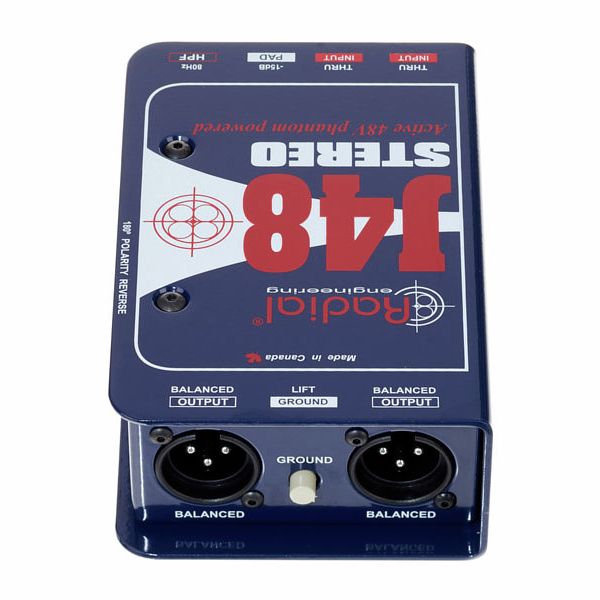
It functions exactly like two mono boxes in a single chassis, with the advantage that both channels share the same reference electronics, guaranteeing coherence between the left and right channels. It typically includes independent Ground-Lift and Pad controls per channel for precise adjustment of each signal.
Galvanic isolation: the invisible protection
Galvanic isolation is a condition of complete electrical separation between the input and output circuits of the DI box. It is achieved through the use of a transformer: its two independent coils transfer the signal electromagnetically, with no direct copper connection between the instrument's input and the output to the console.
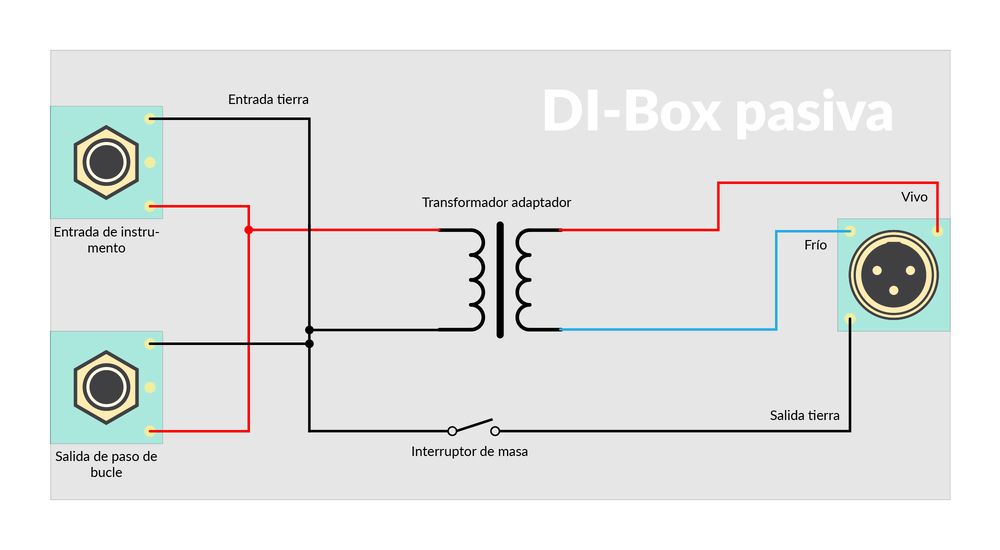
This physical separation has direct consequences for audio quality:
- It structurally interrupts ground loops, not just via the Ground-Lift switch.
- It blocks the passage of unwanted electrical currents that could filter through as noise in the audio chain.
- It protects the signal from external electromagnetic interference, especially in environments with many pieces of electrical equipment connected simultaneously.
Passive DI boxes provide galvanic isolation by design, thanks to the transformer. Active boxes based exclusively on transistors do not always offer this, although many quality models include an output transformer precisely for this reason.
