On a professional stage, the cable is the quietest link in the audio chain and, all too often, the most overlooked. Yet choosing the wrong connector, exceeding the appropriate cable length or using inadequate shielding can result in loss of quality, unwanted noise or even failures mid-show. Understanding the most common types of cables and connectors in live sound is essential for making the right technical decisions.
Balanced and unbalanced cables
Before cataloguing connectors, it is necessary to understand the structural difference between the two main types of audio line, as this directly determines the quality, the recommended maximum length and the susceptibility to noise of any connection.
Unbalanced cable
An unbalanced cable consists of two wires: one conductor carrying the signal and one ground wire closing the circuit. Because the shielding doubles as the signal return path, it is highly susceptible to picking up noise and electromagnetic interference from the surrounding environment. For this reason, these cables should be kept as short as possible, generally no longer than 5 to 10 metres.

Balanced cable
A balanced cable contains three wires: a positive signal ("hot"), a negative signal ("cold" — an inverted copy of the original signal) and an independent ground. At the receiving end, the equipment inverts the negative copy and adds it to the positive signal. Any noise picked up along the way is present on both conductors in the same phase and is therefore automatically cancelled in that inversion process. This allows cable runs of 15 metres or more without perceptible signal degradation.

Shielding: protecting the conductor
All audio cables incorporate some form of shielding to protect the signal from external interference. There are three main variants:
- Braided shielding: Interwoven wire strands around the conductor. The most durable and resistant to pulling, ideal for stage cables that receive heavy and repeated physical use.
- Spiral shielding: A flat wire strip wound in a spiral. More flexible and affordable than braided shielding, but less resistant to interference when the cable is bent or moved repeatedly, as the spiral can open and leave gaps.
- Foil shielding: A layer of aluminium Mylar providing complete coverage of the conductors. Offers total shielding but is the most fragile of the three. Reserved for patch cables or fixed installations that will not be moved.
Analogue connectors
XLR (Cannon)
The XLR connector is the undisputed standard for microphones, PA systems and the interconnection of professional equipment. Its balanced three-pin design allows cable runs of more than 15 metres without picking up noise or external interference. XLR connectors are typically metal-bodied with a locking mechanism that prevents accidental disconnection, making them particularly reliable on busy stages with a lot of crew movement.

The standard pin assignment is as follows: pin 1 is ground, pin 2 is the positive signal ("hot") and pin 3 is the negative signal ("cold").
1/4" jack (6.35 mm): TS and TRS
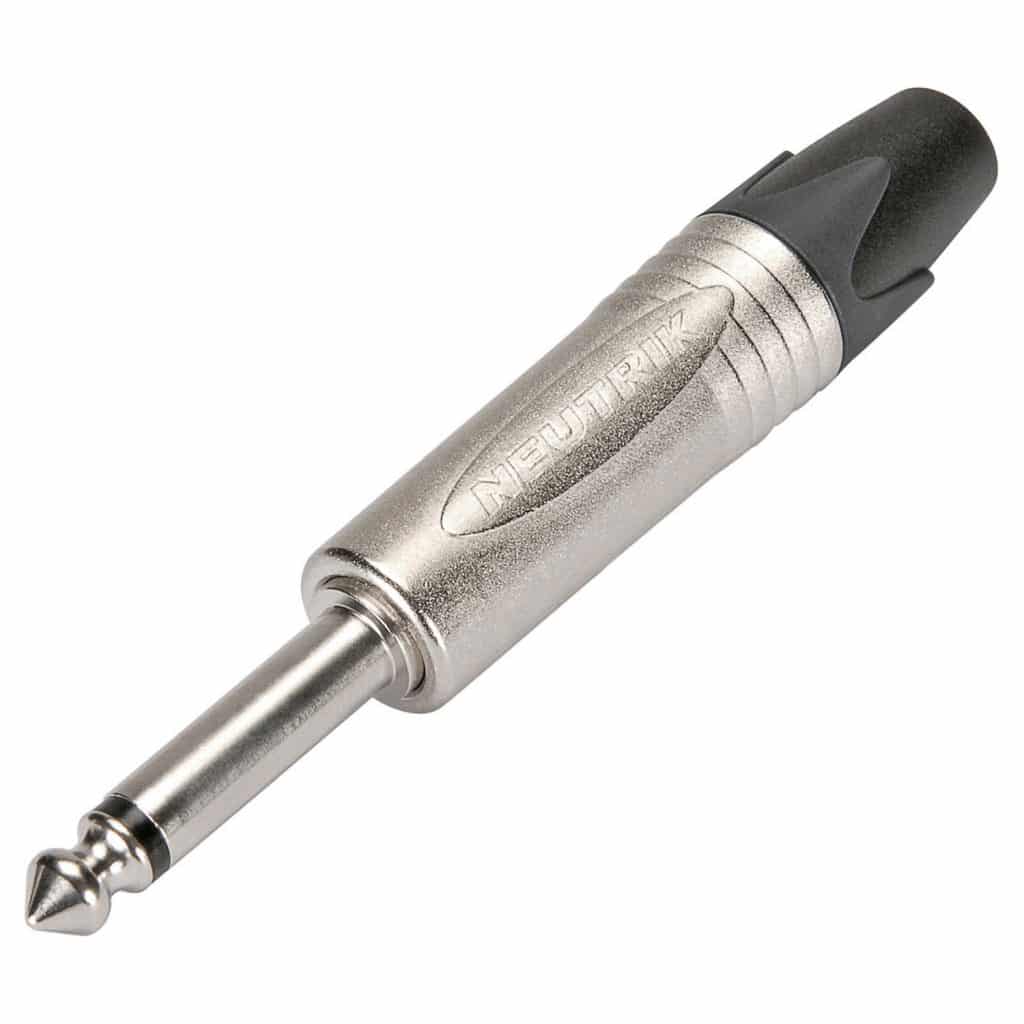
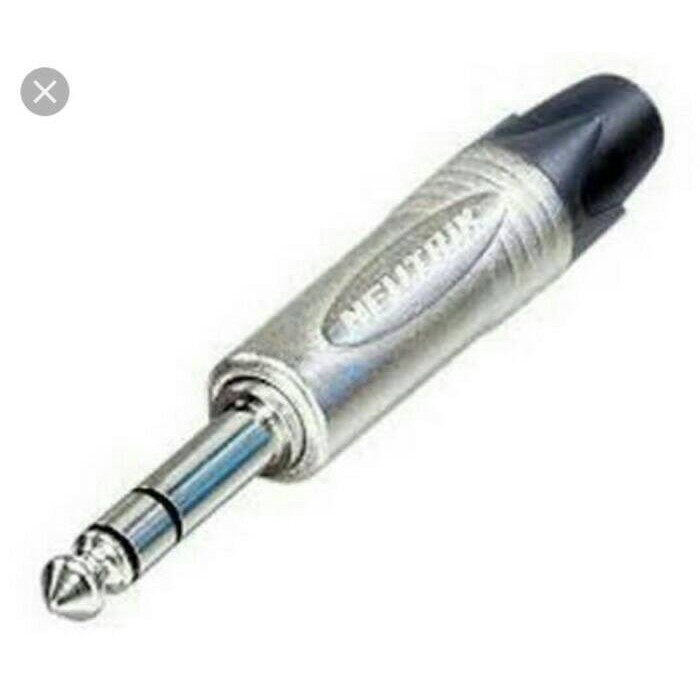
The 1/4" jack connector is the most versatile on the stage and comes in two variants that, although physically similar, serve different electrical purposes:
- TS (Tip-Sleeve): Two contacts. Carries an unbalanced mono signal. The standard guitar or bass cable. Being unbalanced, it should be kept short to avoid noise and high-frequency loss.
- TRS (Tip-Ring-Sleeve): Three contacts. The additional ring allows it to carry balanced mono signals (such as sends to outboard processors or stage monitors) or unbalanced stereo signals (such as headphones). The standard for professional keyboards and audio interface outputs.
RCA
The RCA connector is common in consumer equipment and DJ booths, where it is used to connect mixers, turntables and CDJ players. Being an unbalanced connection, cables should be kept as short as possible to minimise noise pickup. It is not recommended for professional installations with long cable runs.

Power connectors
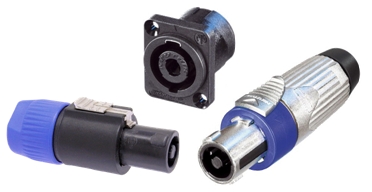
Speakon
The Speakon connector is the professional standard for connecting power amplifiers to passive speakers. Its main advantage on stage is its locking mechanism: once inserted, it twists and locks into place, eliminating the risk of accidental disconnection during energetic performances. It is designed to handle high-power and bi-amplified configurations, offering a level of performance that conventional jack cables cannot match in large-scale systems. Its exclusive design for power-level signals also eliminates the risk of confusing it with microphone or instrument inputs.
Digital and network connectors
Dante (Ethernet)
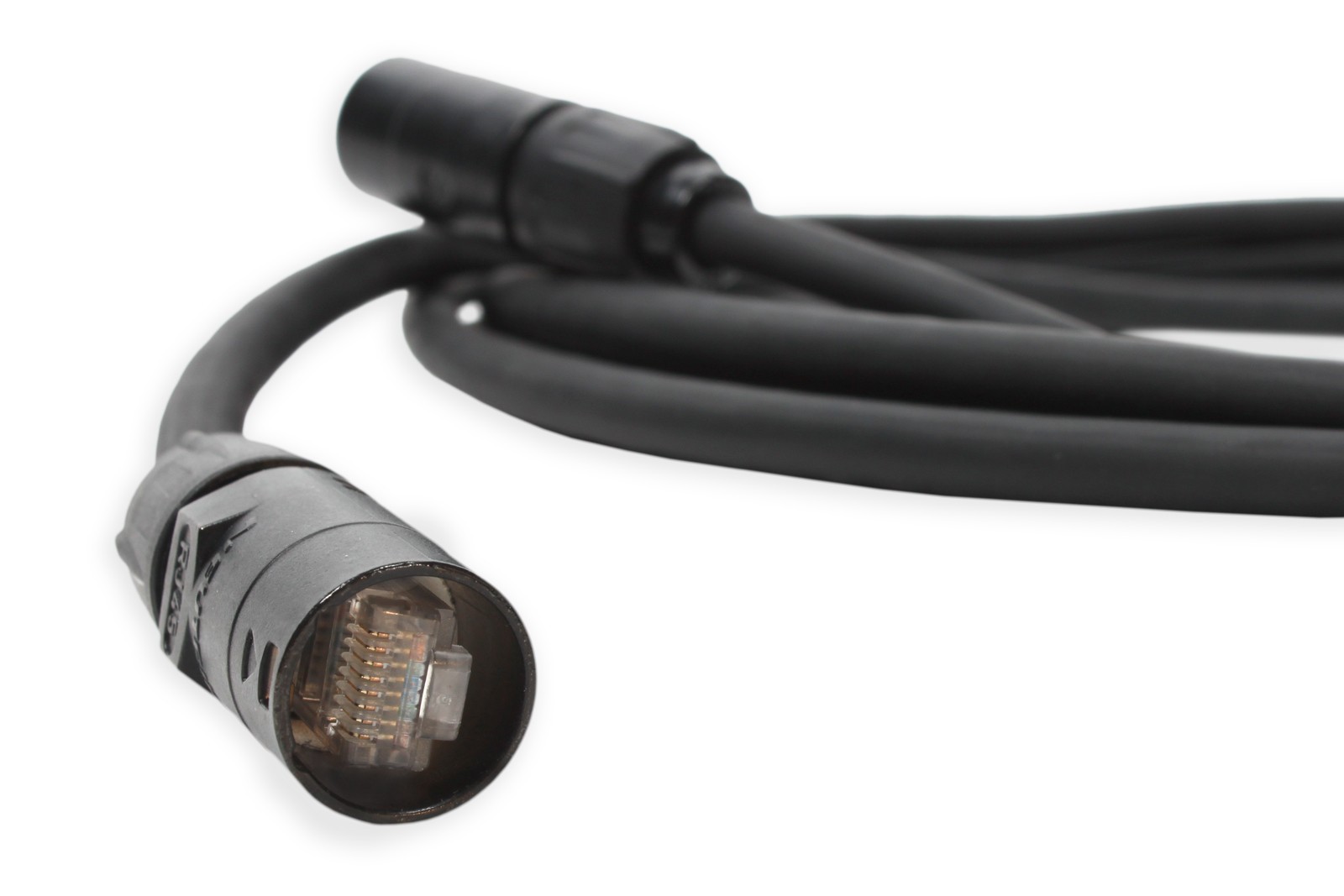
The Dante protocol is establishing itself as the new standard in professional live audio. It uses CAT-5 or CAT-6 (Ethernet) cables to transmit up to 256 channels of digital audio over a single cable, compared to the single channel of a conventional analogue cable or the eight channels of the ADAT protocol.
Its advantages over traditional cabling are significant:
- It replaces heavy, bulky analogue snakes with a thin, lightweight standard network cable.
- It allows stage boxes to be connected directly to the digital mixing console over long distances.
- It makes use of common Ethernet infrastructure, making integration into existing installations straightforward.
- Digital systems are free from the high-frequency loss and tonal degradation associated with long analogue cable runs.
Essential signal management tools
DI boxes (direct injection)
The DI box is not a connector in itself, but it is one of the most ubiquitous devices on any professional stage. Its function is to convert the unbalanced, high-impedance signal from an instrument (guitar, bass, keyboard, drum machine) into a balanced, microphone-level signal suitable for connection to the XLR input of a mixing console.
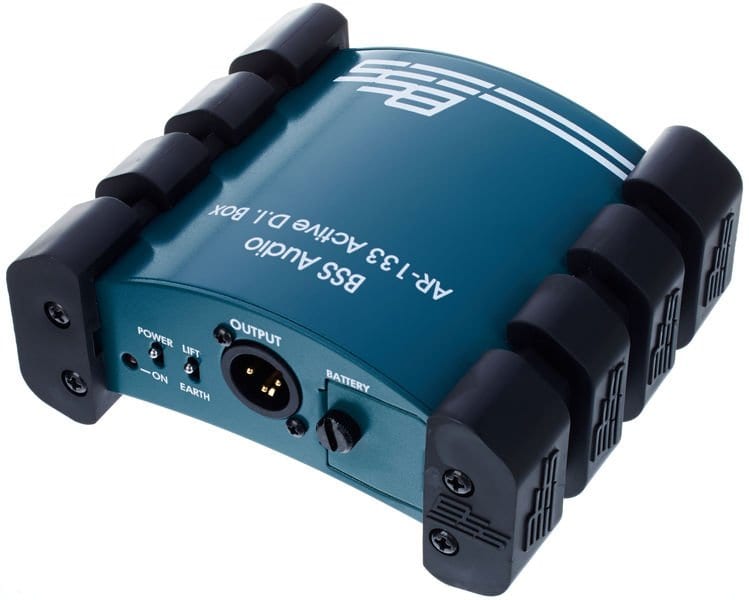
Its use is practically essential in the following cases:
- Passive guitars and basses: High impedance and weak signal that degrades rapidly over long unbalanced cable runs.
- Keyboards and synthesisers: Frequently unbalanced outputs that need to be adapted to the console's inputs.
- Acoustic guitars with pickups: Particularly piezoelectric pickups, which require impedance matching to sound natural in a PA system.
- Drum machines and pedals: Unbalanced mono TS signals that need to travel to the console over long distances.
In addition to balancing the signal, the DI box eliminates noise and hum, corrects output impedance and mitigates high-frequency loss in passive instruments by allowing XLR cable to be used from the conversion point.
Snakes
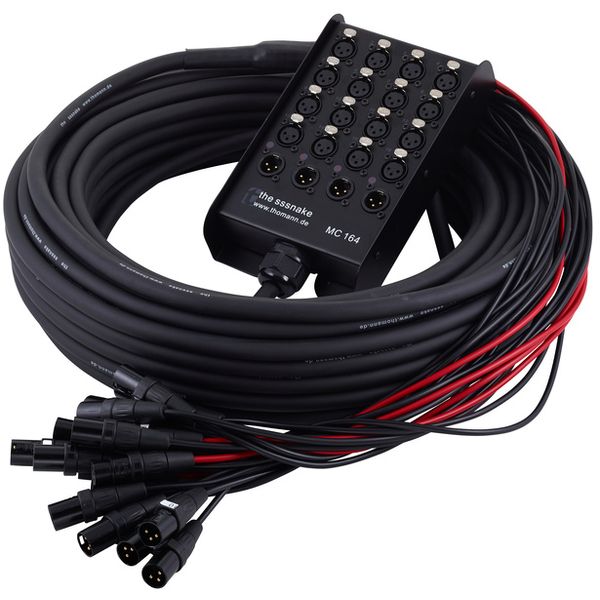
Snakes bundle multiple audio lines — typically XLR or TRS — into a single thick cable. They keep the stage tidy and simplify the connection between the musicians on stage and the mixing console at front of house, eliminating the proliferation of individual cables across the floor.
Daisy chain
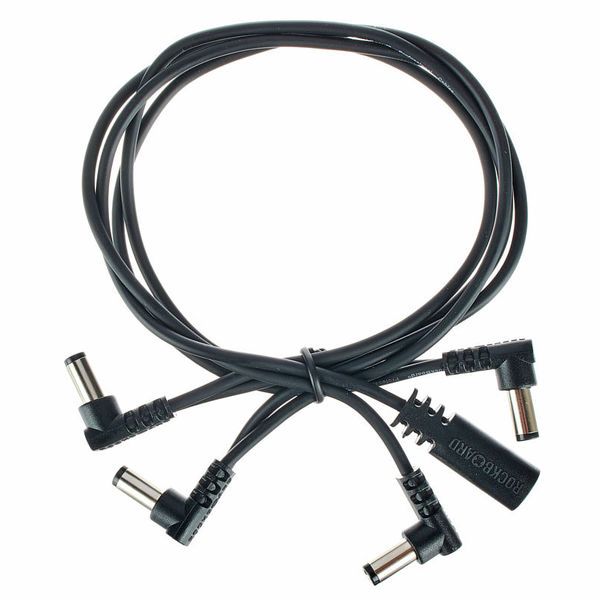
Daisy chain cables are power cables used to connect multiple guitar or bass effects pedals in series, distributing current from a single power supply to several pedals in an organised and efficient way.
How does cable length affect sound quality?
High-frequency loss due to cable length is a phenomenon that primarily affects unbalanced cables used with high-impedance instruments, such as electric guitars with passive pickups. As cable length increases, so does the cable's capacitance, which acts as a filter that progressively rolls off the high frequencies. The effect is typically audible from around 10 metres.
Keyboards and instruments with active pickups are far less susceptible to this problem, as they generate a higher-level, lower-impedance signal. Balanced cables and digital connections such as Dante do not present this tonal degradation regardless of their length.
When a long cable run is required with a passive instrument, the correct solution is to use a DI box: it converts the signal to balanced at the source and allows XLR cable to be run to the console without any loss of quality.
Summary: which connector to use in each situation?
- Microphone → console: Balanced XLR.
- Guitar/bass → amplifier: TS jack (short, unbalanced).
- Guitar/bass → console (long run): TS jack → DI box → balanced XLR.
- Keyboard → console: Balanced TRS jack or stereo DI box → XLR.
- Amplifier → passive speaker: Speakon.
- DJ → PA system: RCA (short) or TRS jack.
- Stage box → digital console (large production): Dante / CAT-5 or CAT-6 Ethernet.
